Evaluation guide
Tactile sensor for robots
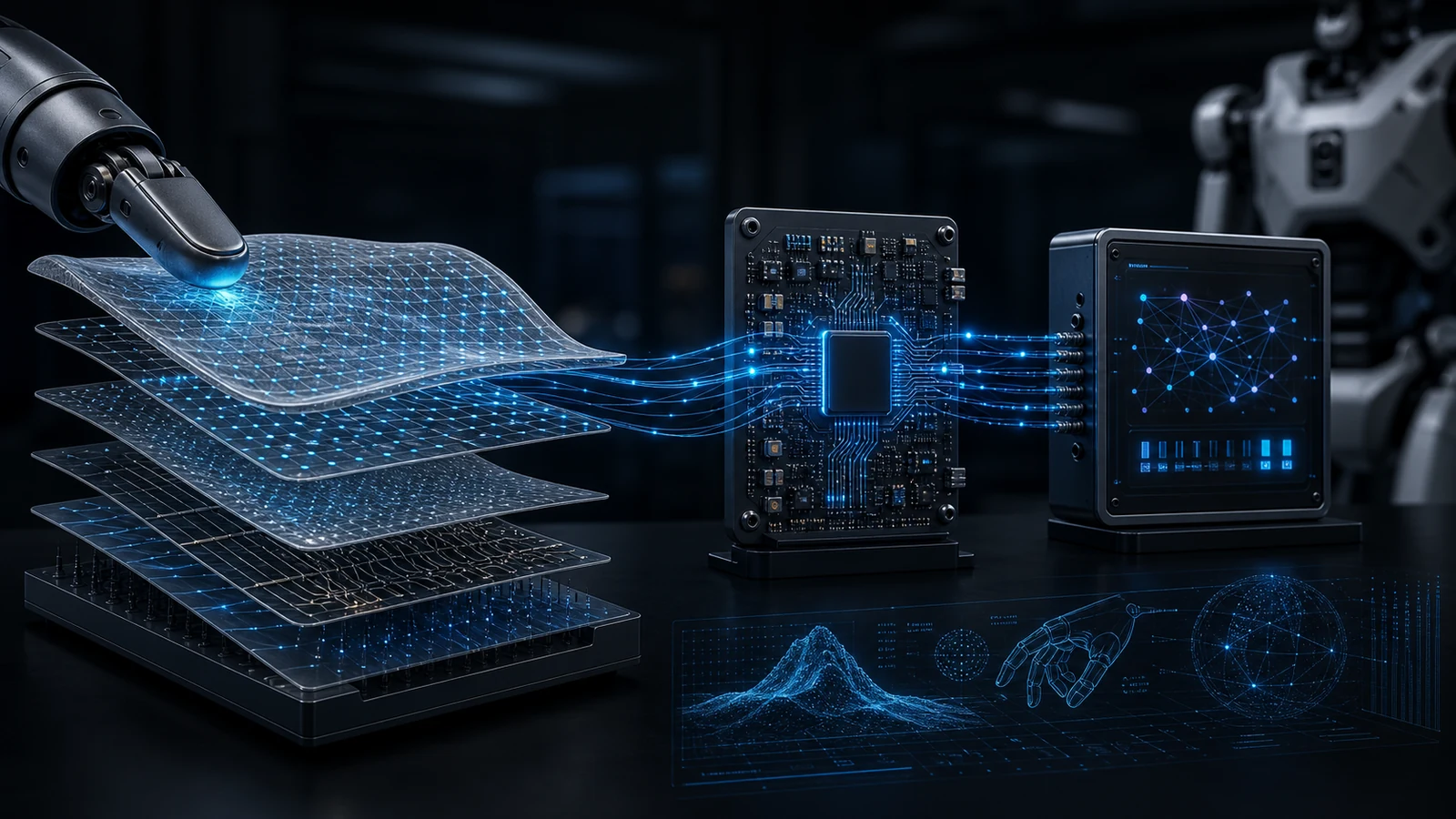
A tactile sensor for robots measures pressure, force, slip, strain, or contact maps. Compare sensors for robot hands, grippers, and robot skin.
Updated 2026-09-22 by RoboSkin.ai Editorial Team
- 5
- sections
- 3
- questions
- 5
- next routes
Short answer
What you need to know
- 1
A tactile sensor for robots measures physical contact so the robot can understand touch at the surface, not only through vision or joint motion.
- 2
Useful comparison criteria include signal type, coverage, resolution, latency, calibration, durability, robot software interface, and task-level benefit.
- 3
The best sensor is task-specific: a fingertip, gripper pad, soft skin, and full-body contact surface do not need the same architecture.
Topic 01
Build a shortlist around documented outputs
Compare the data a sensor actually exposes before comparing headline performance. An optical image, magnetic reading, reconstructed depth map, and calibrated force estimate are different observations. Software and calibration determine which can become a useful input to your robot.
| Selection question | Evidence to collect | Why it changes the choice |
|---|---|---|
| Does the contact fit the sensor? | Active area, geometry, mounting, and expected contact locations. | A detailed fingertip measurement does not cover contacts elsewhere on the hand. |
| What is measured and what is inferred? | Raw sample format, units, reconstruction code, and calibration procedure. | Do not compare camera pixels directly with force accuracy or array element count. |
| Can the data reach the controller in time? | Capture timestamps, transfer delays, inference time, and response measurements. | Sensor frame rate alone does not establish end-to-end control latency. |
| Can the result be reproduced? | Hardware revision, code, dataset access, task protocol, and held-out evaluation. | A published demo may use a different sensor version, object set, or compute system. |
Topic 02
Start with the task, not the sensor type
A robot tactile sensor can be capacitive, resistive, optical, magnetic, piezoelectric, fluidic, impedance-based, or hybrid. The architecture matters, but the first question is what the robot must do with touch.
Pick the measurable outcome: safer contact, grasp stability, slip response, material handling, tactile logging, or research benchmarking.
- Manipulation tasks need contact timing, force patterns, and slip cues
- Human-robot interaction surfaces need broad, robust contact events
- Research platforms need logged, calibrated, reproducible data
- Soft robots need flexible mounting and drift-aware interpretation
Topic 03
Comparison dimensions
Sensor pages often over-focus on sensitivity. For robots, sensitivity is only one dimension. A robot program also needs geometry, replacement, data rate, synchronization, calibration, and controller integration.
A lower-resolution sensor with stable timing and robust packaging can be more useful than a fragile high-resolution sample that cannot survive mounting.
Topic 04
How to connect this to robot skin
Robot skin may use one tactile sensor type or combine many. Tactile sensors are the building blocks; robot skin is the surface-level system around them.
Keeping those levels separate makes component selection and full-surface integration easier to evaluate.
Topic 05
Plan calibration and inspect the data path
A practical robotic tactile sensing workflow connects sensor selection to a measurable target. For optical fingertips, distinguish the raw image baseline from reconstructed depth and independently calibrated force. Then preserve timestamps, units and invalid samples through processing before evaluating an application.
Paper routes
Start with source-backed RoboSkin briefs
 Dexterous Manipulation / 2026-05-14Full-hand tactile sensing for adaptive dexterous graspingA research-oriented explanation of why full-hand tactile coverage matters for adaptive grasping, occluded manipulation, and contact-aware robot hands.
 Manufacturing / 2026-05-14Large-area flexible tactile arrays for curved robot surfacesA deployment-focused article on large-area tactile arrays, curved-surface coverage, adjustable resolution, slip detection, and manufacturing tradeoffs.
Common questions
FAQ for this topic
What is the difference between a tactile sensor and robot skin?
A tactile sensor is the sensing element or array. Robot skin is the integrated surface system that includes mounting, electronics, data handling, and robot use.
Which tactile sensor is best for robots?
There is no universal best sensor. The correct choice depends on task, geometry, signal needs, durability, data rate, and software integration.
Should a tactile sensor page include research citations?
Yes. Cite public papers or documentation, then separate reported source claims from RoboSkin.ai interpretation.