HACo grounds dexterous actions in touch and joint torque
HACo learns compliant bimanual actions from regulated demonstrations and conditions them on fingertip tactile signals plus hand-joint torque.
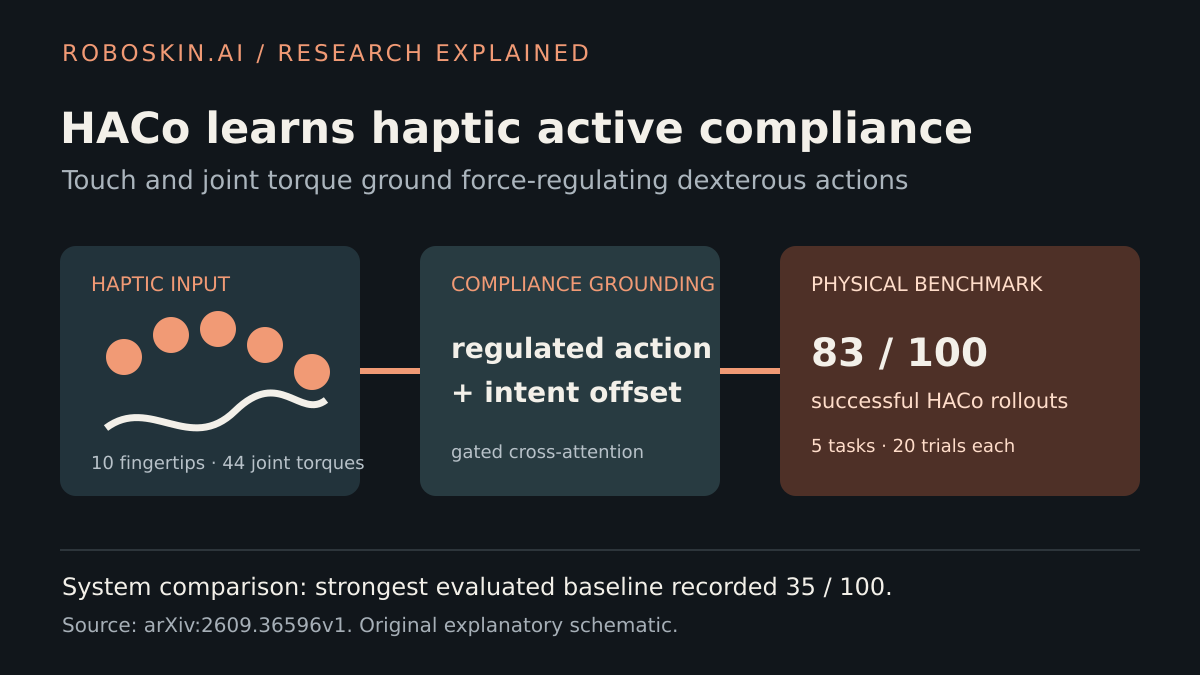
Researchers from the University of Hong Kong, the Beijing Academy of Artificial Intelligence and Johns Hopkins University released HACo on September 29, 2026. HACo stands for Haptic Active Compliance: a dexterous policy that learns force-regulating motion from compliant demonstrations and conditions action generation on fingertip touch plus joint torque. Across five physical tasks and 20 trials per task, the authors report an 83% mean success rate versus 35% for the strongest evaluated baseline. Paper and version record.
Key takeaways
- HACo records controller-executable compliant actions, rather than copying either force-blind operator commands or the robot's constrained observed motion.
- Its five-task mean is 83%, based on 83 successes in 100 rollouts. T-Rex records 35/100, GR00T with appended tactile features 22/100 and unmodified GR00T 15/100 under the paper's protocol.
- The study uses 100 demonstrations per task on one dual-UR5, dual-Sharpa-hand platform. Code is still marked “coming soon,” and no downloadable dataset or model weights were verified.
What changed
Contact creates a supervision problem. A nominal teleoperation command preserves the operator's intent but can keep pushing after an object blocks motion. The measured robot configuration has the opposite defect: it records what physically happened but omits the command-state offset that maintained force.
HACo's data-collection controller regulates the arm through Cartesian admittance and adjusts hand references using fingertip force. It saves the resulting compliant arm and hand targets as executable actions. For the hand, the difference between compliant commands and observed joint positions becomes an auxiliary “compliant intent” target. The model therefore learns both the safe motion reference and evidence of the blocked motion that generated contact load. Method details.
The haptic encoder has two inputs. Ten fingertip tokens combine a short history of local wrench readings with current deformation maps. A second stream embeds 44 joint-torque values. Finger and joint identity preserve the hand's kinematic structure before gated cross-attention lets action tokens query the haptic representation. HACo predicts motion references, not explicit target forces.
A benchmark built around force-sensitive failure
The real-world benchmark covers inserting one playing card into another hand's grasp, opening a book to an interior page, drawing on a balloon, unscrewing a bottle cap and squeezing toothpaste onto a brush. Each method gets 20 physical trials on every task. HACo records 18, 17, 14, 19 and 15 successes, for 83/100 overall.
The strongest comparison method, T-Rex, totals 35/100. Its best tasks are cap removal and toothpaste, where sustained load dominates; the paper argues that its cached visual context and tactile-only refinement may be less responsive to abrupt force transitions. GR00T improves from 15% to 22% when tactile features are simply concatenated, well below HACo's action-aligned haptic fusion.
Ablations separate the ingredients. Removing all haptic input lowers the mean from 83% to 27%. Tactile-only input reaches 68%, joint torque alone reaches 45%, and using both without their coupled encoding reaches 70%. Removing compliant-intent supervision produces 73%; replacing the compliant action with nominal commands lowers it further to 59%. The full method also reports 19% lower mean fingertip force than the nominal-action variant over contact-active samples.
What this means for robotics
RoboSkin analysis: the useful contribution is the link between sensing and action semantics. More touch channels alone do not tell a model how to yield, maintain traction or stop loading a fragile surface. HACo structures both the demonstrations and the policy so that contact evidence can change an executable motion reference.
The baseline comparison still needs care. HACo and the GR00T variants inherit GR00T N1.7 pretraining, while T-Rex and ViTacFormer have different architectures and pretraining. The table is a system-level comparison, not a controlled proof that one fusion block alone creates the 48-point gap. The within-HACo ablations give cleaner evidence for the value of coupled haptic input and compliant targets.
Limitations and availability
HACo is an arXiv v1 preprint, and RoboSkin.ai has not reproduced it. The study uses one robot configuration, 100 task-specific demonstrations per task and no reported confidence intervals. It also depends on force-regulated teleoperation. The authors identify limited whole-hand coverage as an open problem because palm and phalange contacts must be inferred indirectly from joint torque.
The official project page includes task videos, exact rollout counts, ablations and documented failures. Its Code control was disabled and labelled “Coming soon” during verification. No public training code, demonstration archive, checkpoints or implementation license was available.
Sources and related resources
Continue the topic