TactileLab: what simulated tactile flow adds to robot manipulation
The November 5 preprint connects shear-sensitive simulation with physical manipulation. Its contact assumption and sensor translation define where to test next.
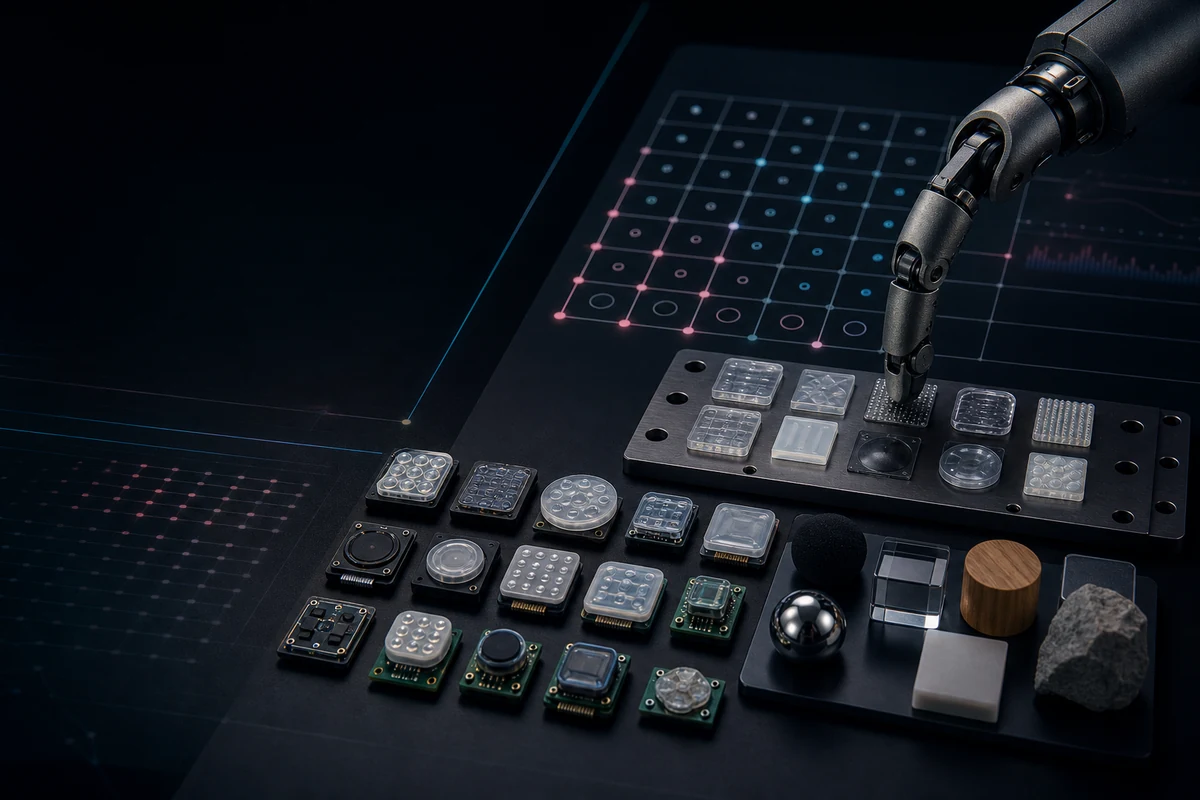
TactileLab is a November 5, 2026 preprint about learning contact-rich manipulation with simulated touch. It combines contact depth with a motion-based representation of tangential contact, then translates real sensor images into that representation. The practical question is whether the simulated observation remains meaningful on the sensor and contact conditions you intend to use.
What the new paper establishes
The v1 manuscript describes an IsaacLab-based, rigid-body approach to simulated tactile flow and author-run physical demonstrations of dual-arm and in-hand manipulation. Its transfer method assumes sticking contact. Abrupt disturbances or slipping can violate that assumption; the authors leave integrating slip into the simulation as an open problem. They also report poor flow recovery with markerless GelSight Mini, highlighting the need for observable tangential deformation.
The official project page still displays code as coming soon in our November 8 review. We verified the paper separately; an outdated paper button does not mean the manuscript is unavailable. No runnable release, checkpoint or software license was verified, and RoboSkin has not reproduced the demonstrations.
Choose an observation before choosing a simulator
RoboSkin analysis: a simulator should be selected for the decision its output supports. Contact location can help decide where to move; changing contact can help decide when to adjust a command. Neither field automatically provides a calibrated force measurement. Define the target decision and the meaning of every channel before comparing policies.
| Your experiment needs | Proposed acceptance question |
|---|---|
| Contact location | Does the estimated contact region track a reference interaction across different placements? |
| Tangential motion | Does the signal preserve direction when the contact moves and when the camera view changes? |
| Recovery from sliding | Can the pipeline identify loss of its sticking-contact assumption rather than treating it as ordinary deformation? |
| A new tactile sensor | Does its image stream expose the motion cue that the translator expects? |
These are our proposed checks, not published TactileLab benchmark results. A convincing rendered field is insufficient if the downstream controller receives a stale, misaligned or semantically different observation.
Separate sensor translation from policy transfer
Evaluate the observation mapping before attributing an end-to-end failure to the policy. Keep the same recorded interaction and examine the raw sensor image, translated field, timestamps and predicted action together. A translator failure and a controller failure require different remedies.
Then reserve a separate trial group for the complete control loop. Log contact loss, recovery attempts, interventions and final outcomes. If contact changes beyond the method's documented scope, label that trial explicitly rather than silently removing it from the denominator. Match task and hardware conditions before comparing success rates with another system.
A useful first experiment
Start with a small contact task whose success can be judged independently of the tactile image. Define a stable-contact condition and a deliberate perturbation condition. Record whether the representation remains useful in each, and keep unsuccessful trials. This makes the experiment informative even when the method does not transfer.
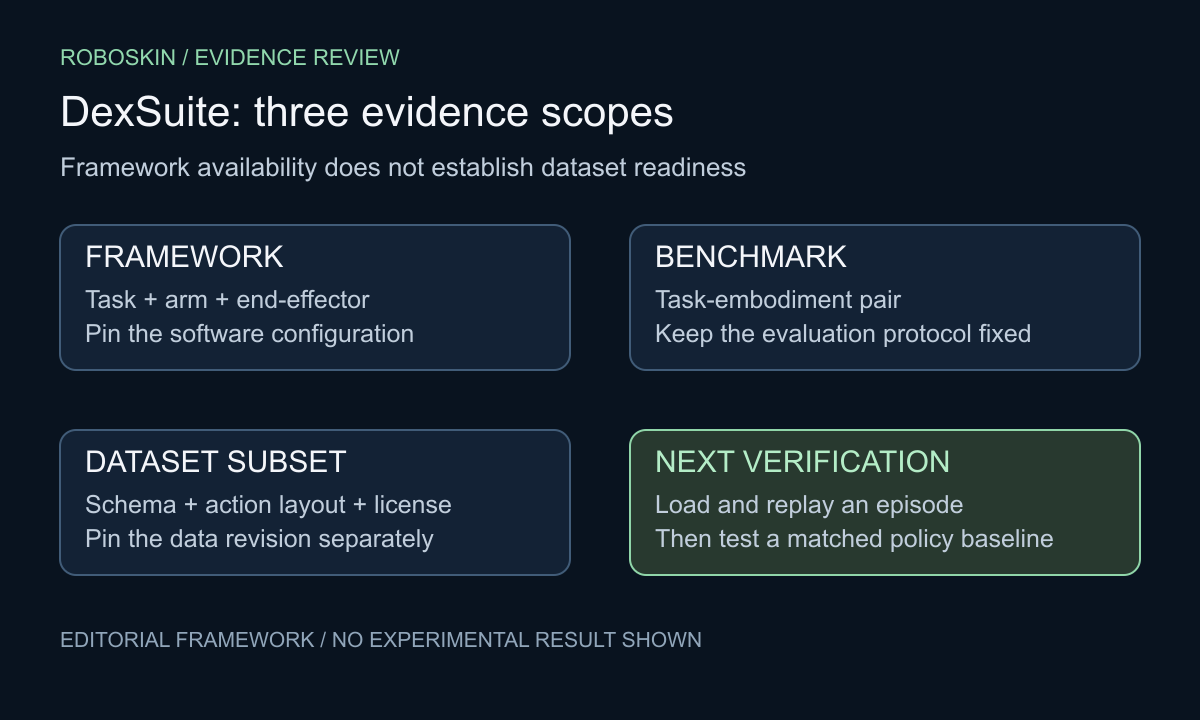
Once an implementation is available, pin its commit, simulator version and sensor mapping. A code link alone will not establish that those components run together. Use the tactile manipulation guide for the contact-assumption record, and the sensor directory to compare sensing interfaces. For a different, already documented simulation-data example, inspect the DexSuite subset.
Evidence boundary
This is source-based reporting plus a proposed evaluation workflow. It is not a claim of general slip robustness, calibrated shear-force accuracy or verified deployment on your robot. The useful next step is to test whether the observation contract survives your contact conditions.
Continue the topic