CAMP plans arm motion and hand shape together in constrained spaces
CAMP combines layered hand search, local arm relaxation and compact trajectory optimization. Its physical trials validate reaching prescribed configurations, not autonomous grasping or button actuation.
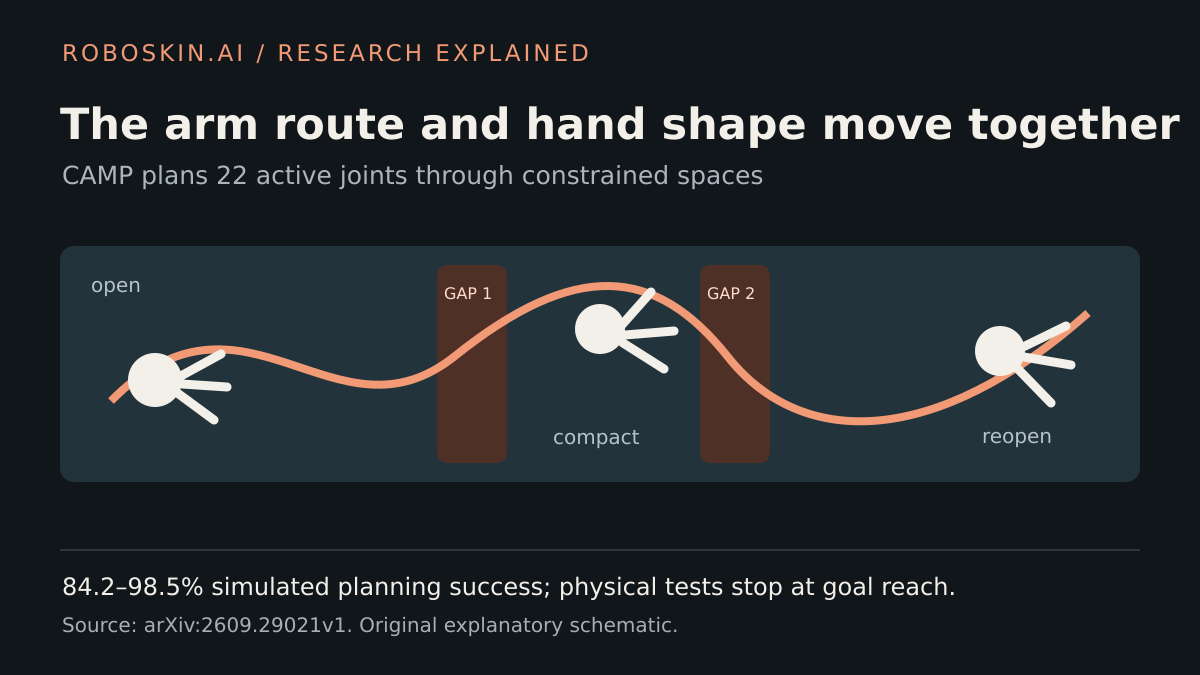
Researchers from Harbin Institute of Technology, Great Bay University and collaborating institutions introduced CAMP on September 24, 2026, for cooperative arm-hand motion planning. Instead of fixing a hand shape while an arm finds a path, CAMP adjusts both throughout the route. On six simulated constrained tasks, reported planning success ranges from 84.2% to 98.5%. Physical evaluation uses a UR7e arm and 16-degree-of-freedom LinkerHand, but its success definitions stop at prescribed goal configurations. Paper and version record.
Key takeaways
- CAMP searches hand configurations along multiple arm guides, locally relaxes the arm when transitions are blocked and then jointly optimizes both trajectories.
- Simulation results average 10 batches of 100 trials per task. Solver time excludes setup, dense validation, collision-checker construction, file I/O and playback.
- Thirty physical trials test three reaching or pregrasp configurations. They do not measure autonomous object pickup, lifting or a real button press. Physical protocol.
What changed
Separate planning creates a geometric blind spot. An arm path that clears an obstacle may still leave no continuous sequence of finger configurations. Searching all 22 active joints at once preserves that coupling but makes global planning difficult.
CAMP represents the possible collision-free hand shapes at each arm configuration as a feasible hand fiber. It creates multiple arm-space guides, performs layered bidirectional hand search and permits small arm changes where adjacent hand layers cannot connect. Complete candidates are compressed into endpoint-preserving via-point movement primitives, then ranked through coarse-to-fine optimization.
Under the reported settings, a waypoint-wise trajectory would require 4,356 optimization variables after fixing endpoints. The movement-primitive form uses 500 weights while keeping independent trajectories for the six arm and 16 hand joints. This compression helps explain why the method can retain coordinated dexterous manipulation without optimizing every waypoint directly.
What do the simulation numbers mean?
Each task-method batch contains 100 randomized obstacle scenes. The authors repeat the main comparison over 10 batches. A success is a complete trajectory that reaches a manually screened goal configuration, satisfies constraints and passes exact MuJoCo collision checks. It is a planning metric, not physical task completion.
CAMP reports 98.5% mean success on Wall Traversal with 3.40 seconds mean solver time, 92.5% and 30.10 seconds on Narrow Passage Traversal, and 84.2% and 42.60 seconds on Cabinet Cylinder Pregrasp. It exceeds RRT-Connect, QRRT*, CHOMP and A-star-plus-CHOMP in reported success across all six tasks, though RRT-Connect is faster on the easiest wall case.
A 100-trial Ball-in-Box ablation separates the design choices. Removing arm relaxation lowers success from 92% to 74%. Replacing the compact representation with waypoint-wise variables yields 79% and increases mean solver time from 32.45 to 84.97 seconds. Using fine-only optimization yields 81% at 25.15 seconds. Full comparisons and ablations.
What happened on the physical robot?
The authors run 10 complete-system trials for each of three configurations. Ball-in-Box Pregrasp reaches its goal in 8 of 10 trials, Display Button Press in 9 of 10 and Cabinet Cylinder Pregrasp in 8 of 10. A 1 cm collision margin compensates for obstacle-modeling error.
The labels need careful reading. The two pregrasp tasks require reaching a goal pose but not grasping or lifting; later grasp motions shown for demonstration are manually adjusted. Display Button Press requires a fingertip to reach a target, and no physical button is actuated. Most failures are hand-obstacle collisions. The physical study therefore validates coordinated execution, not closed-loop contact manipulation.
What this means for robotics
RoboSkin analysis: CAMP addresses the stage before touch. Better coordination can position a large articulated hand where tactile sensing becomes useful, but the planner itself does not observe contact or adapt from tactile feedback. A production stack would still need scene updates, execution monitoring and a contact-aware controller after approach.
The planning-time definitions also matter. Teams integrating CAMP would need to add perception, scene construction, validation and command transfer to the reported solver times. Static known geometry is a narrower problem than moving clutter or a deforming object.
Limitations and availability
The experiments use one arm-hand platform, static obstacles and known geometry. Goal configurations are generated with IK and manually screened. Physical failures remain sensitive to obstacle localization, camera calibration and execution error. No dynamic replanning or contact recovery is evaluated.
The official project page supplies videos and detailed tables, but identifies itself as an anonymous submission even though arXiv lists the authors. Its Code link states that implementation is planned after paper acceptance. No repository, license or downloadable planner was verified on September 25. Official code statement. RoboSkin.ai has not run CAMP.
Sources and related resources
Continue the topic
Related robotics news
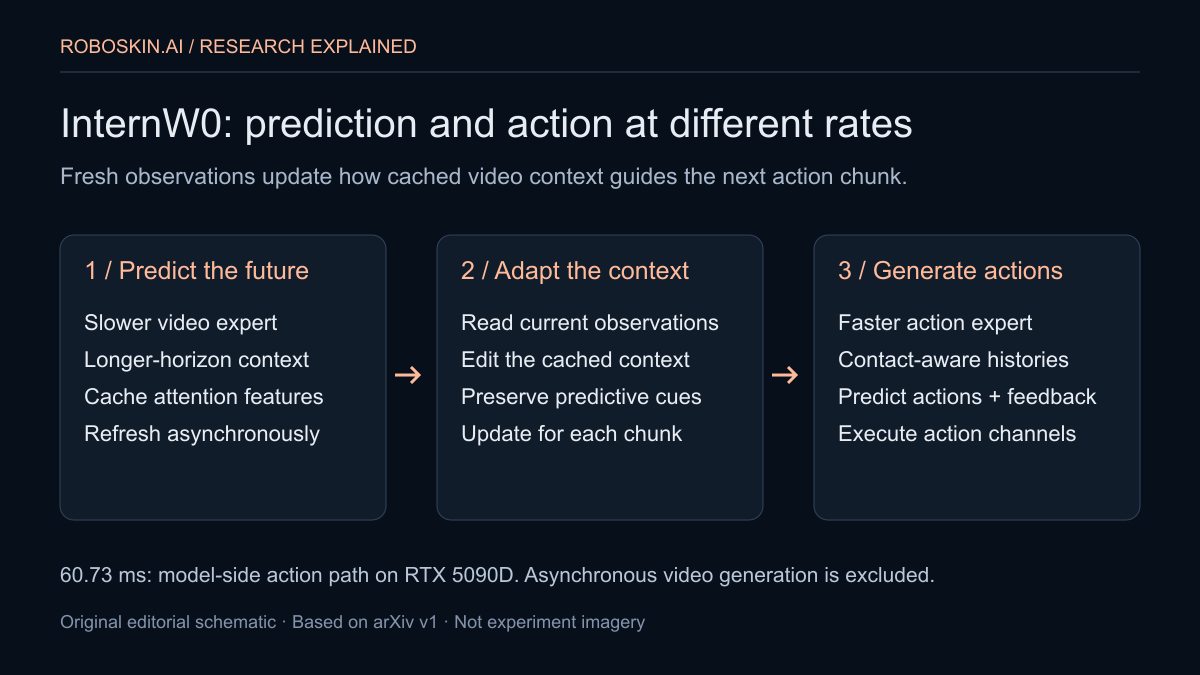 Contact-aware world modelsInternW0 links asynchronous world prediction with contact-aware pipetting
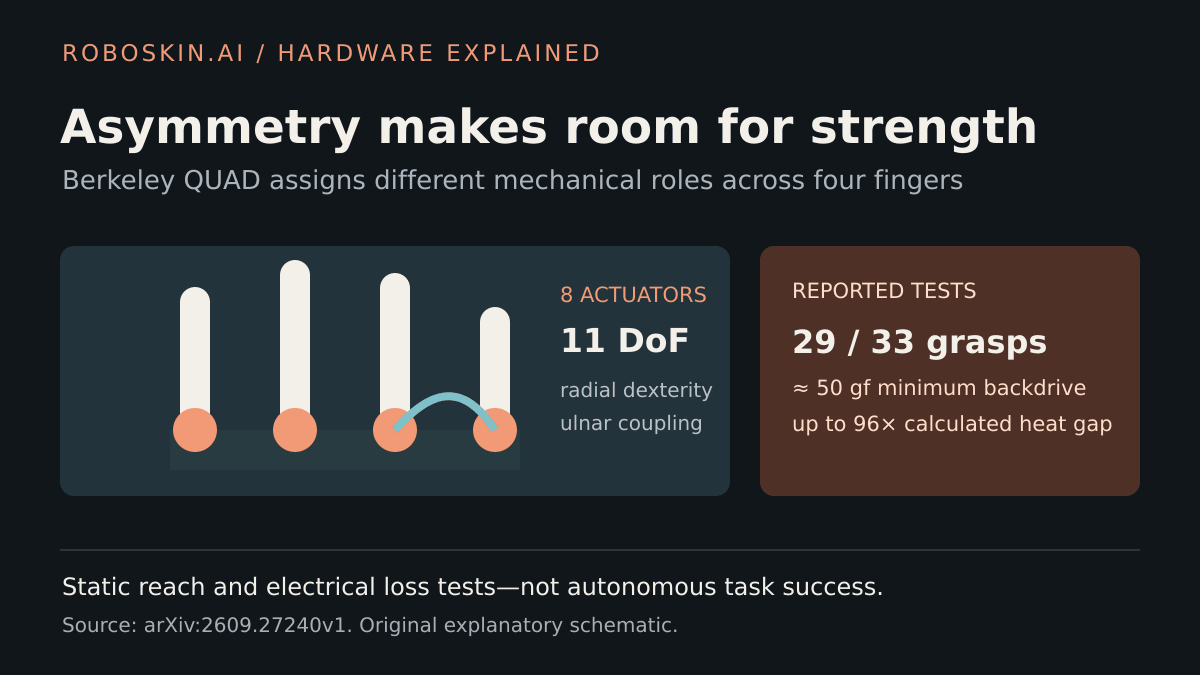 Dexterous robot handsBerkeley QUAD Hand trades finger symmetry for backdrivability and sustained force
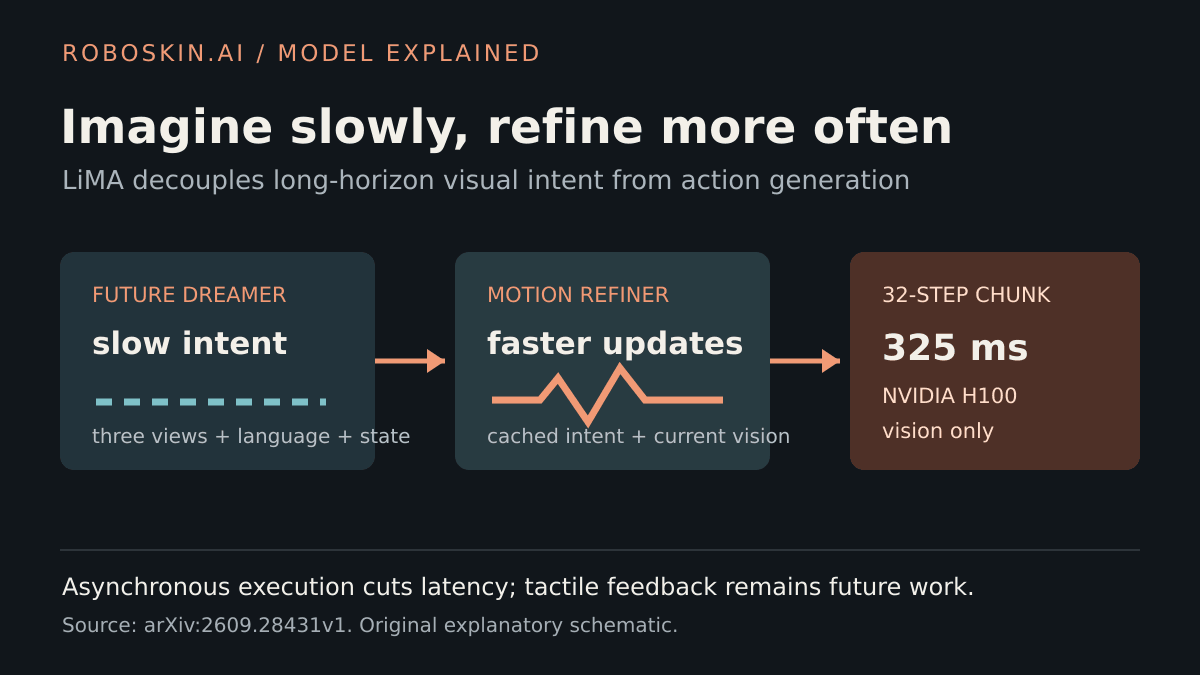 Dexterous world-action modelsLiMA separates slow visual imagination from faster dexterous action refinement