Tactile-JEPA pretrains electronic-skin encoders on taxel topology
The self-supervised method learns from irregular taxel graphs across three public datasets. It leads several perception metrics, but MAE remains better on the reported policy RMSE.
Researchers from Sber AI, Skolkovo Institute of Science and Technology, HSE University and the Artificial Intelligence Research Institute released Tactile-JEPA as an arXiv preprint on September 21, 2026. The method pretrains encoders for distributed tactile sensors by masking connected and dispersed regions of an irregular taxel graph, rather than forcing electronic-skin signals onto a camera-like pixel grid. Paper and version record.
Key takeaways
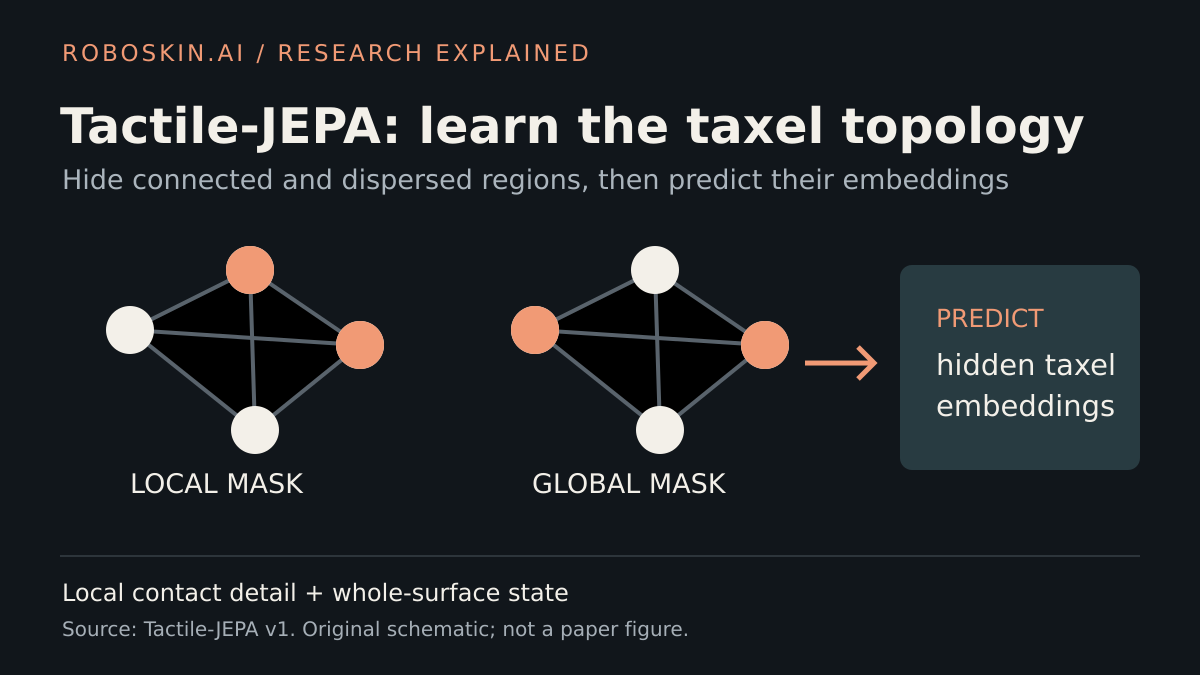
- Tactile-JEPA learns from unlabeled time windows and taxel coordinates, predicting hidden taxel embeddings from visible context with both local and global graph masks.
- Across three public datasets, it reports a 6.3% reduction in force RMSE and a 20.8% reduction in in-hand orientation RMSE against the strongest comparison for those metrics.
- It is not best on every downstream result. On DECO-50 policy learning, MAE pretraining records 0.4400 normalized-action RMSE versus 0.4634 for Tactile-JEPA; lower is better. Tables II and III.
What changed
Distributed electronic skins produce multivariate time series from taxels placed across hands, feet or bodies. Their geometry is often sparse and irregular. Tactile-JEPA represents those taxels as a connectivity graph. A local target mask grows from a seed along connected neighbors; a global mask samples across the surface. The model receives the remaining context and predicts embeddings for the hidden regions. Equal local and global masking is intended to preserve fine contact details and whole-surface state.
The encoder is a small transformer with 12 blocks, 192-dimensional embeddings and three attention heads. The paper freezes pretrained encoders for most perception tests, then trains task-specific heads. Pretraining used four NVIDIA A100 80 GB GPUs and took 0.7 to 6.1 hours depending on the dataset and task. Architecture and compute.
Three datasets, three evidence types
| Dataset | Sensor and scale | Evaluated use |
|---|---|---|
| Sparsh-skin | Xela uSkin, 368 three-axis taxels, 100 Hz, 4.6 hours | Object class, force and in-hand pose |
| Tactile socks | Two piezoresistive socks, 453 total taxels, 14 Hz, 5.9 hours | Human action and full-body pose |
| DECO-50 subset | Two Inspire hands, 2,124 taxels, 30 Hz, 16.6 hours | Visuo-tactile assembly policy |
On Sparsh-skin, Tactile-JEPA reports total force RMSE of 14.05 cN versus 15.00 cN for end-to-end training, the strongest alternative in that row. Orientation RMSE is 5.48 degrees versus 6.92 degrees for BYOL. On tactile socks, action accuracy is 96.91% versus 95.63% for DINO, and full-body pose RMSE is 13.42 radians versus 13.78. These are means across repeated training runs, and selected top-two comparisons use a one-sided Welch test with three pretraining seeds and no multiple-comparison correction.
The policy table requires a different reading. Tactile-JEPA improves over vision-only, random tactile embeddings and an end-to-end tactile encoder, but MAE is better on the reported DECO-50 action RMSE. The paper's stronger claim is stable performance across heterogeneous datasets: BYOL or MAE collapses on some datasets, while Tactile-JEPA trains under one mask configuration.
What this means for robot skin
RoboSkin analysis: representing taxel layout explicitly is a sound fit for conformable robot skin, where physical neighbors need not share adjacent array indices. The local-global mask result also suggests that pretraining should preserve both a contact patch and the state of the wider surface. This is relevant to tactile foundation models, but the evidence is still sensor-family-specific rather than a universal encoder.
Integration is not plug-and-play. DECO-50 groups four or five neighboring taxels to make attention over 2,124 channels affordable. Magnetic data receives baseline correction; piezoresistive data uses different normalization. Dataset coordinates are also missing for DECO-50, so grouping and topology construction must be supplied by the implementation. The datasets directory can help compare these data contracts before reuse.
Limitations and availability
This is a preprint, and RoboSkin.ai has not rerun the experiments. All headline improvements are within the selected datasets, task heads and splits. The policy score is imitation-action error, not a physical task success rate. A lower action RMSE also does not by itself prove safer or more reliable contact.
The paper links a public repository. Inspection on September 22 found runnable JEPA-related modules and configurations, but the README primarily documents earlier Sparsh-X and Sparsh-Skin work, some example configs contain author-local checkpoint paths, and no paper-specific pretrained checkpoint was identified. The repository license is Creative Commons Attribution-NonCommercial 4.0, so public access does not imply unrestricted commercial use.
Sources
Continue the topic