PROPRA anchors pre-touch and tactile signals to robot state and future actions
AIST researchers pretrain sparse fingertip signals against proprioception and upcoming actions. Average real-robot success reaches 75.0%, but the advantage varies by task and remains within seed variation.
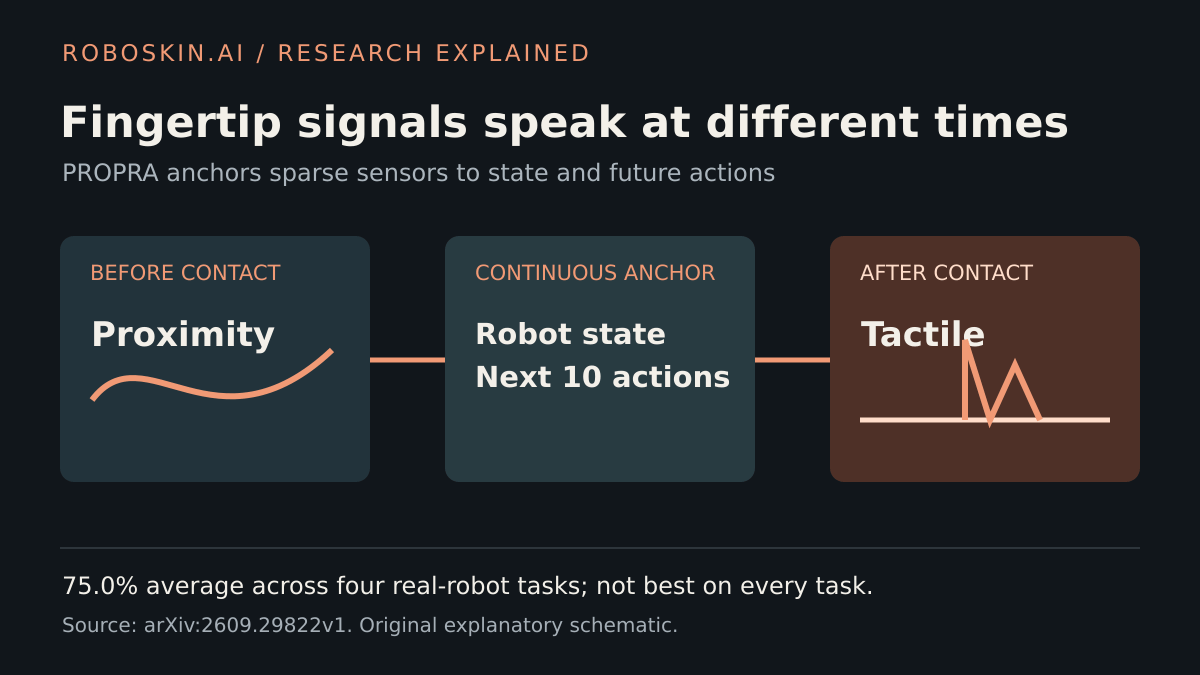
Researchers at Japan's National Institute of Advanced Industrial Science and Technology and the CNRS-AIST Joint Robotics Laboratory introduced PROPRA on September 24, 2026. Short for PROprioceptive-and-PRoactive Anchoring, the method pretrains separate encoders for reflective proximity and pressure-sensitive tactile histories by aligning each with the robot's current state and upcoming actions. On four real-robot tasks, it reports a 75.0% average success rate. Paper and version record.
Key takeaways
- Proximity sensing becomes informative during approach, while tactile pressure responds after contact. PROPRA gives both a continuously changing sensorimotor anchor without directly forcing the two sensor embeddings together.
- Across three seeds and 20 trials per seed, PROPRA averages 75.0% versus 71.7% for image-anchored pretraining and 72.1% for image anchoring plus direct tactile-proximity pairing.
- The improvement is not uniform: the image anchor reaches 76.7% on OpenLid versus 73.3% for PROPRA, and code is still labeled “soon.” Official project.
Why naive sensor fusion is not enough
The AIST gripper carries three tactile and six proximity channels. Each encoder receives 0.5 seconds of history. Proximity varies as the fingers approach an object; tactile stays near baseline until contact. After contact, the relationship reverses. In the authors' demonstrations, at least one sensor stays near its stationary value in more than half of the pretraining samples.
That sparsity makes simple concatenation unreliable. Adding both raw histories to the vision-and-state diffusion policy raises average success from 30.4% to 40.4%, but MovePen falls from 31.7% to 20.0% and OpenLid also underperforms vision alone. More sensors can therefore create competition rather than useful context.
PROPRA aligns each sensor encoder independently to an anchor containing the current end-effector pose, gripper opening and next ten actions. The contrastive objective never directly pairs tactile and proximity. After pretraining, the frozen sensor encoders feed the imitation policy, while the anchor itself is removed.
Results under the reported protocol
The real-robot evaluation uses a UR5e on PickCup, PickSponge, MovePen and OpenLid, with 20 demonstrations per task. Every policy condition is trained with three seeds and evaluated for 20 trials per seed. PROPRA reaches 81.7% on both pickup tasks, 63.3% on MovePen and 73.3% on OpenLid. The corresponding image-anchor scores are 75.0%, 75.0%, 60.0% and 76.7%. Complete comparison table.
The 3.3-point average lead over the strongest image-anchored variant is modest, and the paper notes that per-task differences fall within variation across seeds. A fair reading is that PROPRA is competitive and strongest where sensor responses are sparse, not that it wins every manipulation setting.
Representation probes add a more specific result. Over the two seconds before contact, a linear predictor on the frozen proximity embedding achieves the highest time-to-contact R-squared on three of four tasks. On PickSponge it reaches 0.440 versus 0.377 for the image anchor. On MovePen, the image-plus-pair condition is slightly higher, 0.554 versus 0.544.
The authors also collect 100 additional execution episodes per task. After zero-point alignment to compensate for proximity-sensor drift, PROPRA remains positive on every task and seed when a predictor fitted on demonstrations is transferred without refitting. That preprocessing caveat matters: this is not calibration-free deployment.
What this means for robotics
RoboSkin analysis: PROPRA offers a useful alternative to treating camera features as the universal alignment target. A robot's own state and intended action exist throughout the trajectory, including moments when an individual tactile sensor is silent. This can be especially useful for custom fingertips that do not match large visual-tactile foundation-model hardware.
The paper also supplies a warning for multimodal robot learning: an added channel does not help just because it measures contact. The learning objective must tell the model when that channel carries information. Separating pre-touch and post-contact phases may matter as much as increasing sensor resolution.
Limitations and availability
PROPRA is an arXiv v1 preprint evaluated on one gripper, one robot and four grasp-oriented tasks. It does not compare directly with large-scale tactile foundation models, and it requires the demonstrated robot states and future action segments used as anchors. Pretraining takes about three to four hours and policy training about eight hours on one NVIDIA H200 with 141 GB of memory, which is a demanding reference configuration rather than a minimum requirement.
The official project page provides the paper and videos under a CC BY-SA 4.0 page license, but its code link reads “soon.” No training repository, model weights, demonstration dataset or software license was verified on September 26. RoboSkin.ai has not reproduced the experiments.
Sources and related resources
Continue the topic