PHASE retrieves tactile insertion experience one contact phase at a time
OMRON SINIC X and University of Tokyo researchers segment insertion demonstrations by tactile-proprioceptive contact phase, then retrieve matching prior segments for few-shot policy learning.
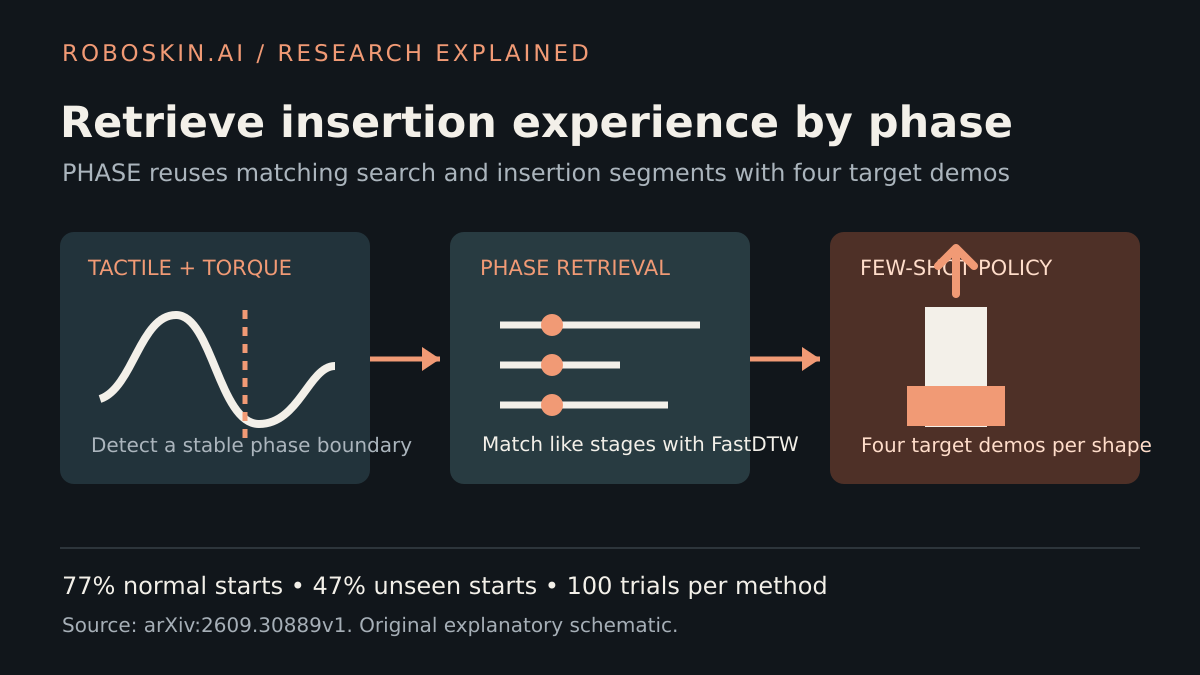
Researchers from OMRON SINIC X and the University of Tokyo released PHASE on September 25, 2026. Accepted at IROS 2026, PHASE uses a compliant wrist and tactile-proprioceptive signals to split insertion demonstrations into contact phases, retrieve relevant portions of prior experience and train a new policy from only four target demonstrations. Official project page.
Key takeaways
- With four target demonstrations per peg shape, PHASE reaches 77% success in the normal-start evaluation, 13 percentage points above the strongest 64% comparison.
- Under unseen starting positions, PHASE reaches 47%, compared with 17% for the strongest baseline—a 30-point gap under the reported setup.
- The evaluation uses one UR5e, one compliant wrist, a 3-by-3 tactile array and 20 trials per shape. Code and data were not publicly linked.
What changed
Demonstration retrieval usually compares entire trajectories. PHASE argues that contact-rich insertion is better compared in stages. A masked tactile-proprioceptive encoder called MAT3 represents contact, while a soft wrist makes the phases physically observable. The system places a boundary after the contact peak, when the coefficient of variation of estimated torque falls below a threshold.
Fast Dynamic Time Warping then compares like phases between four target demonstrations and a pool of 122 prior demonstrations. The retrieved segments train an Action Chunking with Transformers policy. This avoids forcing an entire prior trajectory to match when only its search or insertion segment resembles the target. Method and paper links.
Results under the reported conditions
The physical setup uses a UR5e arm, a soft compliant wrist and a 3-by-3 distributed tactile sensor. Circle and square pegs supply prior experience; rectangle, oval and hexagon are unseen target shapes. Each method receives four target demonstrations per shape and is tested 20 times on each of five shapes, producing 100 trials per method.
Under the normal-start protocol, the target-only policy reaches 50%. Training on all prior data without retrieval reaches 64%; single-trajectory retrieval reaches 56%; whole-trajectory retrieval reaches 64%; fixed-window retrieval reaches 55%; PHASE reaches 77%. The relevant gain is therefore 13 percentage points over the strongest 64% baselines, not a 13% relative improvement.
When start positions shift outside the training distribution, target-only falls to 0%, the no-retrieval prior baseline reaches 17%, single retrieval 2%, full retrieval 14%, fixed-window retrieval 16% and PHASE 47%. The 30-point margin over 17% suggests that phase-level matching helps most when a policy must first recover contact before insertion.
What this means for robotics
RoboSkin analysis: PHASE treats compliance as part of perception. The soft wrist does more than protect the fixture; it turns contact transitions into smooth signals that make retrieval boundaries detectable. That coupling between mechanism and learning is relevant to robot manipulation systems that cannot rely on vision after the peg enters a fixture.
The work also offers a practical data strategy. Instead of discarding old demonstrations because a new peg is different, teams can reuse the segments whose contact dynamics match. But the reuse benefit depends on recognizable phases. Tasks with repeated impacts, slip or more than two stable contact stages may require a learned or multi-boundary segmenter.
Limitations and availability
PHASE is an IROS 2026 conference paper with an arXiv v1 record, and RoboSkin.ai has not reproduced it. Results come from a single arm, wrist and 3-by-3 tactile configuration. Twenty trials per shape limit precision, and the five peg geometries do not establish transfer to threaded, flexible or high-force assembly.
The official project page provides paper, poster and video links. It does not link public code, trained policies or a demonstration dataset, and no software or data license was verified. The OMRON SINIC X announcement confirms the conference acceptance but is not an independent experimental validation.
Sources and related resources
Continue the topic