JFM learns a resolution-consistent Jacobian for a rigid-soft finger
Jacobian Flow Matching treats tendon-to-joint sensitivity as a continuous field, so predictions can be subdivided and integrated without the drift of a pointwise model.
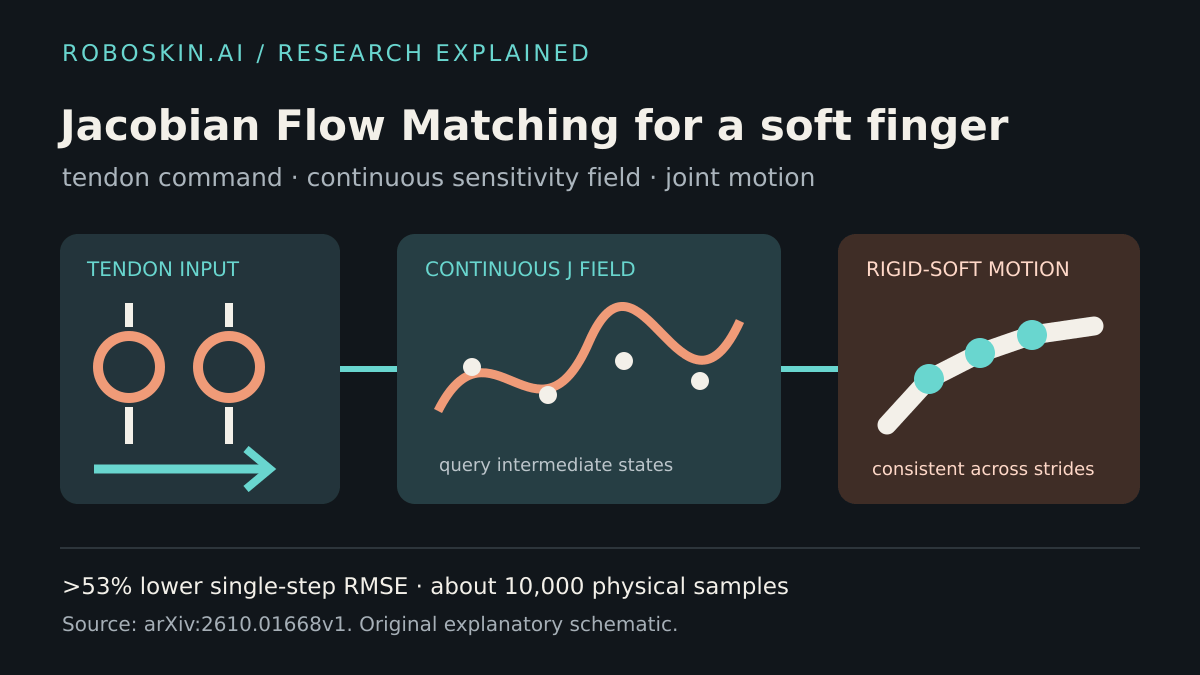
Researchers in China released Jacobian Flow Matching (JFM) on October 1, 2026 for modeling a tendon-driven, rigid-soft robotic finger. The method learns actuator-to-joint sensitivity as a continuous field rather than a pointwise mapping tied to one sampling interval. On the authors’ finger, it reduces average single-step RMSE by more than 53% and keeps multi-step predictions more stable when observations become sparse. Paper and version record.
Key takeaways
- The finger combines 3D-printed phalanges, PTFE-coated joint interfaces, a silicone capsule with woven ligaments and a tendon transmission network.
- Training uses about 10,000 physical samples, with hand pose at 45 Hz and servo state at 55 Hz aligned by nearest timestamps.
- The reported results validate prediction and open-loop command recovery; closed-loop ODE control, multi-finger coordination and out-of-plane motion remain future work.
Why a point Jacobian is not enough
Rigid-soft fingers are difficult to model because the same tendon command can produce different motion depending on pose, friction, backlash, hysteresis and viscoelastic state. A discrete learned Jacobian can fit observed endpoints at one controller rate yet behave unpredictably when an optimizer queries intermediate states or a slower sensor produces larger steps.
JFM normalizes each observed transition into a unit-time flow. Conditional Flow Matching supplies intermediate states between the start and end poses, and a consistency loss discourages the network from depending mainly on the starting anchor. The learned field can then serve either a single pointwise update or an ODE rollout that subdivides a command. The paper compares JFM with pointwise training under identical TinyTransformer and LSTM backbones, isolating the training framework rather than adding model capacity. Architecture and physical data pipeline.
What the numbers establish
For single-step servo-to-angle prediction, JFM reduces global average RMSE by 57.27% with the TinyTransformer and 53.68% with the LSTM. Under the 0.015 RMSE threshold, 96.2% of TinyTransformer JFM samples qualify versus 77.9% for its baseline; the LSTM comparison is 96.1% versus 78.8%. These are distribution-level results across three joints, not a task success rate.
Resolution tests use 160 held-out trajectories. At stride 1, pointwise and integrated predictions are close. At stride 8, ODE inference reduces median RMSE by 14.43% and variance by 24.87% relative to the pointwise mode. This supports the specific claim that the field remains useful when a transition is subdivided or samples are skipped.
An open-loop inverse test optimizes tendon commands for target joint motion. It reports overall RMSE 1.4151, mean angular error −0.2576° and standard deviation 1.39°. The model smooths abrupt commands to zero at hard stops because those boundary conditions are not explicit in its continuous field. Pointwise inference takes about 3.5 ms per query, but the paper does not report a closed-loop ODE controller running on hardware.
RoboSkin analysis
The paper addresses a quiet integration problem for robot hands: perception and control rarely run at identical, perfectly stable rates. A model that changes behavior when the update interval changes can make calibration results misleading. JFM’s value is therefore less about another predictor score and more about a testable consistency condition across controller resolutions.
The current input is proprioceptive, not tactile. Contact, friction and material effects are absorbed as disturbances within the training distribution rather than measured explicitly. For teams combining compliant mechanisms with robot-hand tactile sensors, the next question is whether direct contact observations improve the field or reveal regimes where a local first-order model breaks down.
Limitations and availability
Evidence comes from one finger, flexion motion and one hardware/data pipeline. The method assumes mechanical characteristics change slowly within a trial. It has not been directly validated on pneumatic hands, silicone hands, multi-finger coordination or out-of-plane motion. Sparse-sampling results are open-loop prediction tests, and the inverse test does not demonstrate closed-loop task completion.
The manuscript is an arXiv v1 preprint under review at Robotics and Autonomous Systems. It describes ROS 2 bags converted to HDF5, but no public dataset URL, code repository, model checkpoint, CAD package or implementation license was verified. The arXiv page itself does not grant rights to an absent implementation.
Sources and related resources
Continue the topic