DA-GRD uses sparse touch to recover a grasp after the object moves
A*STAR, NTU and Tsinghua researchers stop tactile exploration when the remaining object poses support the same grasp. Real hardware reaches 71.7% lift success, but only 38.3% task-conditioned success.
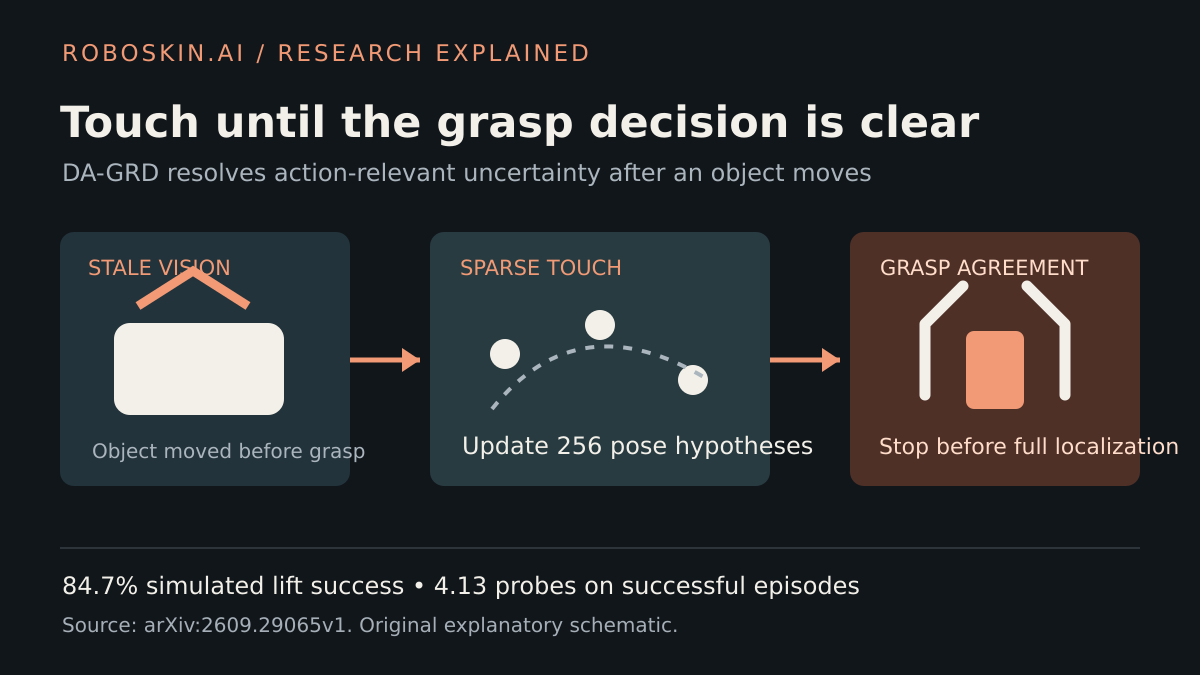
Researchers from A*STAR's Institute of Advanced Intelligence and Computing, Nanyang Technological University and Tsinghua University released DA-GRD on September 24, 2026. Decision-Aware Grasp-Relevant Disambiguation addresses a specific failure: vision selects a grasp, the object moves before execution, and the robot must recover without another camera observation. The method probes with touch until the remaining object-pose hypotheses support a common executable grasp. Paper and version record.
Key takeaways
- In MuJoCo, the principal DA-GRD variant reaches 84.7% physical lift success across ten objects, compared with 63.7% for a fixed 15-scan baseline using the same planar belief representation.
- Successful simulated episodes use 4.13 probes on average, a reported 72.5% reduction from the fixed 15-probe baselines. Zero-probe successes are included in that average.
- On a UR5, 60 trials across six objects produce 71.7% lift success but 38.3% task-conditioned success. The gap shows that lifting an object is easier than recovering the originally intended grasp.
What changed
DA-GRD does not try to reconstruct a complete object pose before acting. It starts from the remembered RGB-D point cloud and task-conditioned grasp produced by a visual-language and AnyGrasp pipeline. When that grasp becomes stale, contact or free-space observations update a weighted 256-particle belief over planar translation and yaw.
Candidate probes approach vertically or horizontally. The selector scores them by how much the expected hit or miss would reduce disagreement among grasps derived from the surviving hypotheses. A grasp-aware stopping rule executes once enough of the belief mass supports a common grasp. This is different from fixed tactile scanning, which spends the same interaction budget whether or not the next touch changes the decision.
Results under the reported conditions
The simulation applies translations up to 5 cm and yaw changes up to plus or minus 45 degrees to ten rigid objects. Each object has 100 shared perturbation episodes per method. A lift counts as physically successful when the robot raises the target by 5 cm. DA-GRD's main policy reaches 84.7%, versus 9.1% for the unrecovered stale grasp, 21.2% for the original XY-only scan baseline, and 63.7% after that baseline receives the same SE(2) belief. Full evaluation.
The stricter task-conditioned measure asks whether the final grasp is also consistent with the grasp originally selected for the task. On that measure, DA-GRD reaches 57.3%, while the adapted fixed-scan baseline reaches 49.2%. A pose-sensitive DA-GRD variant reaches a similar 57.6% but uses 7.70 probes on average, compared with 4.13 for grasp-aware stopping.
The physical setup uses a UR5, a Robotiq 2F-140 gripper, two finger-mounted force-sensitive resistors for lateral contact and a wrist FT300 sensor for vertical contact. Across ten trials on each of six objects, lift success ranges from 60% to 80%; task-conditioned success ranges from 30% to 50%. The overall averages are 71.7% and 38.3%, with 4.20 probes.
What this means for robotics
RoboSkin analysis: the useful idea is that touch should resolve the action, not necessarily the entire scene. If multiple object poses all imply an acceptable grasp, further localization spends time and risks moving the object without improving the decision. That principle could reduce the interaction cost of tactile manipulation systems that operate after occlusion or scene change.
The real-world result also argues for reporting more than a binary lift score. A controller can pick an object up while missing the requested handle, orientation or functional region. Keeping physical and task-conditioned success separate makes contact-aware recovery easier to evaluate honestly.
Limitations and availability
DA-GRD is an arXiv v1 preprint, and RoboSkin.ai has not reproduced it. The belief only covers planar SE(2) motion. Complex non-planar shapes can produce different three-dimensional contacts that look identical after projection; partial remembered geometry can preserve the same ambiguity. The physical implementation also uses both fingertip contact switches and a wrist force-torque sensor, so “sparse touch” does not mean sensor-free deployment.
No official project repository, dataset, checkpoint or software license was linked from the paper or verified at publication time. The arXiv record provides the manuscript under its selected submission license, which does not by itself release implementation code.
Sources and related resources
Continue the topic