CoPRE detects weak robot contact from proprioception without force labels
CoPRE learns the expected joint-torque response from contact-free motion and scores the residual through a noise-weighted Jacobian. It improves recall on ARX and G1 arms, with robot-specific calibration and unquantified downstream task success.
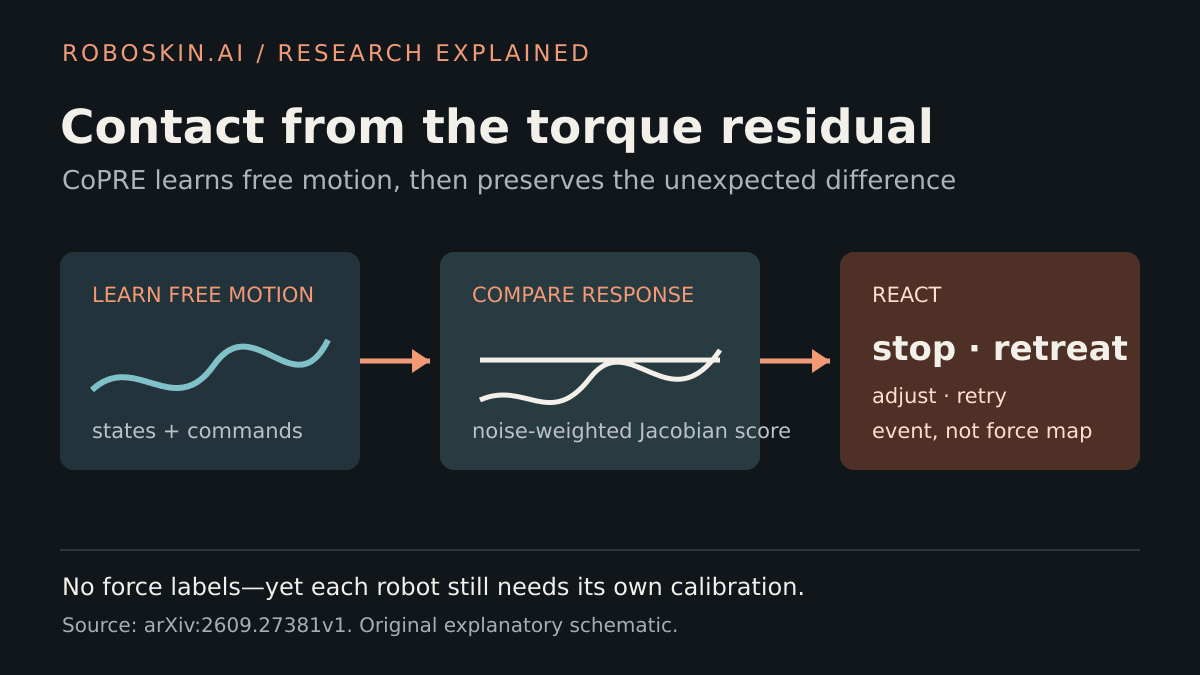
Researchers from Duke University, KTH Royal Institute of Technology and Carnegie Mellon University released Contact-free Proprioceptive Response Estimation, or CoPRE, on September 23, 2026. The arXiv v1 method trains on contact-free joint motion, predicts the torque response that should occur without contact and converts the residual into a contact score. It requires neither dedicated force sensors nor labeled collisions. Across 45 physical contact trials on each of two arms, CoPRE reported 74.1% recall on an ARX L5 and 82.2% on a Unitree G1 right arm. Paper and version record.
Key takeaways
- CoPRE excludes recent measured states from its prediction window so that contact does not immediately contaminate the nominal reference, then weights joint residuals by contact-free noise and the robot Jacobian.
- Under each platform's reported calibration protocol, the detector reached at least 90% detection at separately measured sliding-resistance references of 3.5 N on ARX and 5.5 N on G1. These are not force measurements at the instant of detection.
- The official page exposes videos and summary CSV files, but says those tables are manuscript transcriptions rather than raw logs. Placement and insertion demonstrations have no reported task-success rate. Evidence documentation.
What changed
Low-cost arms often estimate joint torque from motor current rather than dedicated torque sensors. A learned nominal model can flag contact when observed torque diverges from expectation, but a model that consumes very recent state may adapt to the collision itself and suppress the residual.
CoPRE addresses that leakage by predicting three steps ahead from an earlier state-and-command history. A 96-dimensional transformer estimates contact-free joint position, velocity and torque. Detection uses the final predicted torque, centers and scales its error with training residuals, and maps the result into Cartesian space with a noise-weighted Jacobian. Three consecutive threshold crossings confirm contact.
Training, checkpoint selection and threshold calibration all use separate contact-free recordings. The ARX windows use typical 32-millisecond intervals and the G1 windows 20 milliseconds. The method still needs a robot kinematic model for Jacobian scoring, even though it avoids a full analytical dynamics model.
What the 90 physical trials show
Each arm pushed five book stacks at three speeds, with three repetitions for every resistance condition: 5 by 3 by 3 equals 45 physical contact trials per arm. The stacks had separately measured peak sliding resistances from 1.5 to 5.5 N. Those reference values characterize test conditions; the researchers did not track force during individual pushes.
On ARX, CoPRE recorded 74.1% recall, while both a learned torque-prediction baseline and a nominal inverse-dynamics baseline recorded zero under the combined calibration setting. CoPRE reached the study's F90 criterion at 3.5 N. Its held-out broad-motion confirmed-alarm time was 3.32%, versus 14.51% for the neural baseline and zero for dynamics.
On G1, CoPRE recorded 82.2% recall, compared with 16.3% for the neural baseline and 42.2% for dynamics. Its F90 was 5.5 N, and broad-motion alarm time was 0.86%. The paper's 95% confidence intervals were 62.2% to 85.2% on ARX and 72.6% to 91.1% on G1.
Calibration is part of the result. A retrospective ARX sweep increased recall from 74.1% to 95.6% when the allowed calibration alarm budget rose from zero to 1%, while held-out broad alarm time climbed from 3.32% to 12.41%. This is not a free sensitivity gain.
What this means for robotics
RoboSkin analysis: CoPRE shows how proprioception can provide a useful contact channel when adding tactile sensors is impractical. A contact event can stop motion, update a spatial belief and trigger a safer alternative. That makes the method relevant to robot safety and contact-aware manipulation, especially on platforms that already expose joint state and motor-current-derived torque estimates.
It is not a substitute for calibrated force measurement. The detector produces a thresholded event rather than contact location, force vector or pressure map. Its strongest engineering value may be as a protective or task-state signal layered under a policy, not as complete tactile perception.
Limitations and availability
This is an arXiv v1 preprint and RoboSkin.ai has not reproduced it. The detector needs robot-specific training and calibration. Generalization to new payloads, motion distributions and contacts on other arm links was not tested. Sustained contact may enter the history and reduce the residual. The two contact-guided tasks are qualitative demonstrations, so the paper does not establish a numerical task-success improvement.
The official CoPRE page provides project videos, result summaries, ablation tables and a path-free index of the 90 recordings. Its own documentation says the CSV tables are presentation summaries, not raw logs, and that model seeds reuse physical trials. No training code, model checkpoint, raw experiment archive or software license was linked on September 24. Public evidence is therefore more substantial than a paper-only release but not a reproducible package.
Sources
Continue the topic