ReflexArc Explained: Tactile Reflex Latency and Humanoid Controller Conflicts
Why a fast tactile withdrawal can be cancelled by the next learned command, and which timing, coverage and recovery evidence an integration team should request.
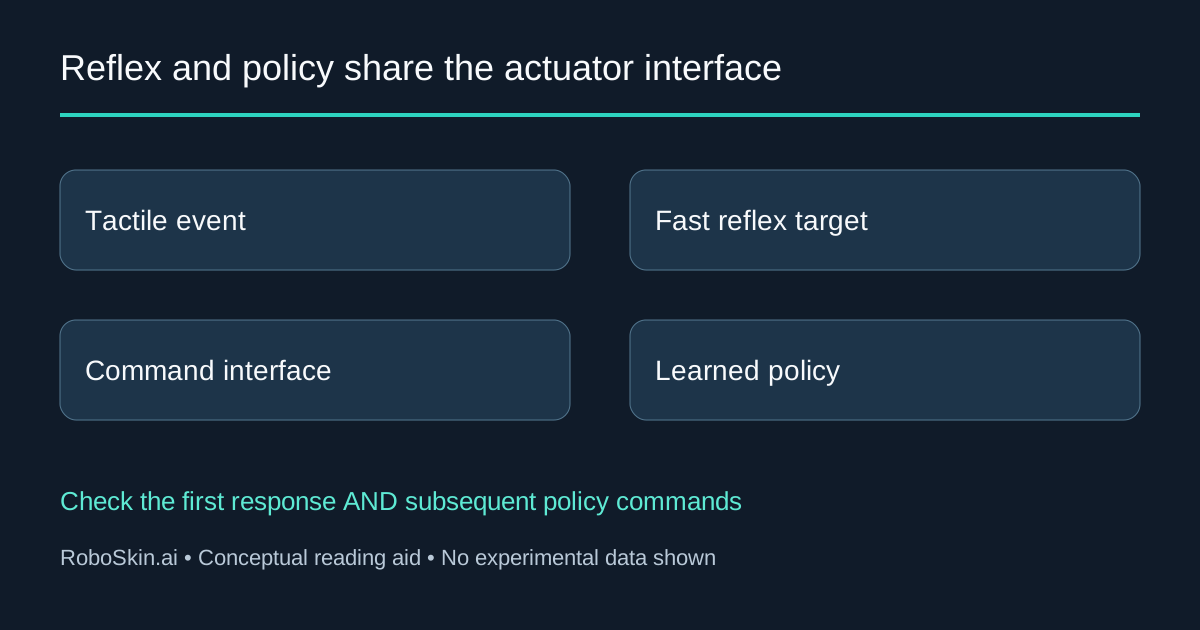
ReflexArc asks a practical question: after a robot detects unexpected contact, can it withdraw quickly without its learned controller immediately steering it back? A fast sensor is only one part of that problem. The reflex and the ongoing movement policy must agree about who controls the same joints, including after the first withdrawal.
Explore VLA robotics for the broader comparison.
This research interpretation was published on November 4, 2026, reviewing the November 3 arXiv v1 preprint by Mingyu Wang and colleagues. Results below are the authors' reports, not RoboSkin.ai experiments or evidence of safety certification. We reviewed the paper, full text and official project. This page serves teams evaluating control interfaces; the broader robot-safety guide covers evidence boundaries.
The contribution is cooperation between two control paths
The authors call their integration method Ascending Reflex Control (ARC). A rapid tactile pathway changes motor targets without waiting for the next learned-policy step. The slower whole-body policy retains responsibility for balance and continued behavior. Simply adding the two commands is insufficient: a policy trained to track motion can interpret the reflex displacement as an error and compensate against it. Method, Sections III–IV.
ARC addresses that conflict through training and alignment. Reflex-in-the-loop training exposes the policy to states produced by withdrawals. Reflex-transparent alignment removes the reflex offset from the joint-position observation and restores it to policy targets, alongside counterfactual training supervision. Contact-informed adaptation addresses the subsequent behavior. This is more than an inference-time interrupt bolted onto an unchanged controller. Integration method.
For an integration review, separate three decisions: start withdrawing, preserve that withdrawal when the next policy command arrives, and choose what happens afterward. A system can succeed at the first and fail at either of the others. A plausible single-frame response therefore does not establish sustained avoidance.
What the reported timing actually measures
The paper describes tactile patches sampled at 300 Hz, startle detection within 5 ms, a local reflex solve under 4 ms, and tactile-to-motor commands within 10 ms. The learned policy operates at 50 Hz. These describe different boundaries, not five interchangeable claims about the robot's reaction speed. Reflex architecture · Author overview.
In particular, a command reaching the motor is not the same event as motion beginning or contact force falling. Nor does a sampling rate specify the longest delay under host load, packet loss or a delayed policy update. The authors' component timings should not be added into an independently certified worst-case bound.
The following is our proposed timing record, not an additional experiment from the paper:
| Boundary | Record to request | Question it answers |
|---|---|---|
| Physical contact to acquired sample | Independent contact reference, sensor timestamp and clock relation | How much delay occurs before the signal exists? |
| Acquired sample to detected event | Receive timestamp, filtering and detector event | Does processing or transport delay detection? |
| Event to accepted motor command | Solver completion, command timestamp and acceptance log | Does the reflex actually reach the actuator interface? |
| Accepted command to physical response | Motion or force measurement with its own timing | When does withdrawal or force reduction occur? |
| Response through the next policy steps | Reflex, policy and executed targets on one timeline | Does later control preserve or cancel the response? |
Keep failed, missing and stale observations visible. Averages from successful events cannot answer what happened to events the system did not detect. Sensor replacement and mounting also change the observation path; the calibration guide explains why the complete assembly belongs in the evidence record.
The collision comparison uses a deliberately delayed reflex
In the controlled physical comparison, the same downward arm swing contacts a fixed-height box. A tactile patch on the stationary box measures force, reducing the influence of robot-skin vibration, while a 240 Hz camera observes withdrawal. The baseline adds 20 ms to the same reflex, approximating one 50 Hz policy step. It is not a comparison against every VLA controller, another commercial robot or an entirely unsensed robot. Contact-impact experiment, Section V-A.
| Author-reported trace metric | Delayed reflex | Direct reflex | Reading limit |
|---|---|---|---|
| First force peak | 21.64 N | 14.25 N | A 34.1% reduction in this reported comparison |
| Contact impulse in the plotted comparison | 0.2632 N·s | 0.1225 N·s | The delayed value is about 2.15 times the direct value |
Figure 6 marks the impulse using the region above 2 N. Do not silently combine it with the separate ablation table's first-100-ms impulse definition. We did not establish a repeat-trial denominator or uncertainty interval for this plotted collision comparison. Its numbers therefore support the described timing comparison, not a population-wide injury probability, validated contact limit or reliability claim. Figure 6 and ablation definitions.
Faster withdrawal and successful recovery are different outcomes
The ablations examine reflex training, transparency and longer-term adaptation. They support investigating controller interference rather than assuming a sufficiently fast interrupt solves everything. They also contain tradeoffs: the full system does not lead every reported recontact or recovery measure. A single best aggregate score would hide that distinction. Ablation study, Section V-C.
For a proposed integration, use an explicit control-authority record:
| Phase | What the reviewer should identify | Failure that a timing headline can miss |
|---|---|---|
| Initial response | Which path may alter the commanded joints and under what condition | An event is detected but never changes the executed command |
| Next policy update | How observation and target transformations preserve the intended response | The policy corrects back toward the contact |
| Sustained recovery | Which behavior moves away, maintains support and handles ongoing commands | The robot withdraws briefly, then recontacts or loses task continuity |
This table is an editorial analysis framework. It does not prescribe a protective controller or replace application-specific safety engineering. Keep the raw policy target, reflex contribution and final executed target separately: recording only the final motion makes competing commands difficult to diagnose. The tactile manipulation overview distinguishes sensor observations, action targets and physical feedback.
Coverage and validation still limit adoption
The demonstrated humanoid is a Unitree G1 with patches on selected convex body regions. The paper explicitly identifies uncovered regions as unprotected by this tactile mechanism. Its teleoperation, movement and contact demonstrations do not establish continuous whole-body coverage or a safety-rated function. Conclusion and coverage limitation.
Before treating the method as relevant to another platform, ask for the body-link map, patch mounting, no-contact baseline behavior, timestamp alignment, joint-target interface and training configuration. Then identify the application conditions the cited experiments did not cover. These are evidence requests, not instructions to recreate collisions around people. The responsible integrator must determine the validation appropriate to the actual robot and use.
Code status and a useful next decision
At our November 4 review, the official project displayed Code: Coming soon. An arXiv paper is available even though the project also retains a coming-soon paper control. We did not verify released implementation artifacts, weights or their licenses, and did not run the system. Availability statements here describe the reviewed page, not proof that no other release exists. Project resource controls.
ReflexArc is useful reading when a team already has a tactile response path but needs to understand how learned control interacts with it. The first decision is whether the observation, command and training interfaces can support that cooperation—not whether a 10 ms headline can be pasted into a robot specification. For a source-backed evaluation brief, use the existing research-services inquiry; RoboSkin.ai does not offer safety certification or claim to have validated this hardware.
Continue the topic