TactileStep closes the loop on Unitree G1 sole pressure
Tsinghua University researchers feed force, center-of-pressure and contact-area features from pressure insoles into a humanoid parkour policy. Hardware measurements improve on several terrains, while long-term sensor behavior and faster motion remain untested.
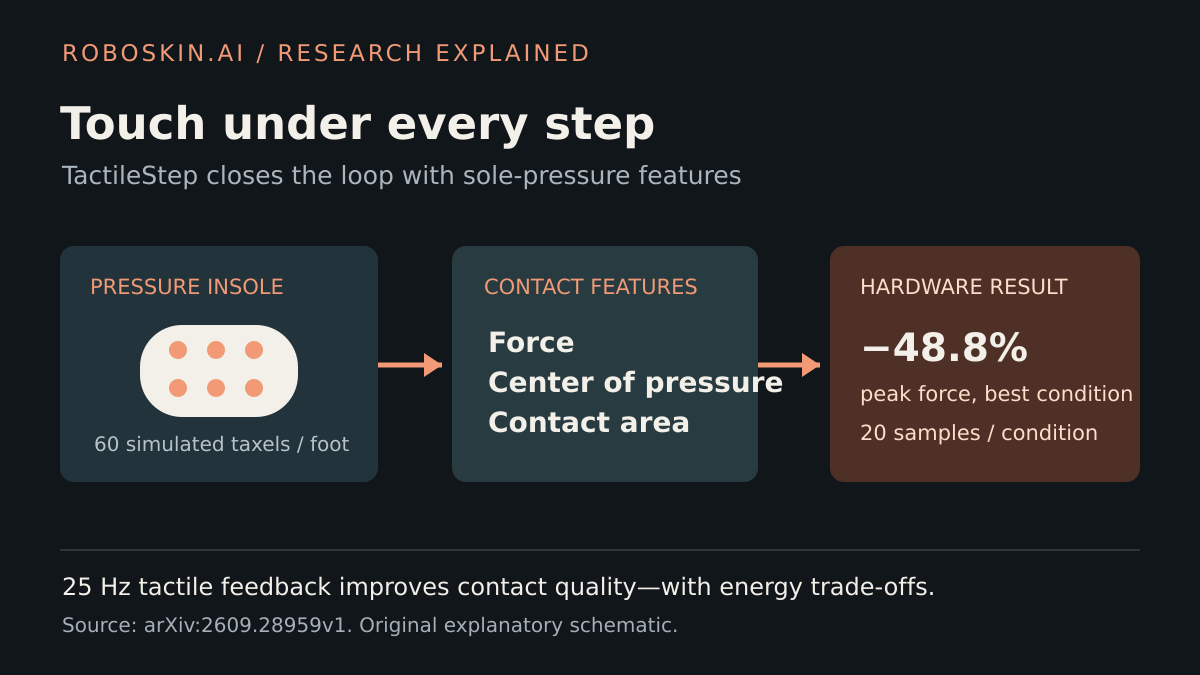
Tsinghua University researchers released TactileStep on September 24, 2026, as a sole-tactile learning framework for humanoid locomotion. The system equips a Unitree G1 with pressure insoles and exposes three contact features to the deployed policy: normalized normal force, center of pressure and contact-area ratio. In controlled hardware comparisons, the largest reported reduction in touchdown force is 48.8%, but that maximum comes from one terrain condition and should not be generalized to every step. Paper and version record.
Key takeaways
- The actor receives 16 tactile values from a two-frame history across both feet, alongside proprioception and depth. It does not consume the full pressure map.
- Hardware testing uses 20 samples per condition and a 25 Hz wireless insole. A separate 100 Hz check on two conditions supports the paper's rising-edge force estimate, but does not establish long-term sensor accuracy.
- TactileStep reduces impact and noise under the reported terrain-matched comparisons, yet its simulated policies generally use more energy and are slightly slower than the vision-based Hiking baseline. Results and protocol.
What changed
Humanoid parkour work often treats traversal as the outcome: the robot either clears the stairs or does not. TactileStep instead makes the quality of foot contact part of control. Its Isaac Sim tactile approximation distributes each foot's resultant normal contact force over 60 virtual taxels, diffuses that load spatially and converts the result into features that can also be computed from the real insole.
The policy organizes every foot cycle into swing, pre-landing, landing and stance. Phase-aware rewards discourage excessive downward motion before contact, reduce the touchdown transient and encourage broader, more centered support after landing. The deployed actor combines these pressure-derived features with joint history and depth observations; privileged foot velocity and phase labels are reserved for training critics.
This is an important integration detail for humanoid robot skin: the authors avoid requiring a soft-body simulator to reproduce every taxel. They align compact contact statistics instead. That lowers simulation cost, but it also discards detailed shear and spatial-pressure structure that a richer foot skin might capture.
Results under the reported conditions
Training uses 2,048 parallel Unitree G1 agents on one RTX 4090. Simulation evaluation contains 4,096 trials per policy and terrain; hardware evaluation contains 20 samples per condition. The external comparison is Hiking in the Wild, a perceptive vision-based parkour policy, plus ablations that remove tactile observations or contact-specific rewards.
On hardware, the largest force reduction occurs during platform ascent: mean touchdown force falls from 695.0 plus or minus 49.4 N for Hiking to 355.7 plus or minus 39.8 N for TactileStep, a 48.8% relative reduction. On stair descent, peak A-weighted noise falls from 97.2 plus or minus 1.2 dB to 67.1 plus or minus 1.4 dB, while contact-area ratio rises from 0.483 to 0.598, a 23.8% relative increase. The paper reports within-terrain comparisons because material and geometry affect all three metrics. Hardware table.
The trade-off is visible in simulation. TactileStep matches or exceeds traversal success across six terrains, but usually has slightly higher velocity error, longer traversal time and higher energy. Stair ascent, for example, uses 1,126.3 plus or minus 66.6 J versus 802.2 plus or minus 97.0 J for the baseline. Lower impact is therefore not a free efficiency gain.
What this means for robotics
RoboSkin analysis: TactileStep is strongest as evidence that distributed pressure can close the loop after vision has chosen a foothold. Geometry predicts where a foot may land; sole pressure reveals the contact that actually formed. That distinction matters for physical AI touch systems operating on edges, stairs or compliant structures.
The engineering lesson is also conservative. A 25 Hz sensing path can improve learned whole-body behavior when the policy uses phase-level contact features, but it is not equivalent to a high-bandwidth impact controller. Teams should budget separately for insole acquisition, wireless reliability, model inference and the lower-level joint controller.
Limitations and availability
The work evaluates one Unitree G1 within bounded motion commands. Faster motion, deformable or granular ground, systematic recovery behavior, insole durability, drift and recalibration are not evaluated. The project page labels the work accepted at CoRL 2026; RoboSkin.ai has not independently reproduced it.
The wireless insole operates at 25 Hz with less than 1 ms of post-acquisition processing and communication delay; wired acquisition supports 100 Hz. In a two-condition validation, 100 Hz measurements were close but not identical to the 25 Hz values. This check addresses peak under-sampling, not every source of calibration error. Sampling validation.
The official project page supplied paper, videos and tables on September 25, but displayed “Code Soon.” No repository, weights, training environments or sensor dataset were verified. Official availability.
Sources and related resources
Continue the topic