Reactive multi-contact planning turns a humanoid hand into a 10 ms brace
A two-stage planner previews reachable hand contacts with a learned post-impact stability model, letting a humanoid brace against nearby surfaces before foot-only recovery fails.
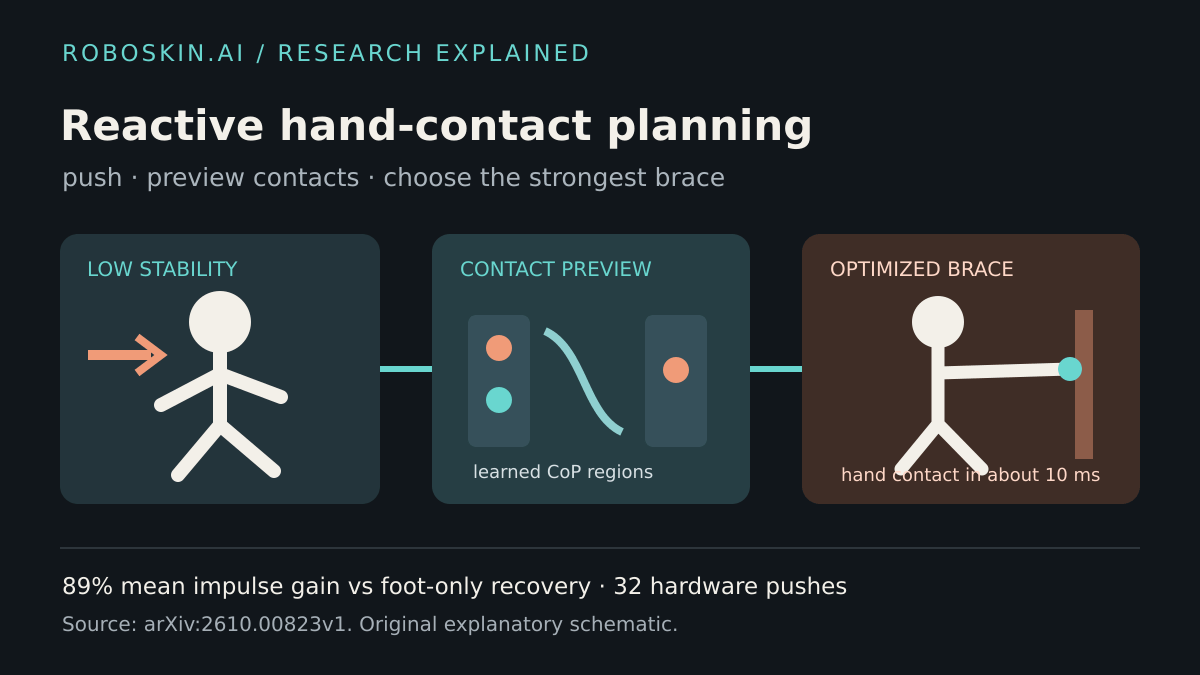
Researchers at the Florida Institute for Human and Machine Cognition and the University of West Florida released a reactive humanoid contact planner on September 30, 2026. Instead of asking the feet to absorb every push, it samples reachable hand contacts on nearby surfaces and estimates which brace will provide the most post-impact control. The learned stability approximation reduces a 388 ms numerical planning path to 9.7 ms in the authors’ benchmark. Paper and version record.
Key takeaways
- The planner first chooses a surface region, then a point inside that region, using predicted Center of Pressure control authority after hand impact.
- Three simulation scenarios show average impulse resilience gains of 89% over foot-only recovery and 17% over choosing the closest reachable brace.
- Hardware evidence covers 32 alternating pushes: two standing protocols with ten pushes each and one walking protocol with twelve pushes.
From reachable wall to useful brace
The problem is not merely finding a wall. A reachable point can place the arm in a configuration with little capacity to redirect the whole-body load. The system therefore rolls a reduced centroidal model through pre-impact, impact and post-impact phases. Candidate points are scored by the size and direction of the feasible post-impact Center of Pressure region.
Computing that region from inverse kinematics and linear programs for every candidate would be too slow for a reflex. The paper trains separate neural networks for five foot-and-hand contact permutations. Their inputs include planar contact geometry, center-of-mass position and robot posture summaries; their 18-dimensional output approximates the feasible region. Per-rollout region computation falls from 0.65 ms to 0.13 ms and avoids a reported 13 ms inverse-kinematics solve. With 14 rollouts per side, the full comparison is 9.7 ms for the learned path versus 388 ms for numerical optimization. Model and planner details.
Results under the reported conditions
In simulation, maximum sustainable impulses are reported for standing, sideways walking and backward walking. Foot-only recovery handles 15.6, 17.7 and 23.0 N·s. The closest-contact baseline reaches 25.8, 36.4 and 26.6 N·s, while optimized bracing reaches 29.4, 42.3 and 32.1 N·s. Recomputing each relative gain gives an average 89.0% over no brace and 16.9% over the naive brace, consistent with the rounded abstract values.
The hardware study alternates baseline and optimized trials rather than measuring a calibrated external impulse. The authors use capture-point-error slope at push time as a proxy and report less than 5% variation between the paired datasets. In the ten-push multi-surface standing test, choosing a front wall instead of the nearer slanted surface reduces average recovery time by 57%. In a second ten-push standing test, shifting one hand about 12 cm along a wall reduces it by 29%. Averaging those two reported reductions produces the abstract’s 43% standing figure. In twelve walking pushes, hand bracing reaches high stability in 316 ms versus 384 ms without hand contact, an 18% reduction.
RoboSkin analysis
The engineering contribution is a contact-selection layer between perception and whole-body control. It does not add tactile skin, but it makes surface contact an active recovery resource: geometry decides where contact is possible, and the stability model estimates what that contact can do. That makes the work relevant to humanoid robot contact design and to teams connecting Physical AI touch with robot safety.
The benchmark also shows why “nearest reachable” is a weak policy. In the sideways simulation there is only one surface, yet moving the contact by 14.9 cm improves impulse resilience by 16%. Contact placement, not just contact availability, changes the recovery envelope.
Limitations and availability
This is an arXiv v1 preprint, and RoboSkin.ai has not reproduced the results. The learned models receive only partial information about the full robot configuration; reported feasible-region RMSE ranges from 0.89 to 2.62 cm across contact modes. The controller relies on reduced-order dynamics, does not directly measure hardware push magnitude, and observed only about 55 ms of hand contact in the walking test. The paper identifies contact-detection latency and unmodeled arm momentum after release as open issues.
The arXiv manuscript is available under CC BY 4.0. No official project page, implementation repository, training data, model weights or software license was verified, so the publication should not be read as a reproducible software release.
Sources and related resources
Continue the topic