GLoTouch lets one parallel gripper search and identify objects without external vision
GLoTouch turns one parallel gripper into a long-range force probe and a local visuotactile matcher. It retrieved 38 of 50 model-specified targets on hardware, but requires known scene geometry and a target mesh.
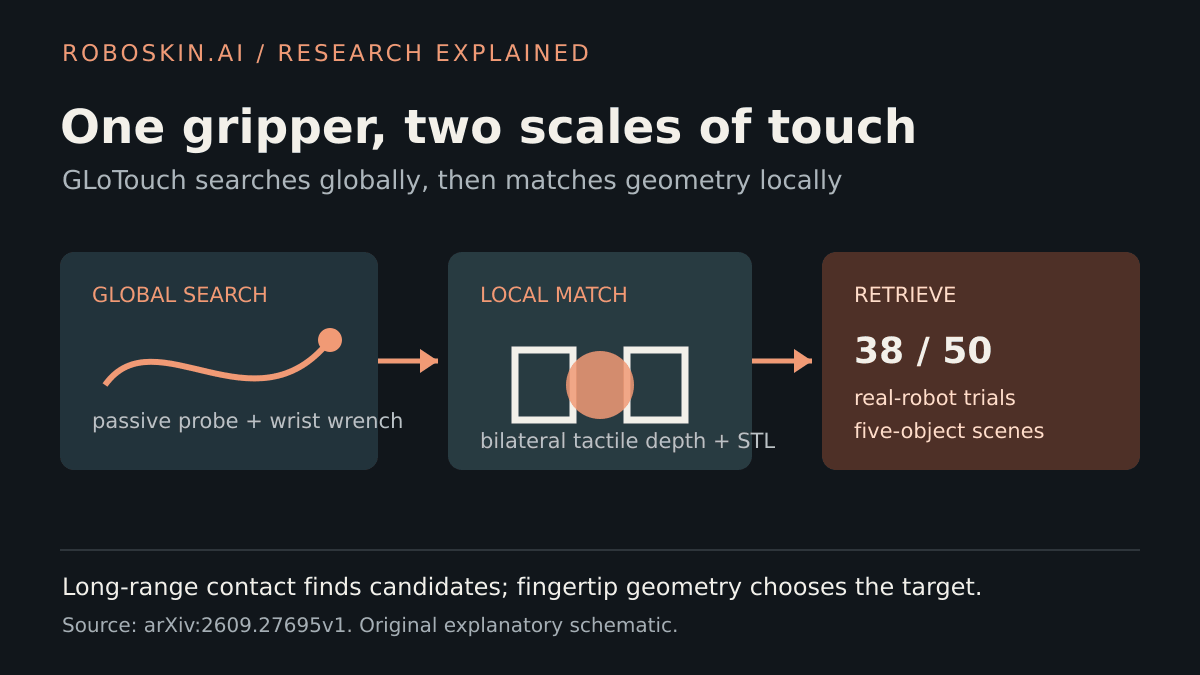
Zonglin Li and colleagues introduced GLoTouch on September 23, 2026, as an arXiv v1 preprint from an independent researcher, Shanghai Jiao Tong University and the University of Hong Kong. The system gives a standard parallel gripper two haptic roles: it first carries a passive probe to search a container with wrist force sensing, then puts the probe away and uses bilateral visuotactile fingertips to identify and retrieve the object matching a supplied 3D mesh. In 50 randomized real-robot trials, the complete pipeline retrieved 38 targets. Paper and version record.
Key takeaways
- GLoTouch retrieved 84 of 100 targets in simulation and 38 of 50 on a Flexiv robot. Each scene contained the same five 3D-printed object classes, and success required search, recognition, grasping and lifting.
- The local matcher needs no object-specific training, but it does need the target STL model, known container registration, known object count and objects that are reachable from above.
- The paper says code will be open-sourced. No repository, downloadable dataset or software license was linked from the v1 record on September 24. Full methods and experiments.
What changed
Parallel grippers normally trade dexterity for simple, reliable grasping. GLoTouch extends their perceptual range without adding an actuated search hand. During global exploration, the Xense gripper holds a spherical-tipped probe that has no embedded sensor. A six-axis wrist force-torque sensor, robot kinematics and the known probe shape localize contact while the robot follows a coverage path. Multi-directional probing estimates candidate centers, contours and heights.
The robot then places the probe in a holder. Bilateral visuotactile depth maps and jaw aperture form a local TouchSet for each candidate. A finite-window matcher compares width, depth and acquisition mode against synthetic observations generated from the target STL. Candidates are ranked by matching loss before the gripper closes under a force limit.
This division matters: the probe covers a larger workspace, while the fingertips collect spatially resolved geometry only after an object is found. The same gripper remains available for the final grasp.
Results under the reported conditions
In simulation, each of five targets was tested 20 times in randomized five-object layouts. GLoTouch completed 84 of 100 retrievals. A separate global-search ablation found all five objects within a 5-meter motion budget in 55% of 100 layouts, compared with 30% for random descent. That is a scene-discovery metric, not the end-to-end success rate.
The local matching component was also isolated on 60 target-and-phase samples from five physical objects. Width and action alone achieved 41 of 60 correct top-1 matches. Adding local depth raised this to 47 of 60; the complete matcher reached 54 of 60. The samples reuse different subsets of contact sequences, so 60 should not be read as 60 independently collected objects.
On hardware, every target was evaluated in 10 randomized scenes. The Flexiv arm and Xense gripper retrieved 38 of 50 targets, or 76%. Apple was retrieved in all 10 trials, while Train succeeded in 5 of 10. Confusion between Train and Truck, object motion during probing and toppling during clamping were reported failure modes.
What this means for robotics
RoboSkin analysis: GLoTouch is a useful integration pattern for haptic search. It reserves high-resolution visuotactile sensing for the stage where local geometry is valuable, and uses cheaper tool-mediated force contact for global coverage. A detachable probe may be easier to service than a large tactile array and leaves the end effector free for manipulation.
The method is not touch-only in the broadest sense: it relies on proprioception, wrist wrench sensing, known robot-to-container registration and a pre-existing target mesh. It also assumes top access and objects resting on the container floor. Deployments in cluttered bins would need safeguards for entanglement, stacked objects and accumulated pose error. Those integration conditions are at least as important as the recognition score for teams building tactile manipulation systems.
Limitations and availability
This is a preprint, not an independently reproduced result, and RoboSkin.ai has not run the system. Evaluation uses one arm-gripper configuration and five printed objects. The global stage depends on a wrist force-torque sensor; the passive probe does not turn an otherwise sensorless gripper into a contact detector. The paper also assumes a known scene cardinality and does not evaluate transparent versus opaque objects as separate conditions because external vision is excluded from control.
The arXiv record and full v1 paper were accessible on September 24. The manuscript states that source code will be released, which is a future commitment rather than current availability. No official code repository, data archive or license was linked. The safest current description is paper-only, with videos and implementation assets not established as reusable resources.
Sources
Continue the topic