FibTac combines pneumatic gripping and tactile sensing
Purdue researchers use the same fiber array to grasp objects and sense contact. The peer-reviewed study reports air and water experiments, with separate protocols for objects, liquids, and granular media.
Research news — paper published August 31, 2026; reviewed September 11, 2026
FibTac is a pneumatic gripper that uses carbon fibers both to manipulate objects and to sense their interaction with the environment. Researchers at Purdue University describe the system in a peer-reviewed paper published in npj Robotics on August 31, 2026. Its useful distinction is the shared mechanical structure: the fibers do the grasping, while an internal camera reads their movement as tactile information. Read the paper.
The laboratory results cover chess-piece identification, liquid classification, granular-material classification, underwater object recognition, and water-flow estimation. These are separate experiments with different training sets and conditions. A single accuracy number would obscure what the gripper has actually demonstrated.
How a fiber gripper senses touch
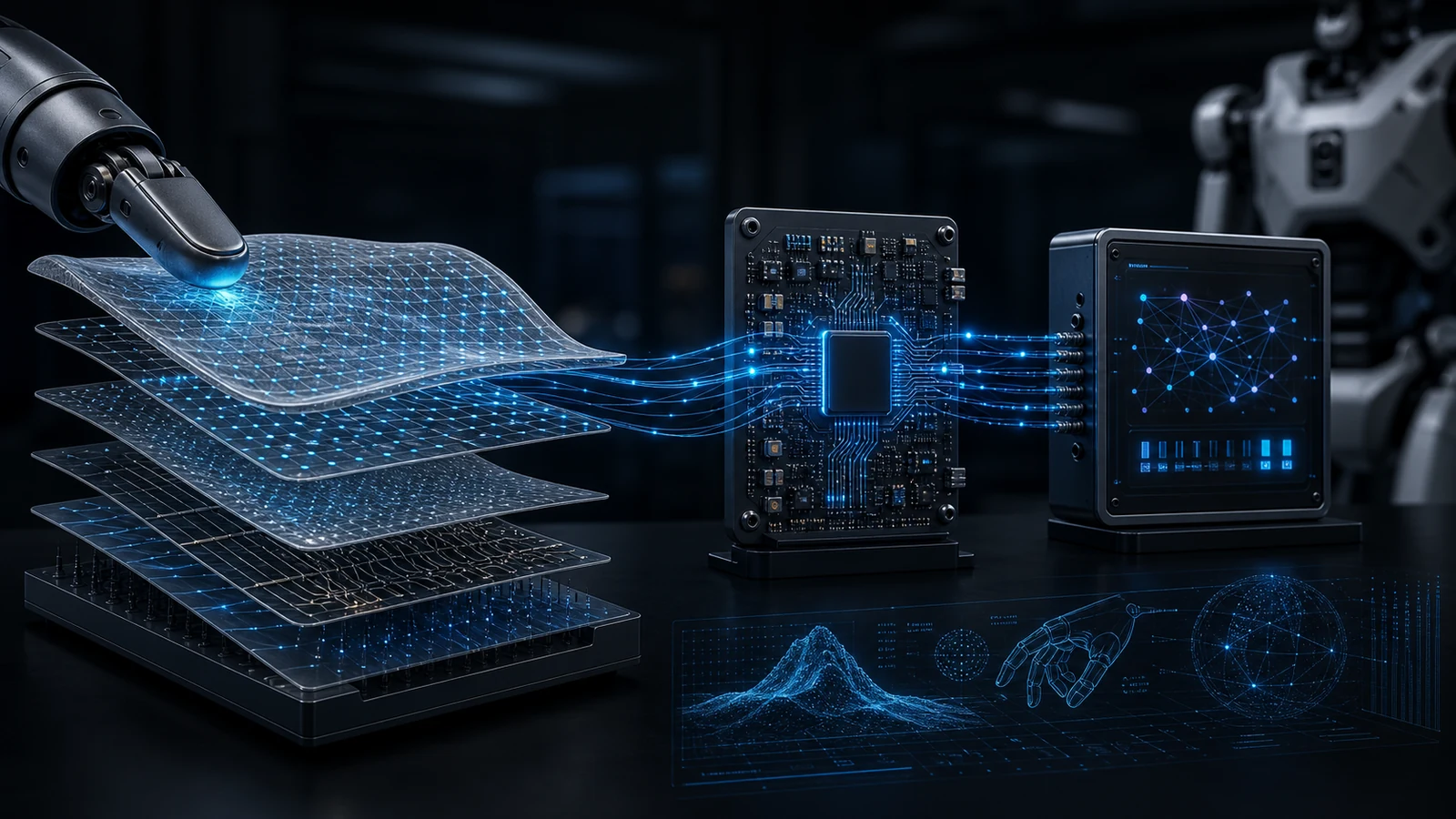
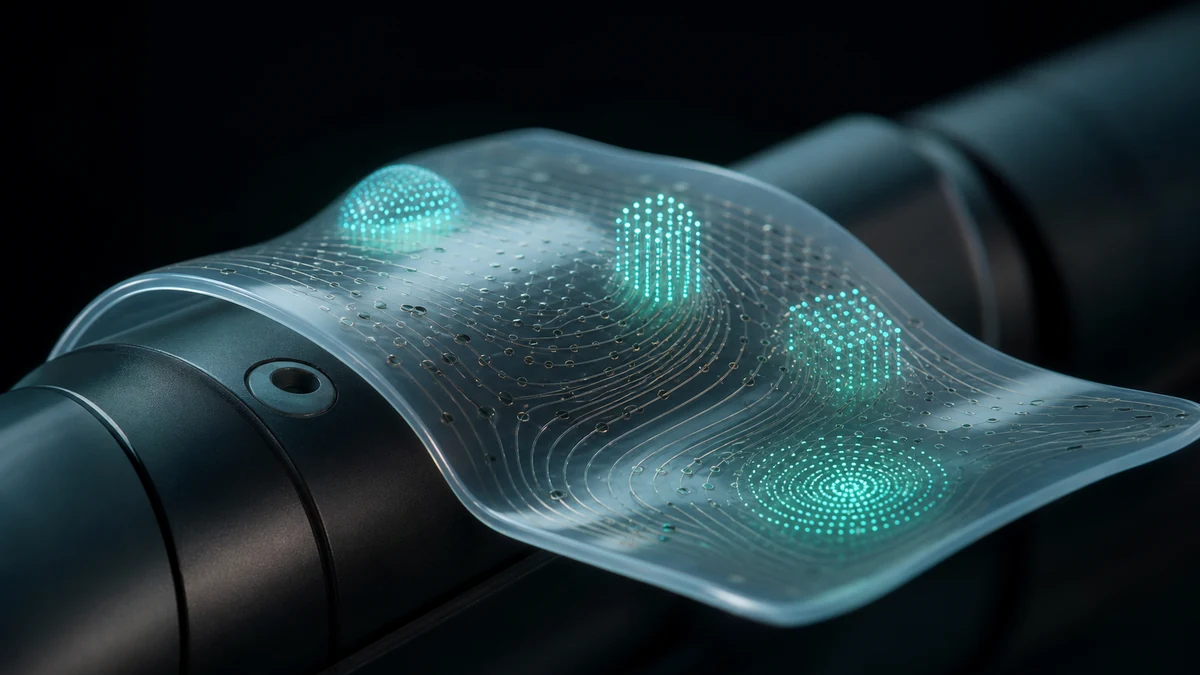
Carbon fibers are embedded in silicone inside a waterproof housing. Pneumatic pressure changes the fiber array’s configuration to grasp or release an object. The camera observes fiber-tip motion, which also changes when an object or surrounding medium resists that movement. Learned models use these image sequences for classification or regression.
This combines actuation and sensing in a compact contact structure. It also makes the signal depend on how the robot moves: liquid tests use active grasp–release cycles, whereas the granular tests move the gripper vertically with passive fibers. The sensing protocol is part of the measurement, not just a detail of the demonstration.
The authors report a payload up to 186 g and more than 3,000 actuation cycles without observable damage under their tested conditions. These establish a laboratory operating range; they do not establish an industrial lifetime or a payload rating across arbitrary objects. The paper’s results and methods describe the tested hardware and procedures.
What the classification results measure
The following values are author-reported results from the paper. Clips, held-out samples, and online manipulation trials are kept separate because they are different evaluation units.
| Experiment | Classes and data protocol | Reported result | Interpretation |
|---|---|---|---|
| Chess-piece recognition | Six piece types; 105 clips per class, with 20% reserved for validation; a separate online manipulation evaluation uses 20 trials in total | 100% in the 20 online trials | A small online cohort, not 100% accuracy across arbitrary grasped objects |
| Liquid classification | Water, honey, syrup, dish liquid, oil, and an empty reference; 220 training and 20 test clips per class | Approximately 97.5% classification accuracy | Six classes include the empty reference; this is not six different liquids |
| Granular-material classification | Flour, beans, rice, oats, and sugar; 200 clips per class with 10% for validation, plus 20 test samples per class | Approximately 90% classification accuracy | Passive fibers sense resistance during robot-driven vertical movement |
| Underwater object classification | Four objects; 110 clips per object, including 10 validation and 10 test clips per object | 100% classification accuracy | A controlled four-object underwater experiment |
The chess experiment’s 20 online trials should not be substituted for the larger clip-based training and validation collection. Likewise, the underwater result does not imply that the gripper can identify unseen marine objects. These distinctions matter when comparing FibTac with other robotic gripper tactile sensors.
Why motion and medium matter
For liquids, the gripper alternates grasp and release every second, collecting the resistance pattern over two cycles. For granular media, the robot moves vertically with a 4 cm amplitude and a 1.4-second period without pneumatic actuation. These motions actively expose material-dependent signals to the fiber array.
The flow experiment adds a different task: regression against measured water-flow conditions. The collection uses seven angles from 0° to 90° in 15° increments, 20 flow levels, and 12 clips per condition, allocated as nine training, one validation, and two test clips. The reference flow-meter values are volumetric flow in L/min; they should not be described as water velocity in m/s. See the flow-sensing methods.
For an engineering reader, this makes FibTac a candidate for studying coupled grasping and active tactile perception in wet or compliant environments. A comparison should match motion, fluid or material, camera settings, object set, and train/test separation before attributing a result solely to the sensor design.
What can be inspected or reproduced today?
The authors’ FibTac repository provides evaluation notebooks for five tasks and links external data and checkpoints. At the reviewed revision, the repository describes validation/test assets rather than a complete training-data release. RoboSkin reviewed the repository and its instructions but did not download the external data or rerun the models.
The paper and repository point to different Google Drive folders. Both are source-provided links; their contents and equivalence were not independently verified in this review. A reproducer should first confirm that the selected notebook, checkpoint, and evaluation split belong together. The reviewed GitHub root did not contain a license file, so the paper’s open-access status should not be treated as a software or data license.
Limits to carry into a comparison
The paper discusses practical constraints, including camera-cable fragility, the tradeoff between gripping strength and fine sensing, and generalization to unseen objects or environments. Those constraints are consequential for a combined actuator and sensor: changing stiffness or fiber geometry may improve one function while changing the other.
RoboSkin did not conduct these laboratory experiments. The article synthesizes the authors’ paper and public repository, and the cover is an illustration. For alternative contact structures, see soft robotic skin and the tactile sensor benchmark guide. For a different approach that reconstructs contact geometry from sparse electrical measurements, compare TacPrint’s controlled grasping results.
Sources
Continue the topic