A support rod turns granular jamming into a continuum-robot gripper
The design couples a compliant membrane and particles with a direct load path at a bending robot tip. Mechanical tests are quantitative; the complete autonomous sequence is demonstrated without a reported success rate.
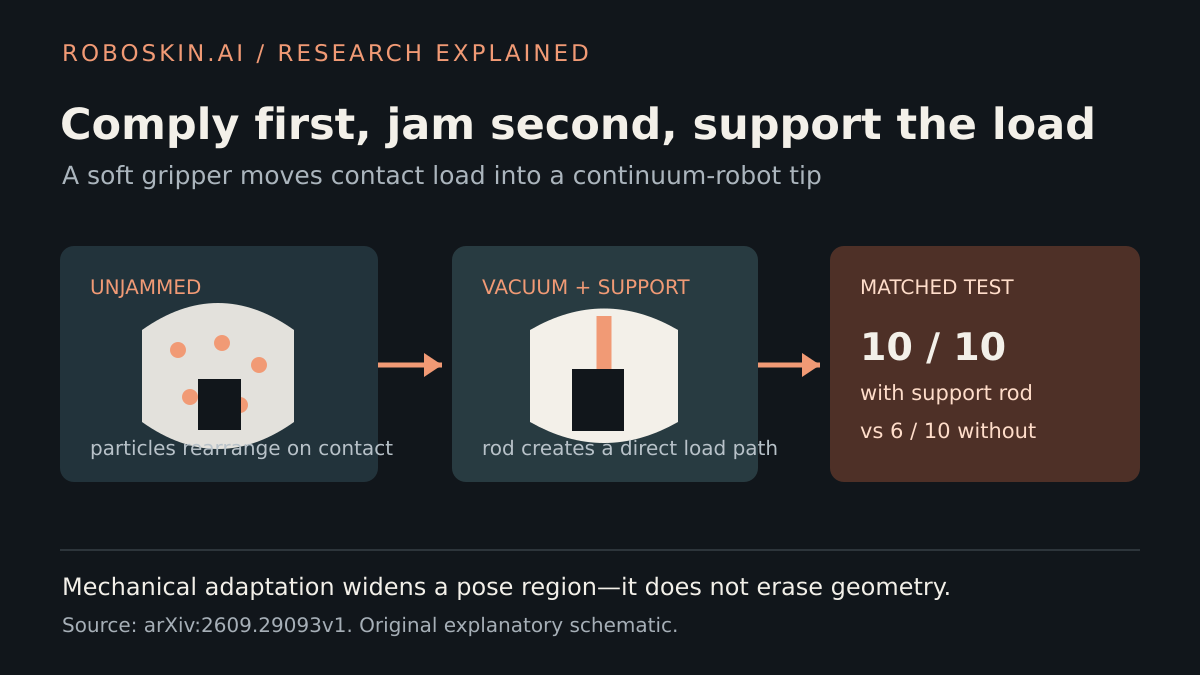
Danyu Liu and colleagues released a support-enhanced granular-jamming gripper on September 24, 2026, for tendon-driven continuum manipulators. A flexible membrane and mobile particles conform during contact; vacuum locks that shape, while an internal rod promotes enclosure and carries load back to the bending robot tip. In a matched 10-trial mechanical test, the supported gripper completed 10 lifts and holds versus six without the rod. Paper and version record.
Key takeaways
- The reported 100% versus 60% result is one 10-trial configuration comparison with a common object, approach and vacuum condition. It is not a broad autonomous success rate.
- Shape tests vary sharply: sphere 10/10, hexagonal prism 9/10, cylinder and cube 8/10 each, and triangular pyramid 1/10.
- A reinforcement-learning controller reaches with 4.23 cm terminal RMSE over 16 physical rollouts, but it controls only the tendon-driven approach. Passive mechanics form the grasp and a task layer switches the vacuum. Design and deployment results.
What changed
Continuum manipulators reach through confined spaces by bending rather than rotating rigid joints, but that compliance makes their end-effector pose difficult to reproduce. A conventional rigid gripper can fail when tendon friction, hysteresis or external loading leaves a small residual error.
The proposed end effector adds a support rod inside a particle-filled membrane. Before vacuum, the rod provides a boundary against which the membrane can wrap, transmits continued approach force and helps develop a deeper enclosure. After evacuation, it creates a more direct load path instead of asking the membrane alone to retain the object.
The team compares natural-rubber and thermoplastic-polyurethane membranes, three particle types and three fill ratios. The selected design uses natural rubber, thermoplastic-rubber spheres and a 50% nominal filling ratio. The paper says the thermoplastic-rubber fill lowers gripper mass relative to polystyrene while retaining the same measured success, but does not report the absolute mass. Configuration study.
How much contact error can it absorb?
Mechanical characterization separates the gripper from the learned controller. A successful trial requires lifting an object clear of the table and retaining it through the lift. Ten trials are run per condition.
The internal-rod comparison improves from 6/10 to 10/10 under the selected configuration. Fill ratio is not monotonic: one-third, one-half and four-fifths fill produce 90%, 100% and 70%, respectively. Too little fill reduces load-bearing particles; too much restricts conformity.
Offset tests reveal an asymmetric graspable region rather than a circular tolerance around the nominal center. The rod approaches at roughly 30 to 40 degrees relative to the table, so the membrane, rod, object and table form better enclosures on one side. The plotted continuous field interpolates discrete tests; it is not a dense measurement at every position.
Object geometry remains a strong constraint. The triangular pyramid succeeds only once in 10 attempts because sharp edges and limited stable contact promote membrane folding and slip. Mechanical compliance enlarges a set of workable poses; it does not remove pose and geometry requirements.
What does the learned controller contribute?
The policy observes four frames of gripper position, target displacement and four tendon lengths, then outputs absolute tendon-length commands. Training randomizes initial posture, target position, effective stiffness and actuation delay in a piecewise-constant-curvature simulation. Deployment replaces simulated positions with RGB-camera estimates and performs no physical fine-tuning.
Across 16 physical reaches to two target positions, terminal RMSE is 4.23 cm versus 2.51 cm in simulation. The complete reach-grasp-lift-transfer-release sequence is shown, but the paper does not report repeated end-to-end success. That distinction prevents one demonstration from being read as a reliability benchmark.
What this means for robotics
RoboSkin analysis: this is physical intelligence at the contact interface. The learned policy only has to reach a finite region, while deformable material absorbs some residual error. That can be useful where a slender continuum robot cannot carry a heavy multi-fingered hand.
The current design does not include tactile or pressure sensing. Vacuum timing is coordinated by the task layer, not inferred from a measured pressure map. Adding contact feedback, as the authors propose, could help decide when sufficient enclosure has formed and detect retention loss during transfer.
Limitations and availability
Tests cover a limited set of objects, approach orientations and contact offsets. The support geometry is not optimized, broader three-dimensional pose variation is not evaluated and the absolute gripper mass is unreported. The paper's title page does not state affiliations; acknowledgements cite support involving the Hong Kong Centre for Logistics Robotics, the Chinese University of Hong Kong, Zhejiang University and China's National Natural Science Foundation. That funding statement is not used here to infer author employment.
The arXiv v1 paper was accessible on September 25. No official project page, CAD, bill of materials, controller repository, dataset or license for implementation assets was linked. RoboSkin.ai has not reproduced the hardware or policy.
Sources and related resources
Continue the topic