An open robotic forearm tests how eight carpal bones redirect wrist stiffness
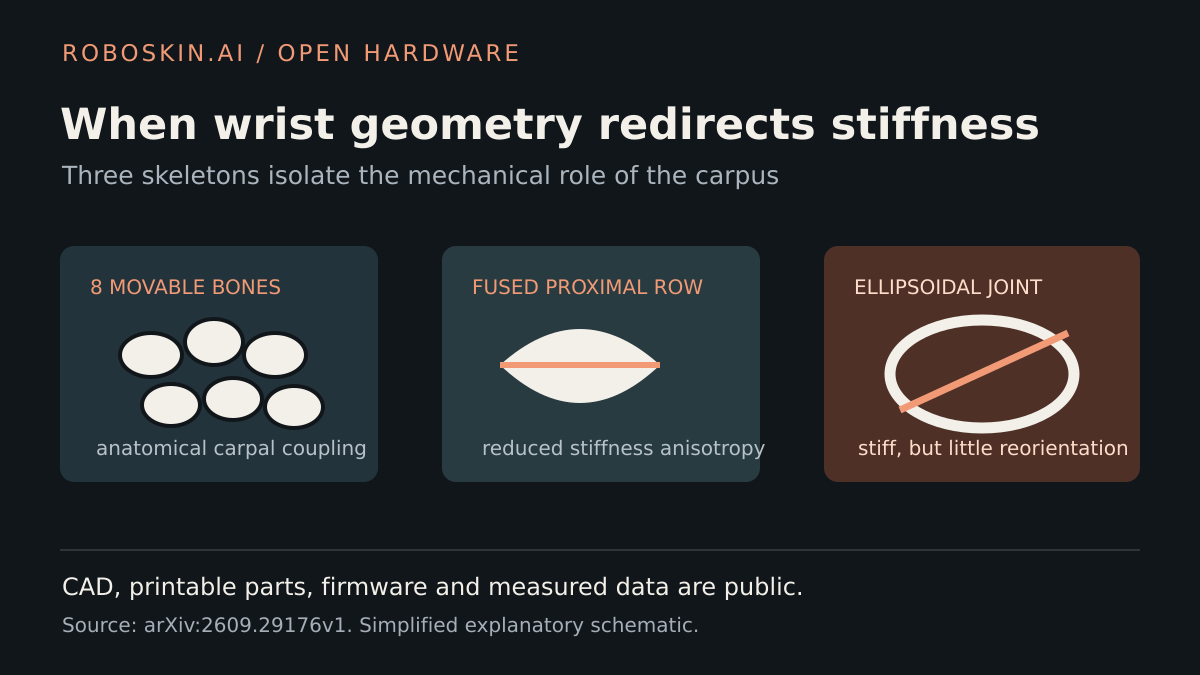
A University of Electro-Communications team compares anatomically shaped, fused and ellipsoidal wrist skeletons. Its open release includes CAD, printable parts, firmware and analysis data under file-specific licenses.
Researchers at the University of Electro-Communications in Tokyo released an anthropomimetic soft robotic forearm on September 24, 2026, to test how carpal-bone structure changes wrist stiffness. The prototype reproduces eight independently movable carpal bones, 22 actuated muscles, 13 finger degrees of freedom and a three-degree-of-freedom wrist. Its open companion repository includes CAD, printable parts, firmware, measured data and analysis code. Paper and version record.
Key takeaways
- The study compares one anatomical wrist, a fused proximal carpal row and a geometric ellipsoidal skeleton under four muscle-activation patterns.
- With the anatomical skeleton, switching from finger-only to combined wrist-and-finger activation rotates the stiffness ellipse by 48.2 degrees; a permutation test reports p equals 0.0038.
- The release is unusually complete, but licenses differ by file: derived bone models and fingertip molds use CC BY-SA 2.1 JP, while the authors' other materials use CC BY 4.0. Repository and license map.
What changed
Many robot wrists simplify the human carpus into one or two joints. This forearm instead uses CT-derived bone geometry, knitted polyethylene ligaments, tendon sheaths, a printed triangular fibrocartilage complex and dual-layer silicone fingertips. Nineteen muscles use tendon transmission; three intrinsic thumb muscles enable opposition. The assembled hand can grasp while its wrist moves, but the research question is mechanical rather than task-level autonomy.
To isolate morphology, every active muscle receives the same 0.6 N tension. A force gauge deflects the wrist 3 mm from 12 directions at 30-degree intervals, while motion capture samples at 100 Hz. The team runs eight trials per activation condition and direction, fits a stiffness ellipse, then separately records 20 repetitions per condition of motion between selected carpal bones.
That protocol matters when interpreting the result: the paper tests whether structure can redirect stiffness under uniform inputs. It does not optimize tendon forces or show an autonomous robot hand choosing stiffness for a manipulation task.
What the stiffness experiment found
For the anatomical skeleton, finger-muscle activation places the low-stiffness axis near the human dart-throwing direction. Combined wrist-and-finger activation instead aligns the high-stiffness axis with that direction. The observed 48.2-degree major-axis shift exceeded 4,982 of 5,000 shuffled-label outcomes.
Fusing the proximal row changes that behavior. Under finger activation, minimum-axis stiffness rises from 80.1 N/m for the anatomical skeleton to 149.5 N/m for the fused skeleton, and the low-stiffness direction moves away from the dart-throwing range. The ellipsoidal skeleton is stiffer overall, reaching major-axis values from 282.2 to 518.3 N/m under finger-only and wrist-only activation, but its ellipse orientation stays between about 86 and 96 degrees across conditions.
The carpal-motion test provides a narrower mechanistic result. Activation condition significantly changes relative rotation and translation at the proximal carpal row, while the midcarpal changes do not reach significance. The paper treats the latter as a supporting trend rather than a confirmed effect. Stiffness and motion results.
What this means for robotics
RoboSkin analysis: high stiffness alone is not the same as useful stiffness. The ellipsoidal wrist is strongest in absolute terms but least able to redirect its compliance. For contact-rich manipulation, morphology that changes where the hand yields may reduce how much active control is needed before tactile feedback reacts.
The open hardware is also valuable as a reproducibility package. Engineers can inspect the bone and jig CAD, bill of materials, Dynamixel firmware and analysis scripts instead of inferring construction from figures. That makes this closer to a buildable mechanical research artifact than most paper-only robot-hand releases.
Limitations and availability
All stiffness measurements are quasi-static. The paper does not evaluate impacts, fast grasp corrections, hammering, autonomous manipulation success or repeated builds. Every reported result comes from one physical prototype. Assembly jigs and current control improve consistency within that build, but cannot establish inter-build variation.
The repository was publicly accessible on September 25 and contained analysis data, Python code, PlatformIO firmware, CAD, STL files, a bill of materials and video. Multiple licenses apply, so “open hardware” does not mean every file has the same reuse terms. Users must preserve the share-alike license for the derived BodyParts3D components where applicable. RoboSkin.ai did not fabricate or test the design.
Sources and related resources
Continue the topic