Touch2Trace: what makes a tactile cable-tracing policy work
A 60 Hz tactile policy traces farther than a joint-only baseline, but the useful lesson is how sensor detail, pretraining, temporal context and action timing interact.
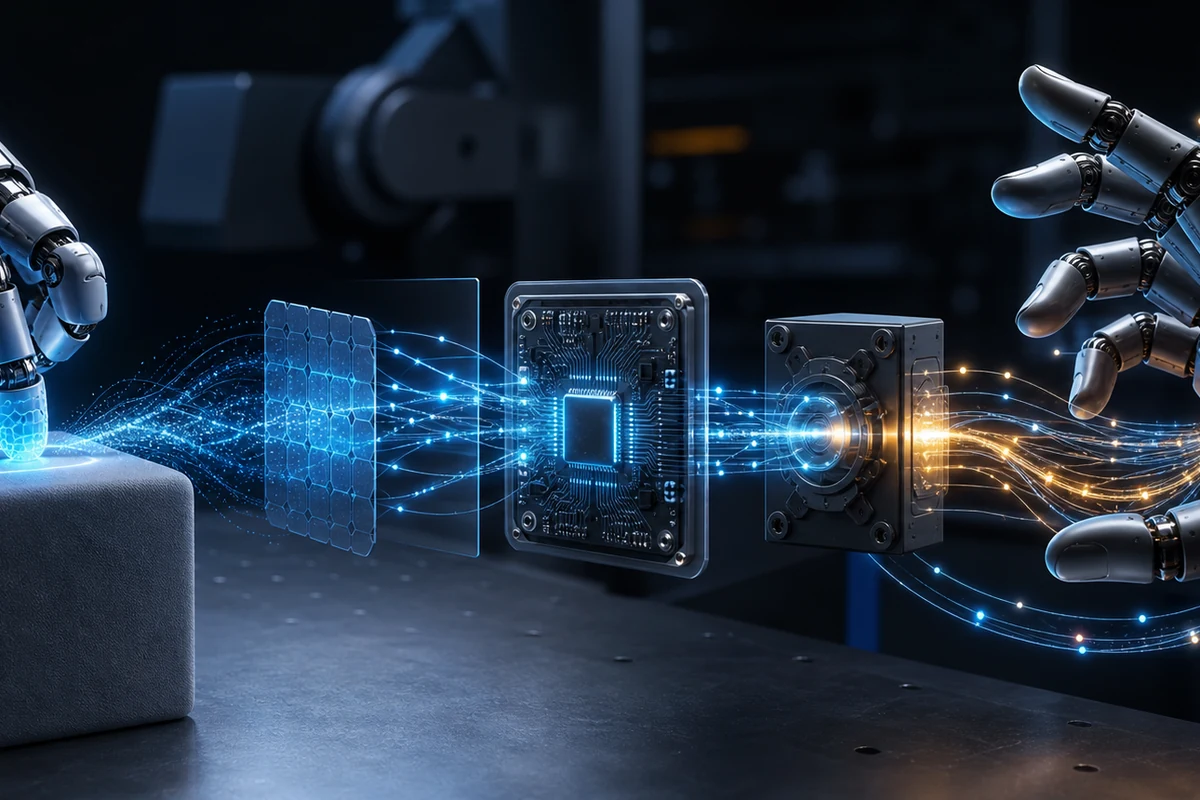
Touch2Trace learns to feed a cable through a dexterous hand with repeated pinch-and-curl motions. It offers unusually useful ablations for a practical design decision: which parts of the tactile pipeline must be preserved when the demonstration budget is small? Its best condition averages 20.1 cm of tracing, compared with 0.2 cm for the matched joint-state-only policy. The result is specific to the paper's hand, cable setup and training protocol. v1 Table 1.
The broader touch-to-action evidence guide compares task success with perception metrics. This article examines Touch2Trace's observation and action contract, the ablation controls, and the limits of a reproduction.
The policy controls eight joints on a fixed hand
The platform is a fixed Tesollo DG-5F hand without a robot arm. Eight of its 20 degrees of freedom are controlled. TacV5 pressure images from the thumb and index finger provide two 32 × 32 inputs. A frozen ViT-MAE encoder produces a 128-dimensional feature for each fingertip; the policy concatenates both with eight joint positions into a 264-dimensional observation. It predicts eight absolute joint-position commands. System and method.
The main TF-GMM policy uses a causal transformer and a Gaussian-mixture action head, receiving 15 frames of history at 60 Hz. The paper describes this as approximately 250 ms of context. There is no explicit cable-state estimator or visual input in this main experiment. That scope isolates the contribution of touch; it does not establish that vision is unnecessary for approaching, locating or routing arbitrary cables.
Ten minutes of task data is not all the training data
The task policy learns from 12 demonstrations totaling 10.1 minutes, collected on one USB cable in a ring arrangement. The tactile encoder was already pretrained on approximately two million simulated grasp/contact samples across 72 objects and approximately 30,000 real contact frames across ten objects. A claim that the complete system learns from only ten minutes would omit that pretraining. Encoder and demonstrations.
Each evaluated condition uses three random seeds and ten rollouts per seed, for 30 trials. The protocol excludes aborted starts shorter than five seconds. Mean tracing distance, SR@10 and SR@20 answer different questions: SR@10 requires reaching at least 10 cm; SR@20 requires at least 20 cm. The headline 93% is SR@10, while SR@20 is 57% for the default Ethernet-straight condition. Evaluation and Table 1.
Freezing preserves useful features in this small-data setting
The following matched TF-GMM results use the main task setup. Table 3 and Appendix Table 5.
| Representation or training choice | Mean tracing distance | SR@10 | SR@20 |
|---|---|---|---|
| Joint positions only | 0.2 cm | 0% | 0% |
| Compact, 16-dimensional tactile features + joints | 7.2 cm | 30% | 0% |
| Dense tactile, frozen pretrained encoder + joints | 20.1 cm | 93% | 57% |
| Dense tactile, fine-tuned pretrained encoder + joints | 4.7 cm | 0% | 0% |
| Dense tactile, randomly initialized encoder + joints | 0.2 cm | 0% | 0% |
The compact representation already improves distance over joint state alone. Learned spatial detail and pretraining provide additional value in these comparisons. Fine-tuning hurts in this limited-data regime, supporting freezing as a candidate starting point. It does not prove that fine-tuning is generally inferior with larger or more diverse demonstrations.
Control rate and history must be compared together
A frame count is not a time duration. Keeping 15 frames while reducing control rate changes both the response interval and the amount of past context. Sensitivity study and Table 9.
| Control rate | History | Approximate duration | Mean tracing distance |
|---|---|---|---|
| 60 Hz | 15 frames | 250 ms | 20.1 cm |
| 30 Hz | 15 frames | 500 ms | 5.7 cm |
| 15 Hz | 15 frames | 1,000 ms | 0.5 cm |
| 30 Hz | Duration held near the default | About 250 ms | 0.2 cm |
The fixed-duration test shows that the longer context partly helps the slower 30 Hz policy. It does not rescue performance to the default level. At 60 Hz, five frames of history yield 5.3 cm, while 20 frames yield 14.5 cm with substantial variation. More history is not automatically better. These experiments support measuring both action timing and physical context duration; 60 Hz and 250 ms are not industry-wide requirements.
Spatial resolution has its own confound. The 8 × 8 and 16 × 16 ablations reach 6.2 cm and 11.2 cm, respectively, but reduced-resolution images are upsampled into the same frozen full-resolution encoder. The decline can reflect lost detail and a mismatch with pretraining. It is not a clean comparison against an encoder trained specifically for each resolution.
The separate visual experiment runs at 20 Hz with a different dataset, representation and action head. Its vision-only and vision-plus-touch comparison is useful within that experiment; it should not be ranked directly against the main 60 Hz TF-GMM result. Appendix Table 6.
Generalization remains bounded by mechanics
Training uses USB-0 in a ring. Tests include three additional cables and straight or ring arrangements on the same fixed hand. These are meaningful held-out cable conditions, but not new robot embodiments or general dexterous tasks. Generalization Table 2.
Reported failures include lateral escape beyond the fingers' reachable workspace, increasing gravitational tension in a straight cable, and a gap between fingers that cannot recover a thin cable. Better tactile features cannot create a missing direction of finger motion. A reproduction should therefore log cable geometry, reachability and termination causes alongside policy outputs.
- Specify sensor layout, normalization, encoder checkpoint and pretraining data separately from task demonstrations.
- Preserve the action definition, controlled joints, command rate, frame count and history duration.
- Report distance and both success thresholds; retain the aborted-start exclusion rule.
- Test held-out cables with the same declared training budget before claiming transfer.
See tactile AI for the system-level evaluation workflow and tactile datasets for access and split checks. No verified official code or data download was found in the paper and arXiv record checked on September 19, 2026; associated licenses remain unverified. A described demonstration corpus is not a confirmed public release.
This review uses the September 14, 2026 v1. Its arXiv comments report CoRL 2026 acceptance; proceedings were not independently checked. Results are author-reported, with no independent RoboSkin reproduction.
Sources
Continue the topic