Tactus tactile glove: reading the evidence before collecting robot learning data
A new sensing-glove preprint raises a practical question: what must a human demonstration record preserve before it can support contact-aware robot learning?
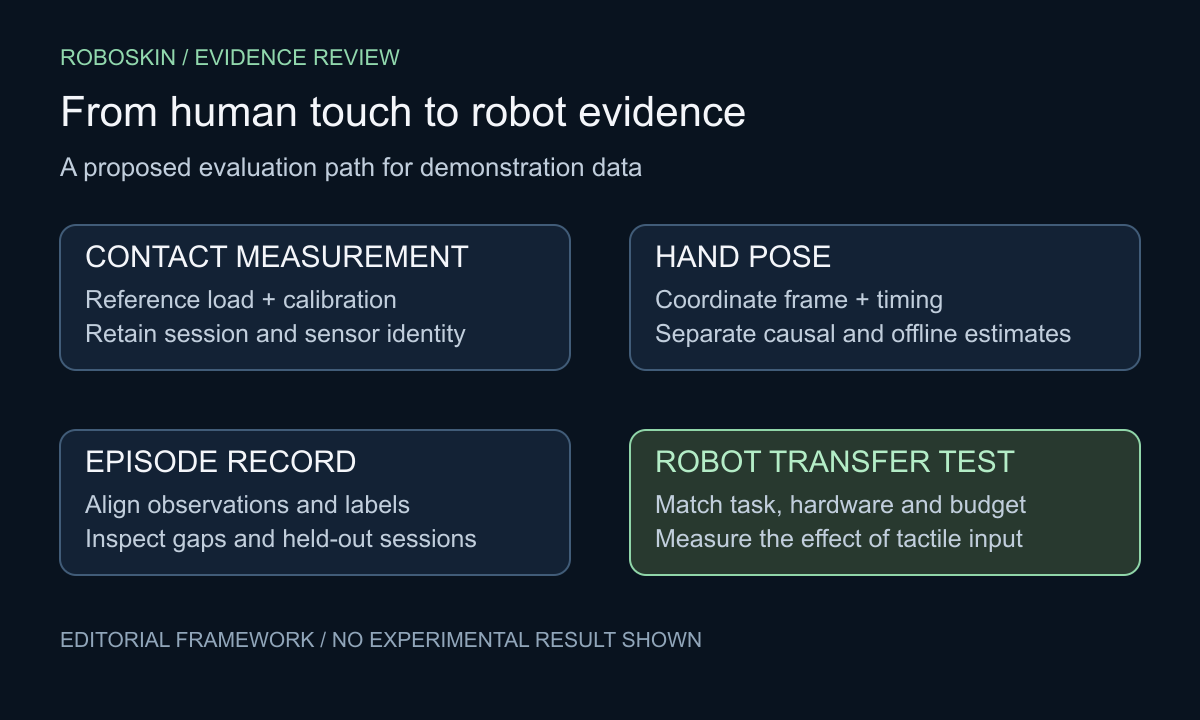
Tactus is a sensing-glove preprint from Meta Reality Labs Research, submitted on October 29, 2026. It combines capacitive touch sensing with inertial-assisted hand tracking. The useful question for robot learning is how to qualify a demonstration stream: contact measurements, hand geometry and an eventual robot action each need their own evidence.
This article separates a short source review from RoboSkin's proposed evaluation workflow. We have not used the glove or reproduced its experiments. A public dataset release, reusable implementation and commercial availability were not established by the manuscript review; a paper link should not be treated as a download or purchase route.
The measurements that need their qualifiers
The original manuscript reports the following. Preserve the measurement definition when comparing another system.
| Reported item | Condition that belongs beside it |
|---|---|
| 0.59 N minimum detectable force | 95% confidence; the fingertip force comparison used three participants |
| 11.0 mm fingertip relative error | Offline trajectory optimization with wrist translation alignment; not online absolute position accuracy |
| Session calibration | Supplements factory calibration to account for wearer and session variation |
Detection threshold, regression error and pose error answer different questions. A low detectable force does not establish equally low error across the working range. A relative hand-pose score does not establish where the hand is in a robot's world frame. These distinctions should govern the experiment before any headline number enters a procurement comparison.
Start from the decision a recording must support
RoboSkin analysis: a demonstration can serve several purposes. A perception model might need a contact/no-contact label. A manipulation policy needs observations aligned with an action target. A retargeting pipeline needs a mapping between a human hand and a robot hand. A world-model experiment needs a defined prediction horizon and a way to test predicted outcomes. Recording more channels does not automatically satisfy all four contracts.
Write one concrete acceptance question first. For example: can a model trained on these recordings distinguish a stable hold from the beginning of an object movement on a new recording session? That question suggests what to label, which sessions to hold out and which mistakes matter. It is more assessable than asking whether a glove produces high-quality data in general.
If the intended use is imitation learning, define the action representation before collection. Human joint positions, robot joint targets and object-relative contact goals are different targets. A file containing accurate hand positions may still lack the robot commands needed by a particular trainer. Keep the recorded observations intact so a later mapping can be audited or replaced.
Treat calibration as part of the dataset
The NIST measurement-process framework distinguishes reference measurements, bias and variability. That is a useful starting point for a glove evaluation: ask both whether readings agree with a reference and whether that agreement survives repeated use. One accurate sample cannot answer the second question.
Our proposed collection record would attach a calibration identifier to every episode. Store the reference instrument, loading geometry, units, fitted coefficients, unloaded baseline and the times of calibration and recording. Record whether a correction was applied during acquisition or later. Preserve raw readings alongside corrected outputs where the acquisition system permits it.
Evaluate repeatability within one wearing session separately from changes after removing and replacing the glove. A fresh fit can alter the measurement conditions without changing the nominal hardware. A model trained across sessions needs to know whether a change in signal came from the object, the wearer or the calibration procedure. Treat a missing calibration record as missing evidence, not as proof that no correction was necessary.
For a small pilot, we would reserve a reference interaction at the beginning and end of each session. Inspect the residuals before pooling sessions. The acceptance limit should come from the intended task: a coarse contact detector and a force-sensitive manipulation target should not inherit the same tolerance simply because they share a sensor.
Why two force-error tables cannot be merged
The paper uses two different calibration and comparison procedures. Section IV-A estimates pressure across the glove from per-sensor transfer functions and then applies a session correction. Section V-B compares learned, multi-channel fingertip normal-force regressors against a Nano-17 reference in lighter-force pressing trials. Their error values do not describe the same estimator, contact region or loading range. Calibration and tactile protocols.
The comparison also does not show one glove winning every metric: the authors report a slightly lower fingertip point error for JQ, while Tactus has the lower minimum detectable force. A selection decision should identify which error matters to the intended recording, rather than combine the best number from each table into a synthetic specification.
For a proposed procurement record, keep the estimator, loaded region, force range, reference, session correction and held-out grouping beside each metric. Request residuals under the intended conditions before adopting a headline threshold. The tactile calibration guide provides the broader distinction between a fitted mapping, repeatability and an independently checked measurement.
Keep causal and offline pose streams separate
Offline processing can use observations that arrive after the instant being estimated. That can be appropriate for curating a demonstration, while an online controller must act using information available at its decision time. Both outputs may be useful, but they belong in separate columns with separate descriptions.
For a robot-control experiment, our recommendation is to retain the causal estimate, its timestamp and its availability time. If an offline trajectory is used as a training label, identify it as a reconstructed target. Otherwise, a model can appear to work with a signal that the deployed controller could never receive at the same moment.
Check coordinate conventions as carefully as error magnitudes. Document the wrist frame, camera frame, object frame and any robot reference frame. Store the transformations and their calibration versions. A hand articulation estimate can be internally consistent while the entire hand is displaced relative to the object. For a contact task, those failure modes should be scored separately.
An episode contract worth checking before a large collection
The following table is a RoboSkin proposal, not the released Tactus file schema. It makes the evidence needed by a downstream team explicit.
| Field group | Proposed record | Reason to retain it |
|---|---|---|
| Identity | Episode, session, glove revision and calibration ID | Prevent accidental mixing of incompatible conditions |
| Timing | Capture time, clock source, dropped samples and synchronization method | Detect lag and gaps across modalities |
| Contact | Raw signal, calibrated value, units and sensor-location map | Distinguish a measurement from a derived label |
| Pose | Coordinate frame, causal/offline flag and tracking validity | Prevent future information or frame mismatch in a controller input |
| Outcome | Independent task annotation and intervention log | Separate a successful recording from a successful manipulation |
| Split | Participant, session, object and task grouping | Evaluate the intended kind of generalization |
If exporting to LeRobot, inspect the actual schema rather than assuming that the format supplies these fields. The v3 documentation describes shared Parquet and video files with episode boundaries resolved through metadata. That storage organization helps locate samples; it does not define a glove's calibration or human-to-robot mapping for you.
Test transfer as a second experiment
Our suggested pilot has three gates. First, verify measurement integrity against a reference under the intended contact conditions. Second, train and evaluate a bounded perception task using held-out sessions or participants. Third, test whether the resulting signal improves a robot task with a matched no-touch baseline. Passing one gate should not be reported as passing the next.
Keep the robot, objects, training budget and success definition fixed in that last comparison. Include failed attempts and interventions in the denominator. A transfer result should also specify what was changed to bridge the embodiments: contact-location mapping, sensor normalization, action retargeting or additional robot demonstrations. Without that record, it is difficult to tell which part of the system produced an improvement.
For practical planning, the next useful artifact is a small, inspectable episode with its calibration and timing record. Use our sensor task-selection guide to define the measurement requirements, then the tactile dataset index to compare available records. The companion DexSuite data review examines a different evidence stage: inspecting a public simulated tactile dataset before treating it as training-ready.
Evidence and editorial review: November 4, 2026. Original publication date retained.
Continue the topic