TacGooseBumps adds shear cues to normal-only tactile sensors
TacGooseBumps retrofits ordinary pressure arrays with an electronics-free dome film that converts tangential loading into learnable spatial patterns.
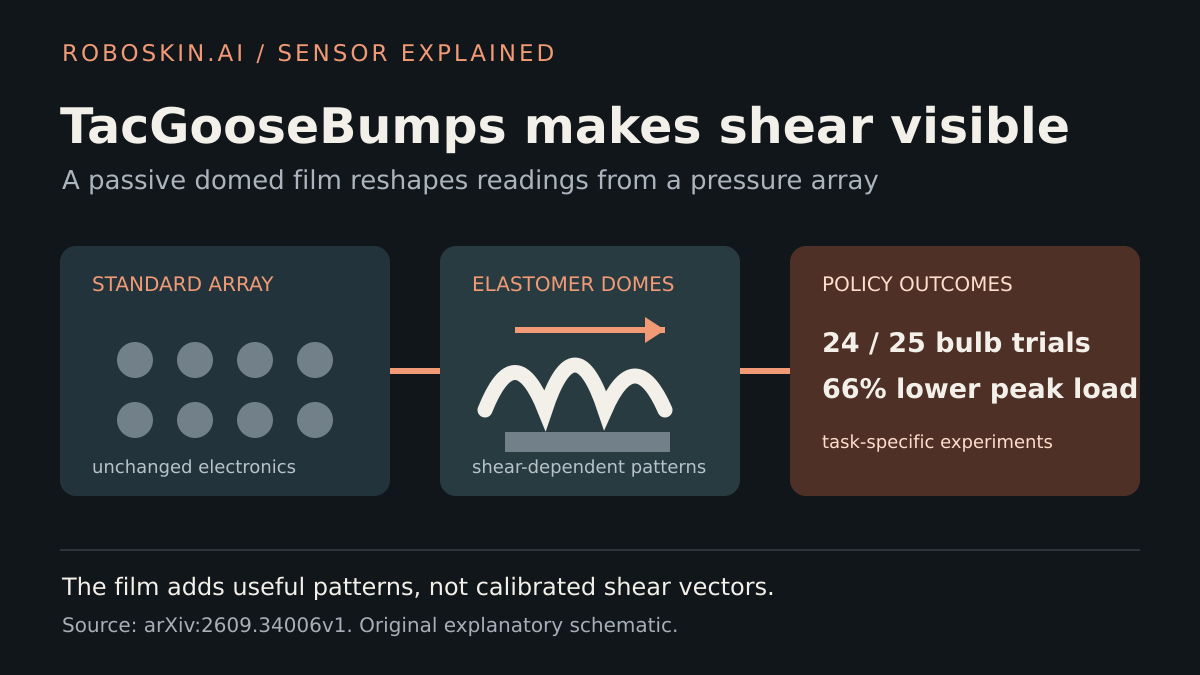
University of California, Berkeley researchers released TacGooseBumps, or TacGB, on September 27, 2026. TacGB is a removable film of elastomeric domes that sits on an existing normal-pressure array. Tangential loading tilts each dome and redistributes pressure across neighboring taxels, giving a learned policy repeatable shear-dependent patterns without new electronics or explicit force reconstruction. Paper and version record.
Key takeaways
- On USB insertion, the bare pressure array succeeds in 15 of 20 rollouts, versus 19 of 20 with an off-the-shelf TacGB layer and 18 of 20 with molded domes.
- On bayonet light-bulb insertion, success rises from 15 of 25 to 24 of 25; the 36-percentage-point gain is measured over 20 nominal and five out-of-distribution trials.
- TacGB does not measure calibrated shear force. It mechanically encodes tangential interaction into a pressure-map pattern that an end-to-end policy may learn.
What changed
Many thin electronic skins primarily report normal pressure. Adding true multi-axis sensing usually requires co-designed structures, electronics and calibration. TacGB instead changes the surface above an existing array. Each dome spans several taxels; shear causes a leading-edge increase and trailing-edge decrease in the native pressure map.
The team tests both molded domes and inexpensive cabinet bumpers. Neither variant needs one-to-one dome-to-taxel registration. Policies receive the same kind of pressure-map tensor as before, so the retrofit changes the observation physics without requiring a new electrical interface. Mechanical design.
Two collection pipelines test the idea. USB and light-bulb insertion use a FANUC LR Mate arm, a rigid gripper and a 32-by-32 commercial capacitive array. Egg transfer and whiteboard drawing use a handheld iPhUMI setup with 12-by-32 open-source FlexiTac arrays and a compliant robot gripper.
Results beyond binary success
For USB insertion, the researchers collect 100 demonstrations for each of three surfaces: bare, off-the-shelf TacGB and molded TacGB. Each policy receives the same 20 deployment initializations. Success is 75%, 95% and 90% respectively. Mean time among successful trials decreases from 29.3 seconds to 27.1 and 26.7 seconds. A surface-only control, where the robot wears the domes but the policy does not receive their pressure maps, does not reproduce the gain.
For the bayonet light bulb, the off-the-shelf layer raises total success from 15/25 to 24/25. Nominal trials improve from 13/20 to 20/20, while the five changed-height/free-rotation trials improve from 2/5 to 4/5. Those five out-of-distribution episodes are too few for a stable standalone percentage, so the article preserves the counts. Insertion evaluation.
Egg transfer exposes a limitation of binary success. Both policies complete 25/25 rollouts, yet two eggs in the bare-sensor condition develop visible cracks. An external cup sensor—not an input to the policy—shows mean peak readout falling 66%, from 0.77 to 0.26, while mean contact-transfer duration rises from 0.99 to 3.84 seconds with TacGB. These readings are an external load proxy, not calibrated impact force.
On whiteboard drawing, each policy is evaluated over 20 rollouts. TacGB improves ink coverage and reduces perpendicular path deviation, supporting the claim that the encoded signal helps with sustained two-directional contact as well as discrete insertion states.
What this means for robotics
RoboSkin analysis: TacGB demonstrates a useful middle layer between sensor hardware and learned representation. If a policy needs a repeatable cue rather than a calibrated wrench, mechanical preprocessing may be cheaper than redesigning the sensor stack. This is particularly relevant to robot skin systems where thickness, wiring and integration time are hard constraints.
The engineering caveat is equally important. Pattern separability can help a policy while remaining unsuitable for safety limits, force control or comparison across sensors. A dome layer may also change friction and compliance; the paper's surface-only controls reduce that concern for the tested tasks but do not eliminate it across materials and geometries.
Limitations and availability
TacGooseBumps is an arXiv v1 preprint, and RoboSkin.ai has not reproduced it. Repeated deployment rollouts reuse a trained policy and therefore do not measure variability across independently trained seeds. The authors explicitly call for studies that vary dome geometry, material and layout while separating training, object and rollout variation.
No official project page, public code repository, CAD or mold files, training data, checkpoints or software license was verified. The paper demonstrates off-the-shelf and lab-made surfaces, but it does not yet provide a packaged bill of materials or a calibrated shear-transfer function.
Sources and related resources
Continue the topic