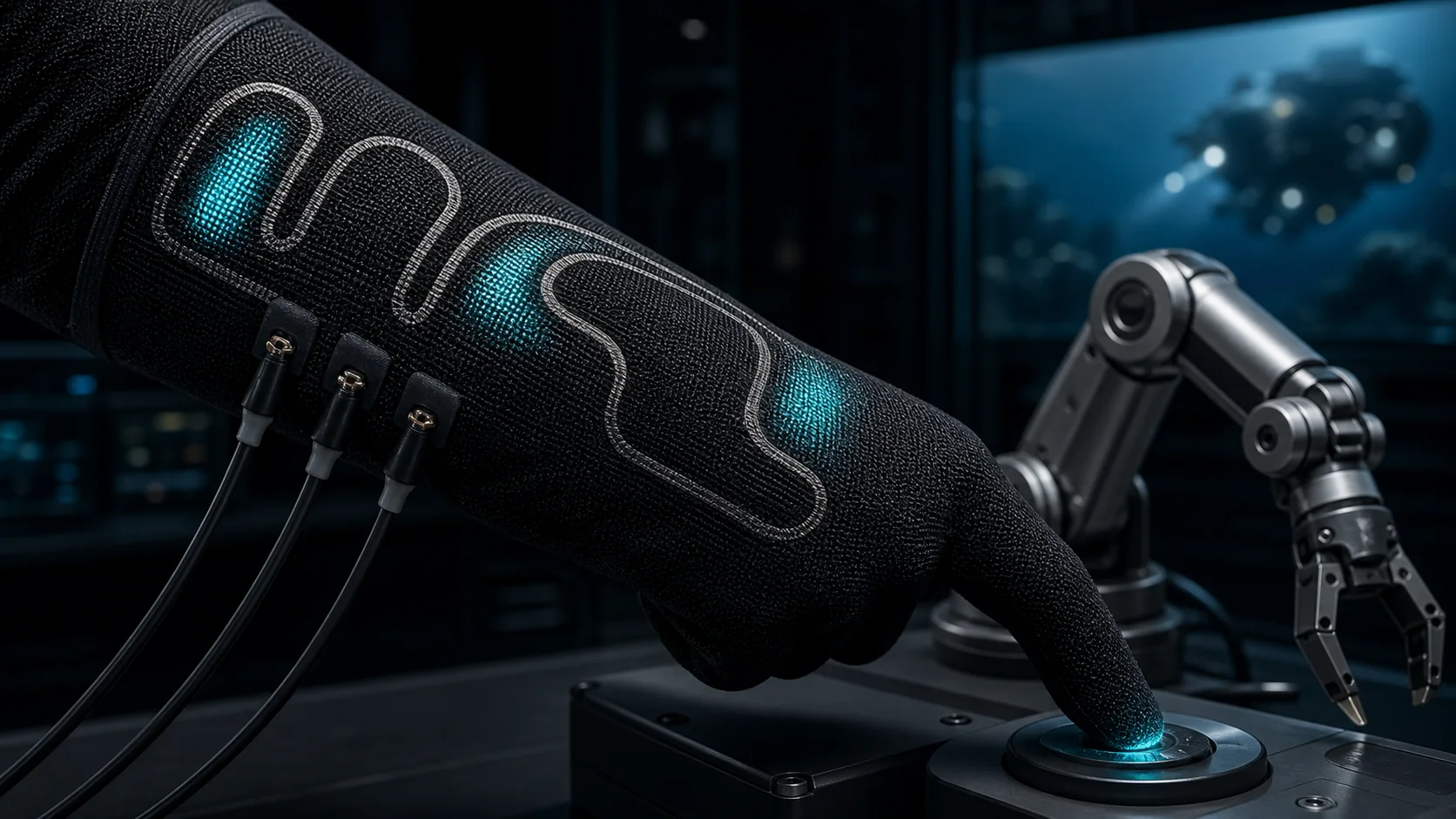
A single-element tactile sensor separates pressure from tackiness
A soft magnet and one Hall sensor generate opposite-polarity signals for compression and pull-off, enabling continuous pressure and tackiness tracking.
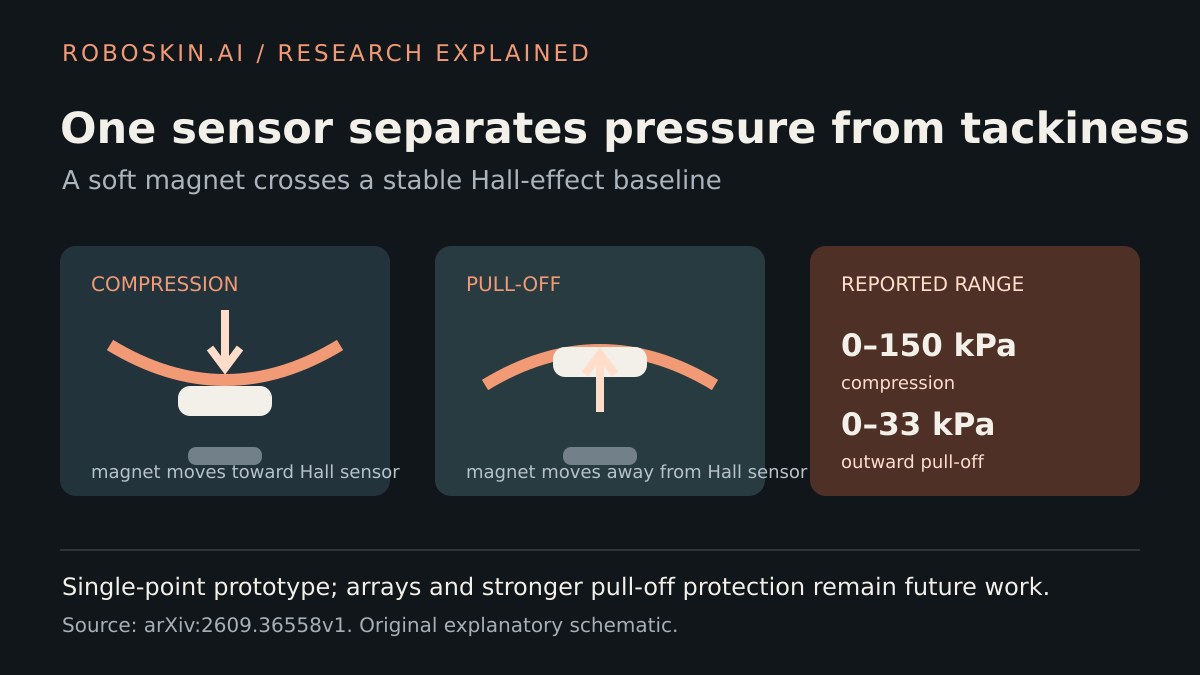
Researchers at Sun Yat-sen University and Helmholtz-Zentrum Dresden-Rossendorf released a single-element tactile sensor for concurrent pressure and tackiness measurement on September 29, 2026. A soft magnet moves toward one Hall sensor during compression and away from it during adhesive pull-off, putting the two force directions on opposite sides of a stable electrical baseline. The authors report ranges of 0–150 kilopascals for pressure and 0–33 kilopascals for outward pulling stress. Paper and version record.
Key takeaways
- One magnet and one Hall element track inward pressure and outward pull-off at the same contact location; signal polarity separates the two modes without a learned decoder.
- Reported response/recovery times are 33.2/33.5 milliseconds for pressure and 21.8/10.3 milliseconds for outward pull-off under the paper's laboratory setup.
- The sensor survives more than 50,000 cycles near 63 kPa pressure and repeated robot touch tests, but the authors say its replaceable upper layer can still fail under large pull-off loads.
What changed
Tackiness is not the same as friction or normal pressure. Measuring it requires monitoring the whole press-and-retract sequence: contact pressure, dwell time, retraction speed, peak pull-off stress and sometimes the energy dissipated before separation. Stacking separate sensing layers can introduce cross-talk, while a pressure-only skin loses the tensile half of the interaction.
The reported device uses an elastic polydimethylsiloxane structure. A 0.3-millimeter membrane carries a soft neodymium-iron-boron/PDMS magnet above a fixed Hall sensor. Compression reduces their distance and raises the measured magnetic signal; adhesive pull-off bulges the surface outward and lowers it. A PDMS-filled melamine sponge extends the pressure range by adding compressive resistance. Design and experiments.
This is a single-point prototype, not a spatial skin array. Its value is the shared transducer and baseline-separated waveform. The researchers vary membrane support height and magnet thickness to trade sensitivity against range, then choose a configuration that accommodates both compression and tensile deformation.
Characterization and robot demonstrations
The optimized sensor covers 0–150 kPa compression and 0–33 kPa pull-off stress. The paper reports a stable no-load baseline over ten hours, more than 50,000 loading/unloading cycles at roughly 63 kPa and 5,000 pull-off trials. Hammer strikes did not damage the tested device or erase its ability to detect a lightly contaminated finger. These are author-run laboratory tests, not a standardized independent durability certification.
The response-time test uses a 6-volt sensor supply, while most characterization uses 5 volts and robot demonstrations use 2 volts. That matters because the paper also notes that sensitivity changes with supply voltage. Range and timing figures should therefore be read as properties of the reported configurations, not universal ratings for every integration.
For manipulation, the team mounts the sensor on a two-finger electric gripper attached to a commercial arm. Scripted grasps distinguish a clean bottle from one carrying double-sided tape: the contaminated object produces a pull-off signal and triggers another grasp attempt at a clean area. A separate robot-hand demonstration touches seven PDMS samples with different base-to-crosslinker ratios. Three runs reproduce their tackiness order at fast retraction speed.
What this means for robotics
RoboSkin analysis: the device adds a contact property that most electronic skins do not expose. A gripper may need to know not only that contact exists but whether a lightweight object will remain attached after opening. The opposing-polarity signal is also attractive for embedded systems because separation does not depend on a complex multimodal inference model.
Pull-off amplitude is not a complete material label, however. At slower separation speeds, the stickiest PDMS sample produces a lower peak than expected but the greatest separation energy. The paper concludes that integrating the full force-distance curve can be more accurate than ranking surfaces by peak pull-off alone. Robot software would therefore need controlled contact conditions or richer temporal features for reliable material comparison.
Limitations and availability
This work is an arXiv v1 preprint, and RoboSkin.ai has not reproduced it. Robot motions are predefined, and the manuscript does not report repeated end-to-end task success rates. The present device is one sensing element with commercial Hall packaging. The authors describe miniaturization and arrays as future work.
Large adhesive loads can damage the upper structure despite its compression durability; replacement is possible, but the design is not yet maintenance-free. The arXiv record and manuscript were accessible during verification, while no official project page, fabrication repository, CAD package, raw dataset or implementation license was identified.
Sources and related resources
Continue the topic