RADMCS steers scuba divers with low-thrust haptic cues
A tank-mounted wearable robot uses two underwater thrusters as directional haptic cues, but its wall-following behavior depends on a distance estimate that failed in one documented run.
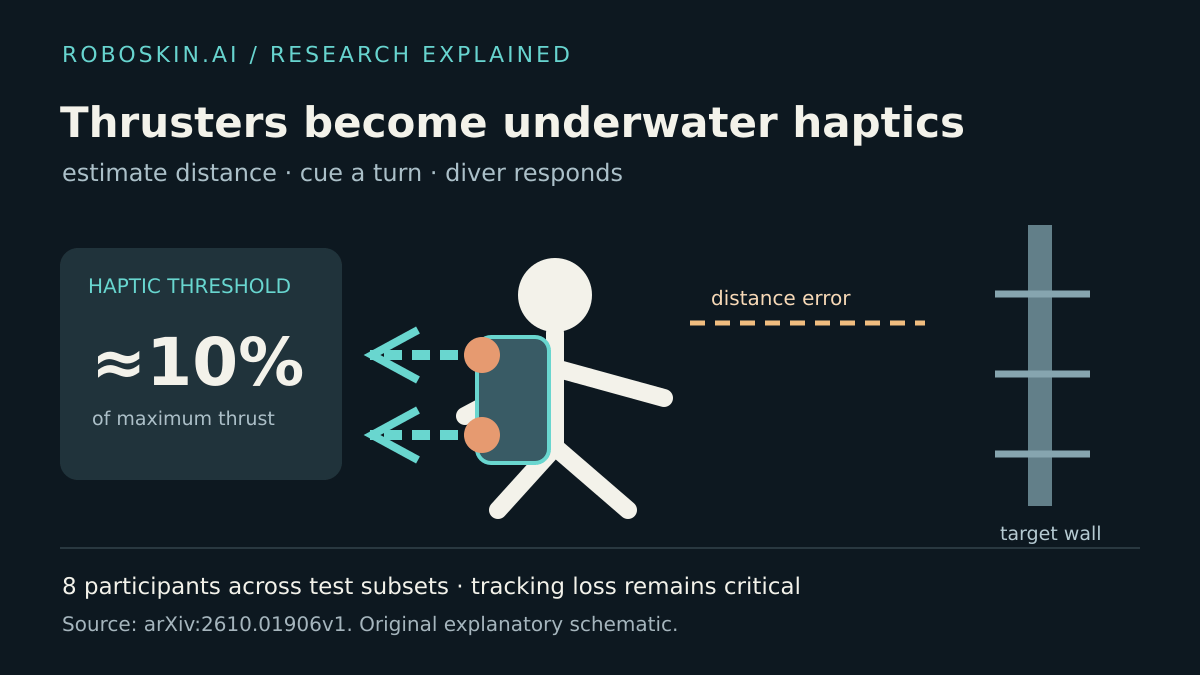
University of Minnesota researchers Demetrious T. Kutzke and Junaed Sattar released RADMCS on October 1, 2026, a wearable underwater robot that straps to a scuba tank and uses two thrusters to cue a diver to turn toward or away from a surface. An IRB-approved study involved eight participants across several pool and ocean tests. The most stable quantitative finding is perceptual: approximately 10% of maximum thrust was enough to produce detectable motion in the tested configurations. Paper and version record.
Key takeaways
- RADMCS is a haptic navigation aid, not a propulsive exoskeleton: its thrusters perturb the diver so the diver responds with their own motion.
- Pool threshold tests use four participants split across three thruster configurations; ocean threshold tests use two participants in two configurations.
- A seven-participant pool wall-following study exposes a critical dependency: when visual distance estimation is lost, the last thrust command can persist.
From camera distance to physical cue
RADMCS carries two Blue Robotics T200 thrusters in either longitudinal or transverse arrangements with 225 mm or 325 mm spacing. A camera estimates distance to a target surface. After exponential filtering and a dead zone, the controller maps distance error to differential thruster commands. The tested setup uses a practical sensing range of 1.5 m and clips larger errors.
The mechanism deliberately closes the loop through a person. A positive or negative thrust moment asks the diver to yaw; it does not autonomously translate the diver to a coordinate. That distinction matters for haptic interfaces: the relevant output is a perceivable, directional body cue, not robot trajectory accuracy.
What the participant study shows
Eight divers participated overall, but not every person completed every test. In the pool, two participants tested the 225 mm longitudinal and transverse layouts, while two different participants tested the 325 mm transverse layout. Facility time prevented collection for the 325 mm longitudinal configuration. Participants were neutrally buoyant at 1.8 m depth and reported when they first perceived the force during ascending and descending PWM sweeps.
Open-water threshold testing used two participants, 5 m from shore at 1.5 m depth, with both 325 mm layouts. Despite 0.25–0.5 m wave-height variation, the reported perceptible level again clustered around 10% of maximum thrust. The authors explicitly leave two explanations unresolved: divers may have confused environmental motion with robot feedback, or the device may couple strongly enough that directional cues remain distinct.
The closed-water distance-maintaining test used seven participants wearing blackout masks beside a 7 m tarp carrying AprilGrid targets at 1 m intervals. In one illustrated run, participant P2 completed the course in 89.89 s while responding to left and right cues. In the P8 example, distance estimates disappeared at about 12 s and never recovered; the controller retained a high left-turn command until the 43.28 s run ended. The paper therefore supports guided movement when the estimate is stable, not robust autonomous wall following under arbitrary underwater vision.
RoboSkin analysis
RADMCS is a useful counterexample to the idea that more force always makes a haptic cue better. A low, detectable threshold can conserve power and reduce intrusive motion, but perception reliability becomes the dominant safety constraint. The controller needs an explicit stale-signal policy before the device can be treated as a dependable wearable robotics platform.
The sample structure also matters. “Eight participants” is the union of the study, not the denominator for every result. Threshold findings, wall-following examples and a form-fit test come from different subsets. Reporting those boundaries keeps a promising prototype from sounding like a validated navigation product.
Limitations and availability
This is an arXiv v1 preprint, not an independently validated dive system, and RoboSkin.ai did not test it. The paper reports a qualitative ocean form-fit trial with one participant at up to 80% thrust. The apparatus shifted, moved regulator hoses forward and created a painful pinch point near the participant's head. Those observations are design constraints, not cosmetic issues.
Distance sensing used structured AprilGrid targets rather than natural reef geometry for the pool control study. The tarp warped in circulation currents, autofocus affected measurements, and one documented run preserved an unsafe stale command after tracking loss. The manuscript is available under CC BY 4.0. No official code repository, CAD package, dataset or software license was verified.
Sources and related resources
Continue the topic