A stretchable membrane lets a delta array manipulate sub-pitch objects
A nylon-spandex membrane couples 64 three-axis delta robots into a continuous surface, removing actuator spacing as a hard object-size floor.
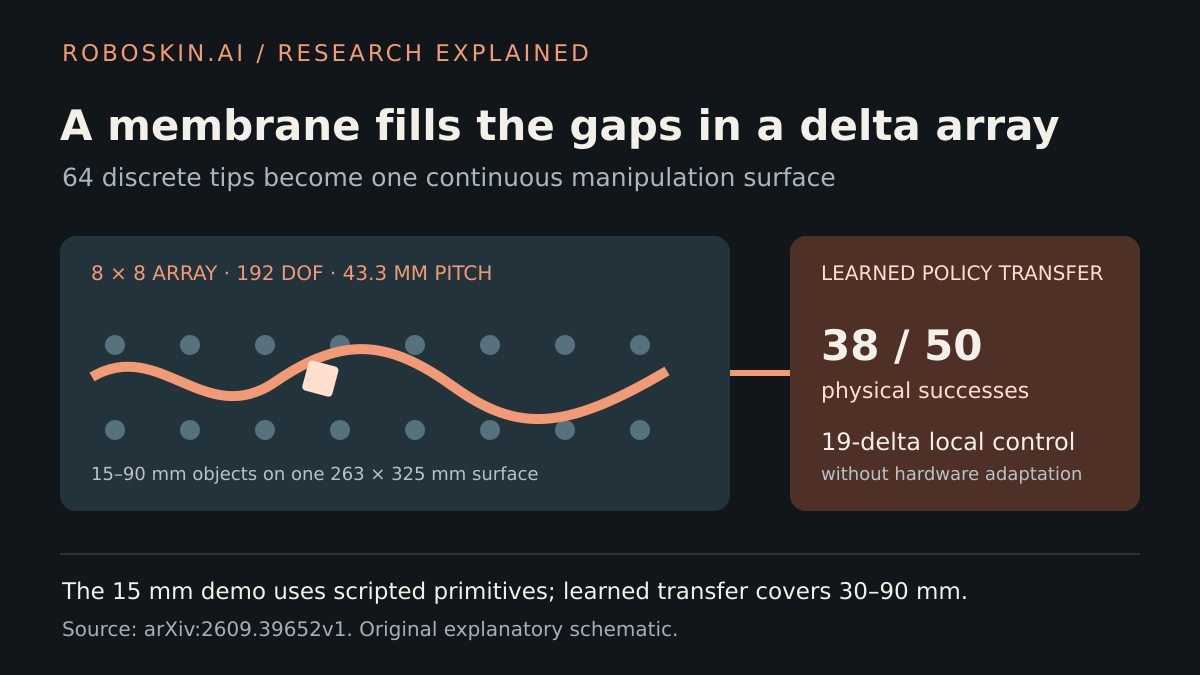
Researchers spanning IT University of Copenhagen and Carnegie Mellon University released a membrane-coupled delta array on September 30, 2026. The prototype links an 8 × 8 grid of three-degree-of-freedom delta robots with stretchable fabric, turning 64 discrete supports into one deformable contact surface. It manipulates objects from 15 to 90 millimeters on hardware even though neighboring actuators are 43.3 millimeters apart. Paper and version record.
Key takeaways
- Sixty-four delta robots provide 192 controlled degrees of freedom beneath a 263 × 325 mm nylon-spandex membrane.
- Local open-loop primitives route 15 mm cubes, while a learned policy moves five 30–90 mm objects to target positions in 50 physical trials.
- The learned policy reaches 76% hardware success versus 100% for identical start-goal cases in simulation; fine placement remains the main transfer gap.
What changed
Distributed manipulation arrays normally require an object to bridge several actuators. Their center-to-center spacing therefore becomes a lower limit on object size. This design inserts a continuous interface: an 80/20 nylon-spandex sheet, 0.4 mm thick, mounted at neutral strain across the actuator tips. Small objects rest on the fabric between tips rather than falling through the grid.
Each delta uses three 100 mm-stroke linear actuators, a compliant TPU/PETG parallel mechanism and position feedback. Sixteen modular 2 × 2 units form the full array. Four 1080p cameras running at 30 frames per second track objects with OpenCV image moments and AprilTags. The fabric can be relaxed to cradle an object or stretched to create local slope, curvature and strain. Hardware and control details.
The authors describe the surface as a displacement field rather than 192 independent motors. Quasi-static fields tilt, translate, dilate or bend the membrane. Cyclic fields create traveling waves. Local cell primitives can move several sub-pitch objects concurrently, while larger objects use a neighborhood of tips for translation and rotation.
From 192 motors to a compact action space
Directly exploring 192 actuator coordinates destabilized the simulated soft body. The learned controller instead acts on low-order discrete cosine transform coefficients. It commands either the whole array or a ring around the tracked object. All policies train for one million MuJoCo steps and are evaluated over 392 held-out episodes covering 49 EGAD shapes.
A 19-delta neighborhood using three-axis motion reaches 95.1% simulation success, with a 3.5 mm median final error and 8.4 mm 90th-percentile error. The whole-array controller reaches a similar 93.5%, but its median and 90th-percentile errors are 6.5 and 14.2 mm. Thus “halves the placement error” refers to the median changing from 6.5 to 3.5 mm, a 46.2% reduction, not a doubled success rate.
For physical transfer, the 19-delta policy is deployed without adaptation on five objects sized 30, 45, 60, 75 and 90 mm. Each receives ten start-goal trials, and the identical cases are replayed in simulation. Hardware succeeds on 38/50 trials, or 76%; simulation records 50/50. Mean final error is 19.4 mm on hardware versus 3.46 mm in simulation.
What this means for contact hardware
RoboSkin analysis: the membrane is not a sensor, but it behaves like a mechanically continuous contact layer. It fills the spatial gaps between actuators, much as robot skin fills sensing gaps across a body. That suggests an engineering pattern in which a compliant interface performs useful spatial interpolation before perception or control software runs.
The paper also points directly to the missing next layer. The learned observation contains object position, goal, actuator state and object size, but no geometry or contact measurement. Concave features sometimes catch on real tips, a failure absent from the convex-hull simulation. Adding tactile sensing at the tips or estimating contact through vision could let the policy distinguish rolling, sliding and snagging instead of treating them as unobserved disturbance.
Limitations and availability
This is an arXiv v1 preprint, and RoboSkin.ai has not reproduced the system. The 15 mm result comes from scripted local primitives; the learned-policy transfer covers 30–90 mm. Hardware trials total 50, with ten per object. The nylon-spandex membrane is nonlinear, anisotropic and subject to wrinkling, boundary loads, motor backlash and manufacturing tolerance. The simulation uses an idealized flex surface and convex-hull collision geometry, which helps explain the fine-placement gap.
The manuscript does not link an official project page, public controller code, MuJoCo environment, CAD package, bill of materials, dataset or implementation license. The arXiv article is CC BY 4.0; no reuse terms were verified for the unreleased hardware or software assets.
Sources and related resources
Continue the topic