Single-material soft robotic skin for multimodal e-skin sensing
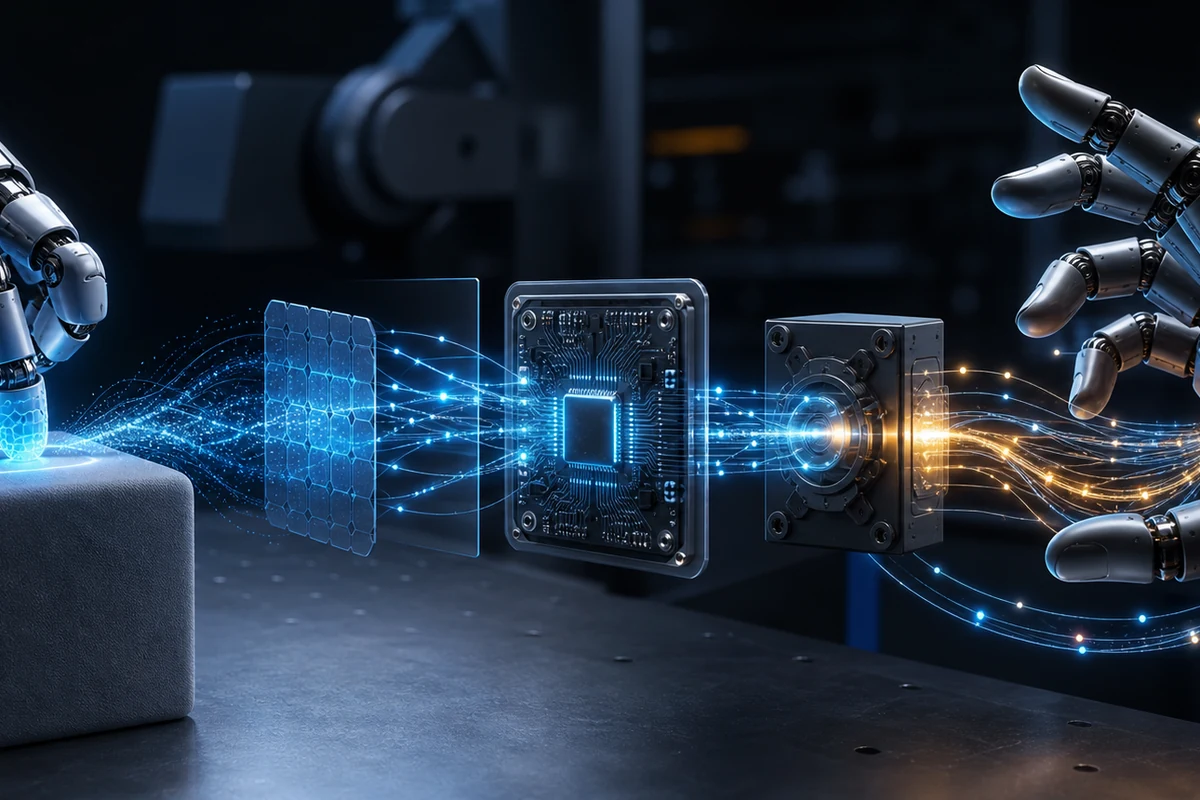
A peer-reviewed single-material robotic skin uses wrist-mounted EIT electrodes and data-driven channel selection to interpret touch, strain, heat, damage, environment, and proprioception across a soft hand.
Updated technical brief - August 2026
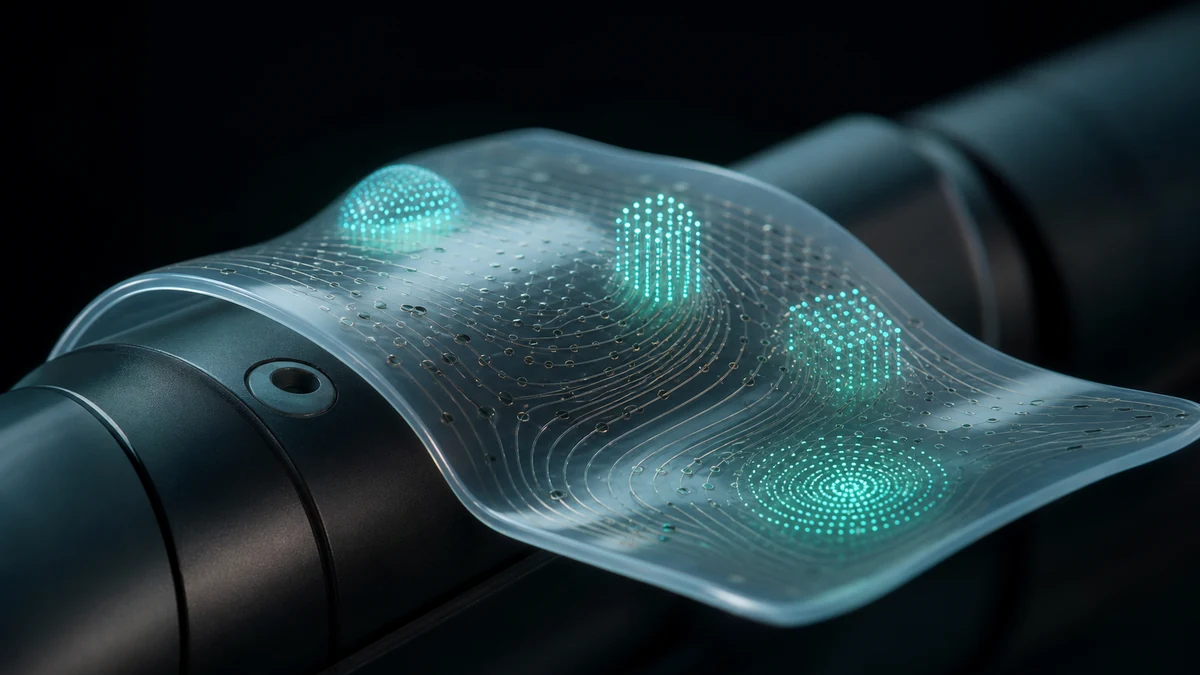
The 2025 Science Robotics paper by David Hardman, Thomas George Thuruthel, and Fumiya Iida reports a single-layer sensory skin made from a conductive gelatine-based hydrogel. The team cast the material as a full-size hollow hand, routed 32 electrodes around its wrist, and used high-density electrical impedance tomography (EIT) plus data-driven information selection to interpret interactions across the continuous surface.
Source findings
The work demonstrates a research architecture for multimodal soft sensing. It does not establish calibrated force magnitude, production durability, or deployment on a working humanoid. The University of Cambridge report identifies improved durability and further testing on real-world robotic tasks as future work.
### What “single-material” means
“Single-material” describes the soft sensing membrane, not the complete measurement system. The hand still requires electrodes, EIT electronics, multiplexing, data collection, and computational interpretation. Its advantage is that the continuous hydrogel surface can respond to several kinds of interaction without embedding a separate rigid sensing unit for each modality.
The paper investigates at least six active stimulus types, including an insulated probe press, single- and multi-location human touch, conductive touch, damage, and localized heating or melting. It also demonstrates environmental temperature and humidity prediction and a proprioceptive response when the fingers are actuated.
These are distinct experimental signals. They should not be collapsed into a claim that the prototype measures a universal physical quantity with calibrated accuracy across arbitrary loads, objects, or robot geometries.
### Electrode configurations are not information channels
The paper reports two related numbers that must remain separate:
| Reported quantity | Value | Meaning |
|---|---|---|
| Physical electrodes | 32 | Electrodes arranged around the wrist of the hydrogel hand. |
| Electrode configurations | 863,040 | Ordered four-electrode excitation and measurement configurations available to the EIT system. |
| Amplitude-and-phase information channels | 1,726,080 | Each configuration yields an RMS amplitude channel and a phase-shift channel. |
The 1,726,080 figure is therefore not a count of electrodes, taxels, independent physical sensors, or simultaneously updated contact points. It is twice the configuration count because amplitude and phase are evaluated separately.
### The scan-rate boundary
The highest and lowest rates in the paper describe different acquisition loads:
- Monitoring all 1,726,080 information channels is reported at a 0.02 Hz frame rate.
- The stated maximum of 33 kHz applies when monitoring one electrode configuration, which produces two information channels.
The paper's information-structuring method selects smaller, setup-specific subsets to trade information coverage against update rate. It would be inaccurate to describe 33 kHz as the full-hand update rate for all available channels.
### What the data-driven layer does
EIT measurements across a continuous conductive body are highly redundant and coupled. Rather than treating every available channel as equally useful, the authors rank and select channels that contain information for a target task. The reported demonstrations include light-touch localization over the hand, environmental temperature and humidity prediction, and finger-actuation proprioception.
This approach moves part of the sensor design problem into experiment design and computation. Electrode placement, excitation configuration, selected channels, environmental drift, training data, and model assumptions all affect the output. Recasting the same material on a different geometry would require new validation rather than inheriting the hand's reported behavior automatically.
RoboSkin analysis
A continuous hydrogel field may simplify soft coverage over complex geometry, but it shifts responsibility into electrode routing, calibration, channel selection, timing, and data interpretation. A conventional taxel array exposes discrete sensing locations. This EIT architecture exposes a distributed electrical field whose useful signals must be learned or reconstructed.
Engineering implications
For system design, the key question is not how many raw channels exist. It is how many task-relevant signals can be acquired at the required control rate, with known calibration and repeatability. The robot skin vs e-skin guide explains the terminology; the ROS 2 tactile sensor pipeline covers timestamps, metadata, and replay once signals leave the sensing hardware.
What this does not prove yet
This is a peer-reviewed experimental study, but it is not a commercial specification or a universal benchmark for robot skin. The evidence comes from the reported hydrogel samples, electronics, channel-selection procedures, and hand geometry. The study does not establish long-duration abrasion resistance, cleaning tolerance, attachment to a moving robot, replacement calibration, production yield, or closed-loop task performance on a deployed humanoid.
The Cambridge research story explicitly says the team hopes to improve durability and conduct further real-world robotic-task tests. Those remain future-work boundaries, not demonstrated deployment claims.
Practical questions
- Does 1,726,080 mean physical sensors? No. It is the count of amplitude and phase channels derived from 863,040 four-electrode configurations.
- Does the complete hand update at 33 kHz? No. That maximum applies to one configuration; scanning all available channels is reported at 0.02 Hz.
- Does the paper establish calibrated force measurement? No. It demonstrates data-driven interpretation of touch or press interactions, strain-related proprioception, environment, damage, and local heating in the reported setup.
- Is the skin ready for a humanoid robot? The paper demonstrates a full-size soft hand-shaped sensing surface, not whole-body integration or real-world humanoid-task validation.
Source boundary
This review uses the peer-reviewed Science Robotics article, the author-accepted manuscript in the University of Cambridge repository, and the official University of Cambridge research story. Numerical values belong to the authors' reported hardware and protocols. RoboSkin.ai did not reproduce the experiments and is not affiliated with the authors, Cambridge, UCL, or Science Robotics.
Primary and official sources
Continue the topic