TouchScale dataset: separate the 500-hour study from available data
The November 2 paper revision supports a timely dataset review. The study corpus, currently described release and robot action labels require separate checks.
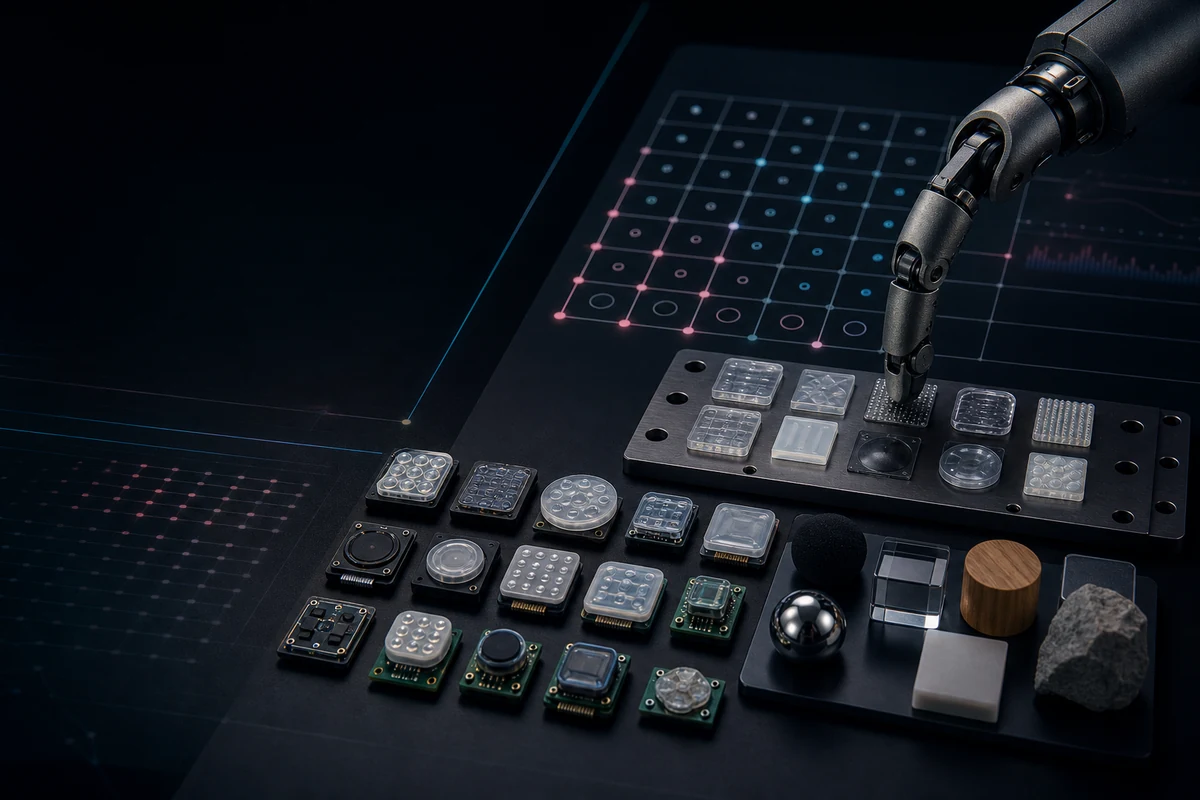
TouchScale pairs human visual observations with touch for representation and robot-learning research. Its November 2 paper revision describes a 500-hour study corpus, while the public dataset card checked on November 8 still describes a 100-hour release. Plan around the artifact you can access and inspect, not just the number in the paper title.
What the sources currently say
The v3 paper studies synchronized human vision and touch, with downstream robot evaluation limited to one platform and four manipulation tasks. It explicitly says the human dataset does not include action labels. Human tactile supervision and robot action supervision therefore remain different resources.
The public data-card page describes 100 hours and 15,324 episodes, labels the data CC BY-NC 4.0, and requires acceptance of access conditions. Its stated plan to release all 500 hours before November is not evidence that the full release occurred. The host API reported revision 74914cc2e11d0a7f37ddbe5d57db4fe4e14a0a7e, but the revision-specific README required authentication. We inspected public metadata only and did not accept conditions or download gated payloads.
Make the release scope part of the experiment
RoboSkin analysis: write three separate entries in your experiment record: the paper's collection, the provider's described release and the episodes your loader actually decodes. If those quantities differ, retain all three. Replacing the paper total with a subset total can misdescribe the study; replacing the subset total with the paper total can misdescribe your training data.
| Decision | Evidence to retain |
|---|---|
| Can we obtain the data? | Host, access conditions, exact revision and the observed access result |
| Can we reuse it for this project? | Dataset terms and any separate code, model or asset terms |
| Can our pipeline read it? | One complete decoded episode, field meanings, timestamps and missing values |
| Can it train our policy directly? | Actual action labels or a documented additional robot-training stage |
The TouchScale directory record keeps these distinctions visible in the same comparison and export workflow used for other datasets. It is an evidence record, not a mirror of the gated files.
Human observations are useful without being robot commands
Contact observations can support representation learning or an intermediate prediction objective. A robot policy also needs an action target that matches its embodiment and controller. Do not silently rename human motion, task descriptions or contact maps as robot actions to satisfy a loader's schema.
Before adapting a trainer, list which inputs and targets already exist and which must come from another source. Preserve the provenance of any inferred target. If robot demonstrations are added later, record their collection protocol separately; a successful run on the combined pipeline should not be attributed to the human dataset alone.
Design a comparison that answers your question
To investigate the value of tactile supervision, hold the downstream task and evaluation conditions fixed. Compare a baseline against the additional training stage and record the data actually used. If your access covers a subset, describe that experiment as a subset experiment rather than a reproduction of the full study.
Reserve complete sessions or other appropriate collection groups for evaluation, and inspect the split for repeated interactions. Report failures and missing channels alongside successful episodes. A larger advertised corpus cannot compensate for a split that allows nearly identical observations into training and evaluation.
What to check next
Recheck the host for a changed release manifest, pin that revision and inspect a permitted sample before scaling a download. Keep access permission distinct from license suitability; an accepted access request does not remove noncommercial restrictions.
For format preparation, use the LeRobot dataset guide as a schema checklist, without assuming TouchScale is already a compatible robot-action dataset. For the control question, read tactile manipulation. Our review establishes what the public sources state and what remains unverified, not a reproduced model result or a guaranteed transfer benefit.