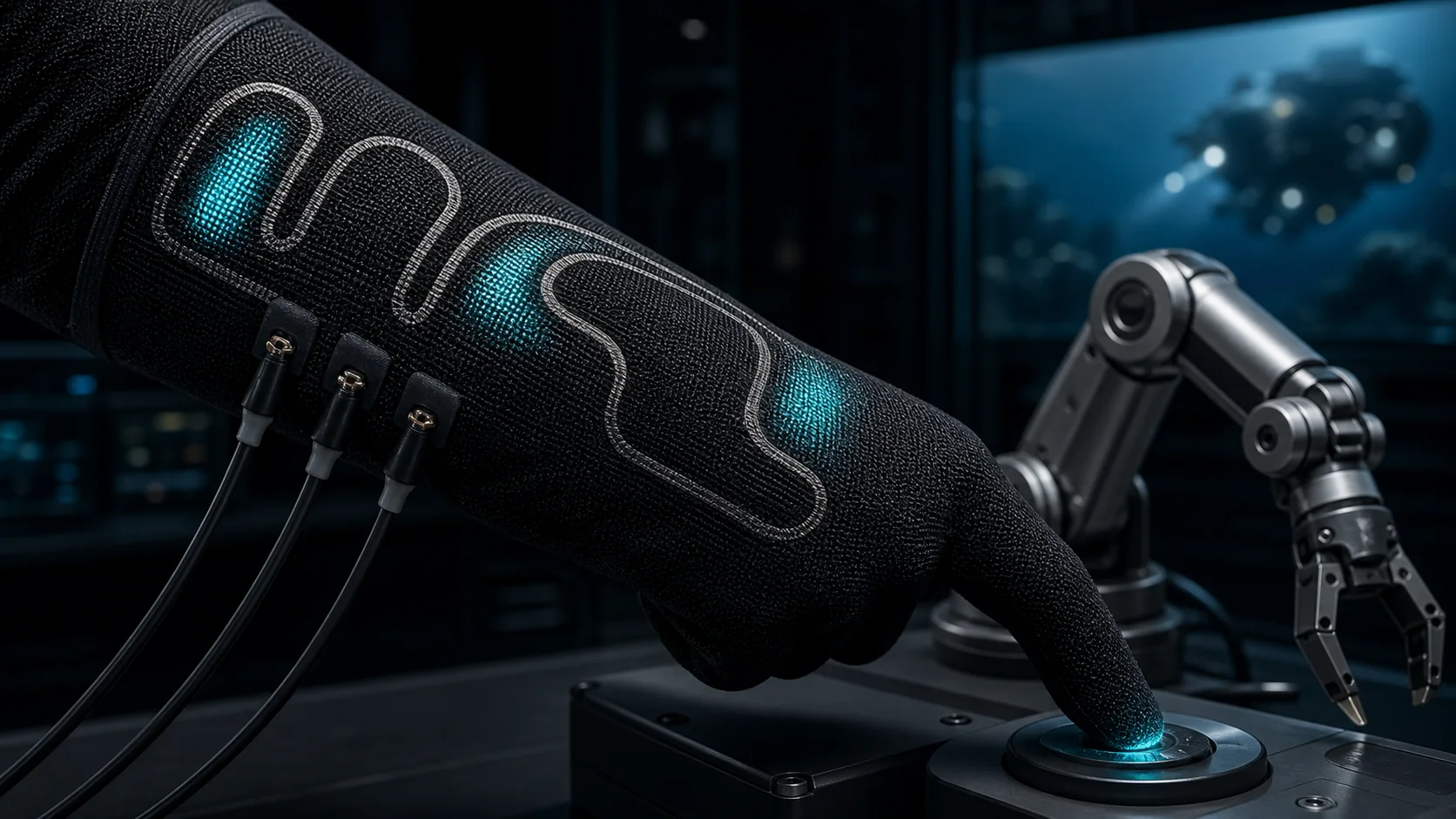
Single-pixel tactile skin targets the wiring bottleneck in large-area robot touch
A flexible 10 x 10 tactile array uses compressive sampling and one summed output channel to reduce wiring and readout demands for responsive robot skin.
News brief - July 2026
A Communications Engineering paper presents Single-Pixel Tactile Skin, a flexible tactile array that applies compressive sampling in hardware. Instead of reading every sensing element independently, the array combines programmable weighted signals into one output channel and reconstructs tactile images from repeated global measurements.
What the paper reported
The prototype uses a flexible, daisy-chainable 10 x 10 array. Each sensing element applies a programmable analog weight, and the pixel currents are summed into a single channel. Sparse-recovery methods then reconstruct the contact image.
In the reported experiments, the system achieved at least 98% object-classification accuracy with 20 measurements, corresponding to an effective 3,500 frames per second. It also captured an 8 millisecond projectile impact in 23 reconstructed frames. The authors describe progressive reconstruction: a robot can localize contact from fewer measurements and refine the image as more data arrives.
Why this matters for robot skin
Large-area tactile skin creates a scaling problem. More sensing points usually mean more wires, more readout channels, more bandwidth, and more failure points. A body-scale sensor cannot be evaluated only by sensitivity at one pixel; the data path must also remain practical as coverage grows.
Compressive sampling changes the trade-off. Rather than demanding a complete raster scan before acting, the system can use a coarse early estimate and improve it over time. That is relevant to robots that need a fast contact location first and detailed contact shape second.
What this does not prove yet
The publisher labels the current article as an unedited early version. The reported classification and impact results are specific to the prototype and experimental setup. They do not yet prove performance on full robot bodies, in cluttered environments, or after long-term mechanical wear.
The architecture also introduces reconstruction assumptions and distributed electronics at each sensing element. Wiring is reduced, not eliminated, and teams would still need to evaluate power, synchronization, fault isolation, calibration, and latency in a complete robot.
Where this fits next
The robot skin definition guide explains why body coverage changes the sensing problem. The ROS 2 tactile data pipeline adds the software side: timestamps, message structure, recording, and replay after tactile data leaves the surface.
Practical questions
- What is the single pixel? It refers to the shared output used to reconstruct the array, not a skin with only one physical sensing location.
- Why use compressive sampling? It can recover useful spatial information from fewer global measurements than a complete point-by-point scan.
- What should be tested next? Larger arrays, multiple simultaneous contacts, damaged pixels, long-term drift, controller latency, and robot-scale integration.
Source boundary
This brief summarizes the published paper and adds RoboSkin.ai systems context. All quantitative results belong to the cited study and have not been independently reproduced by RoboSkin.ai.
Sources
Continue the topic