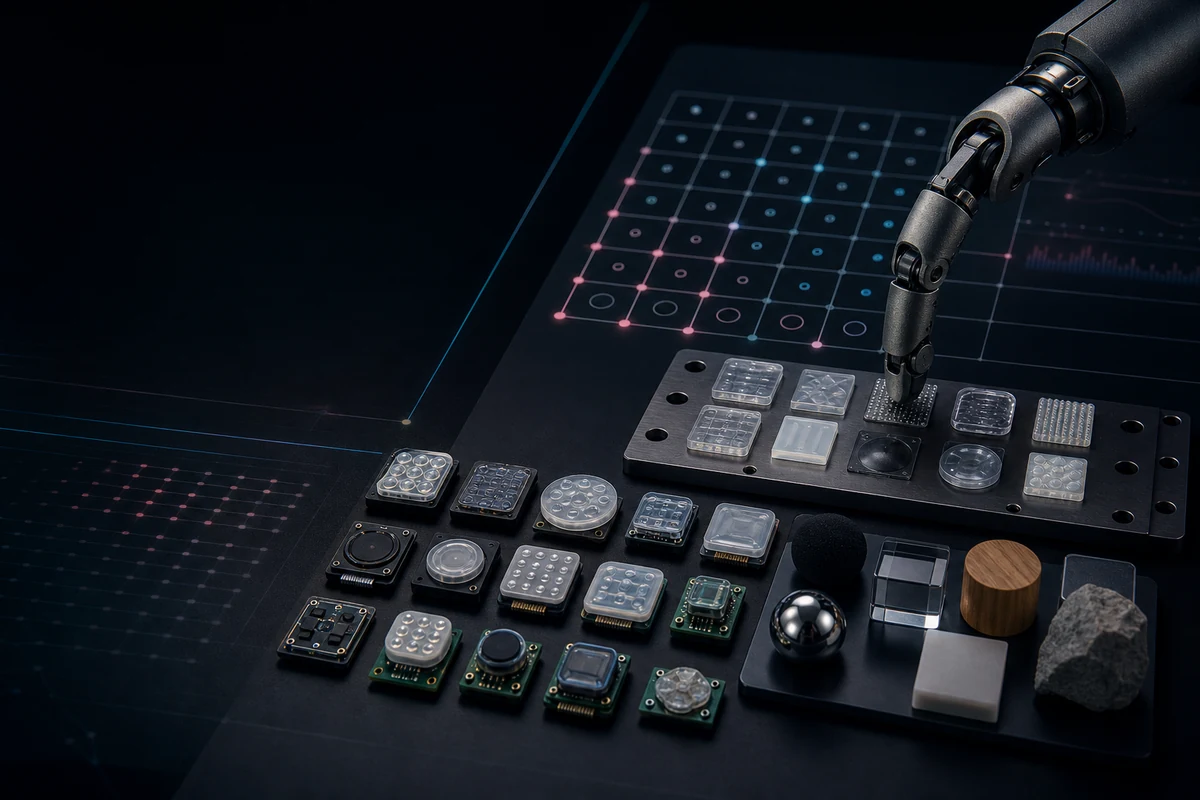
DexSkin and high-coverage conformable robotic skin for manipulation
A practical research note on DexSkin, conformable capacitive e-skin, high-coverage tactile sensing, calibration transfer, and contact-rich manipulation learning.
Updated technical brief - June 2026
Why this source matters
Many tactile sensors are strong at one contact patch but weak at coverage. Robot skin needs something different: a sensing surface that can wrap around useful geometry and still provide localized, repeatable signals. The DexSkin preprint is useful because it puts coverage, conformability, calibration, and robot learning in the same discussion.
The authors describe DexSkin as a soft conformable capacitive electronic skin. In the reported gripper integration, the skin covers almost the entire surfaces of parallel-jaw gripper fingers. The research then evaluates whether that coverage helps contact-rich manipulation tasks and whether calibration can support transfer across sensor instances.
Core idea
DexSkin points toward a practical robot skin design question: where does contact actually happen? A flat fingertip pad may miss side contact, rolling contact, edge contact, or accidental contact. A higher-coverage skin can expose more of the contact story to a learning system.
| Design issue | Why it matters | DexSkin relevance |
|---|---|---|
| Surface coverage | Contact may happen around sides and curved regions | Conformable skin around finger geometry |
| Localized readings | Learning systems need where contact occurs | Addressable tactile signals |
| Calibration | Data-driven policies need consistent inputs | Sensor instance calibration and transfer |
| Contact-rich tasks | Manipulation often depends on hidden touch | Learning from tactile feedback |
Why high coverage changes manipulation
Vision is often blocked during manipulation. Once a robot finger touches an object, the camera may no longer see the contact patch. Tactile coverage becomes the missing evidence layer. If the skin covers only a small front pad, the policy may miss side pressure or a changing contact edge. If the skin covers more of the finger, the policy can receive richer contact information.
The source discusses manipulation tasks such as in-hand object reorientation, elastic band wrapping, and delicate object handling as examples for learning with tactile feedback. For RoboSkin.ai, the editorial value is not the task list by itself. The value is the connection between skin coverage and what a policy can learn.
Calibration and transfer matter as much as sensitivity
A high-coverage skin produces more data. That is useful only if the data is stable enough to compare across trials and hardware instances. Calibration is therefore not a secondary detail. It is part of the robot skin product concept, even when the source is a research prototype.
For a robotics reader, the practical test is whether a model trained with one skin instance can still work after replacement or recalibration. If every new sensor requires a full new training campaign, the system becomes hard to scale. DexSkin is useful because it makes this scaling problem visible.
| Reader question | Why it matters |
|---|---|
| How much of the useful contact surface is covered? | Coverage determines what contact signals exist |
| How are taxels calibrated? | Calibration determines whether readings are comparable |
| Can policies transfer across skins? | Transfer determines maintenance cost |
| What blind spots remain? | Blind spots become manipulation failure modes |
Evaluation checklist
- Check which robot morphology was actually tested.
- Compare coverage claims against blind spots, seams, and cable exits.
- Ask whether the tactile readings are used directly or processed into features.
- Separate sensor characterization from manipulation performance.
- Look for transfer across sensor instances, not just repeated trials on one unit.
- Treat preprint results as research context until peer review and broader replication are available.
What not to infer
DexSkin should not be read as proof that conformable robot skin is solved for all dexterous hands. The reported system is a research implementation, and the source itself discusses limits around tested morphology and remaining blind spots. Different robot hands, grippers, surface materials, and tasks would need their own validation.
For RoboSkin.ai, the useful lesson is specific: high-coverage robot skin should be evaluated by contact coverage, calibration effort, transfer between hardware instances, and learning value. A page that only says "more skin area" is not enough.
Source
arXiv: DexSkin: High-Coverage Conformable Robotic Skin for Learning Contact-Rich Manipulation
Continue the topic