Full-hand tactile sensing moves robot hands beyond vision-only control
New research in full-hand tactile sensing shows why dexterous robot hands need distributed touch, not just cameras and joint feedback.
News brief - June 2026
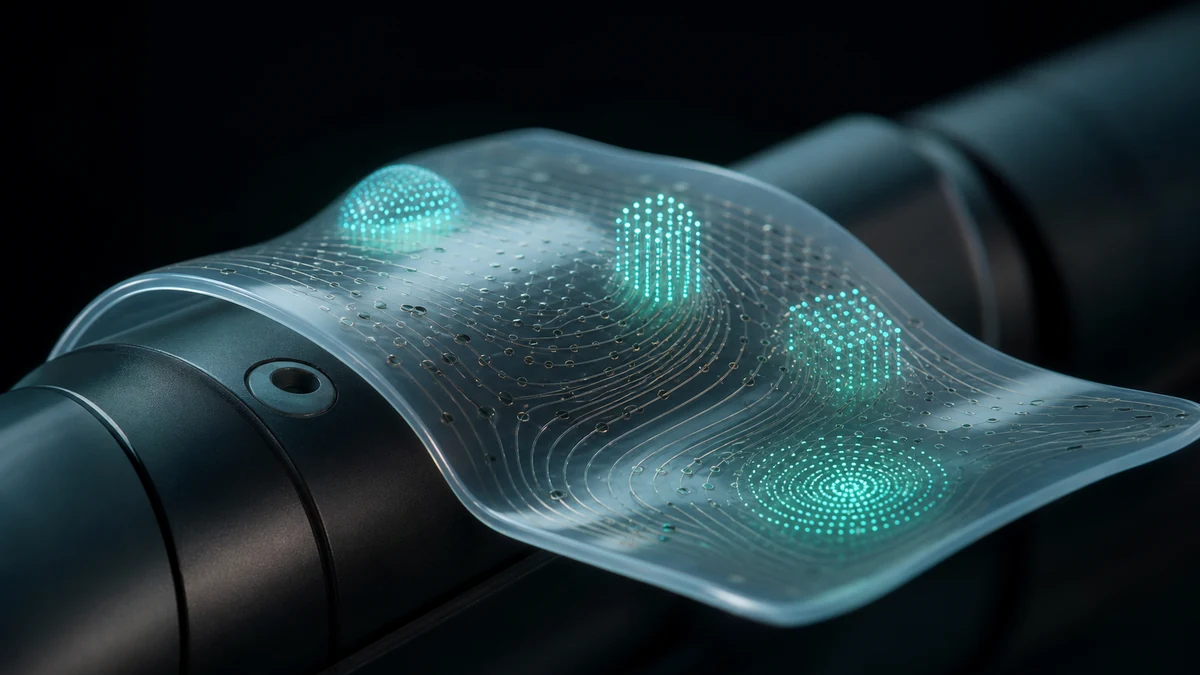
Robot hands are getting better mechanically, but dexterous manipulation still depends on feedback from contact. A 2025 Nature Machine Intelligence study presented F-TAC Hand, a biomimetic robot hand with high-resolution tactile sensing across 70% of its surface.
The reported system used 0.1 mm spatial resolution and integrated 17 vision-based tactile sensors across six configurations. It preserved human-like hand motion with 15 degrees of freedom and the ability to perform all 33 human grasp types referenced in the study.
The key result is not the hardware specification alone. The researchers evaluated the system across 600 real-world trials and reported that tactile-informed control significantly outperformed non-tactile alternatives in complex manipulation tasks. That matters because real execution often breaks ideal grasp plans: objects shift, collide, rotate, or behave differently than expected.
Meta FAIR's tactile AI work points in the same direction. Meta Sparsh was trained on more than 460,000 tactile images and evaluated across six touch-centric tasks. Meta also introduced Digit 360, a tactile fingertip with more than 18 sensing features, force detection down to 1 millinewton, and an optical field of view with more than 8 million taxels.
Key data points
- F-TAC Hand covers 70% of the hand surface with tactile sensing.
- Spatial resolution: 0.1 mm.
- Integrated 17 vision-based tactile sensors.
- Evaluated across 600 real-world trials.
- Meta Sparsh used more than 460,000 tactile images.
- Digit 360 reports force detection down to 1 millinewton and more than 8 million taxels.
| Metric | Reported value | Why it matters for robot skin |
|---|---|---|
| F-TAC Hand tactile coverage | 70% of the hand surface | Coverage moves touch from a fingertip accessory to a hand-level sensing layer. |
| F-TAC Hand spatial resolution | 0.1 mm | Dense geometry can support in-hand pose and contact-shape reasoning. |
| Real-world evaluation | 600 trials | The paper gives readers more than a hardware description; it tests contact-rich behavior. |
| Meta Sparsh dataset | More than 460,000 tactile images | Tactile AI increasingly depends on representation learning, not only sensor construction. |
| Digit 360 optical field | More than 8 million taxels | High-dimensional touch data needs processing, compression, and task-aware interpretation. |
RoboSkin analysis
The F-TAC Hand paper is important because it frames tactile sensing as embodied coverage. A fingertip sensor can help a gripper detect local contact, but dexterous hands use fingers, palm, thumb opposition, and changing contact patches. If a hand rolls, reorients, catches, or stabilizes an object, the informative contact may not be where a single sensor was placed.
The study's real value is the connection between coverage and control. The 70% surface coverage and 0.1 mm resolution are impressive, but the stronger question is what the controller can do with that information. The paper reports closed-loop tactile-informed behavior, real-world trials, and a statistically significant performance difference compared with non-tactile alternatives. That gives readers a better standard for evaluating future robot hand claims.
Meta's work adds the representation layer. Sparsh shows that touch data can be treated as a general-purpose perception problem across sensors and tasks. Digit 360 shows how much signal a fingertip can produce when a sensor captures multimodal contact. Digit Plexus then points toward hardware-software integration across fingertips, fingers, and palm.
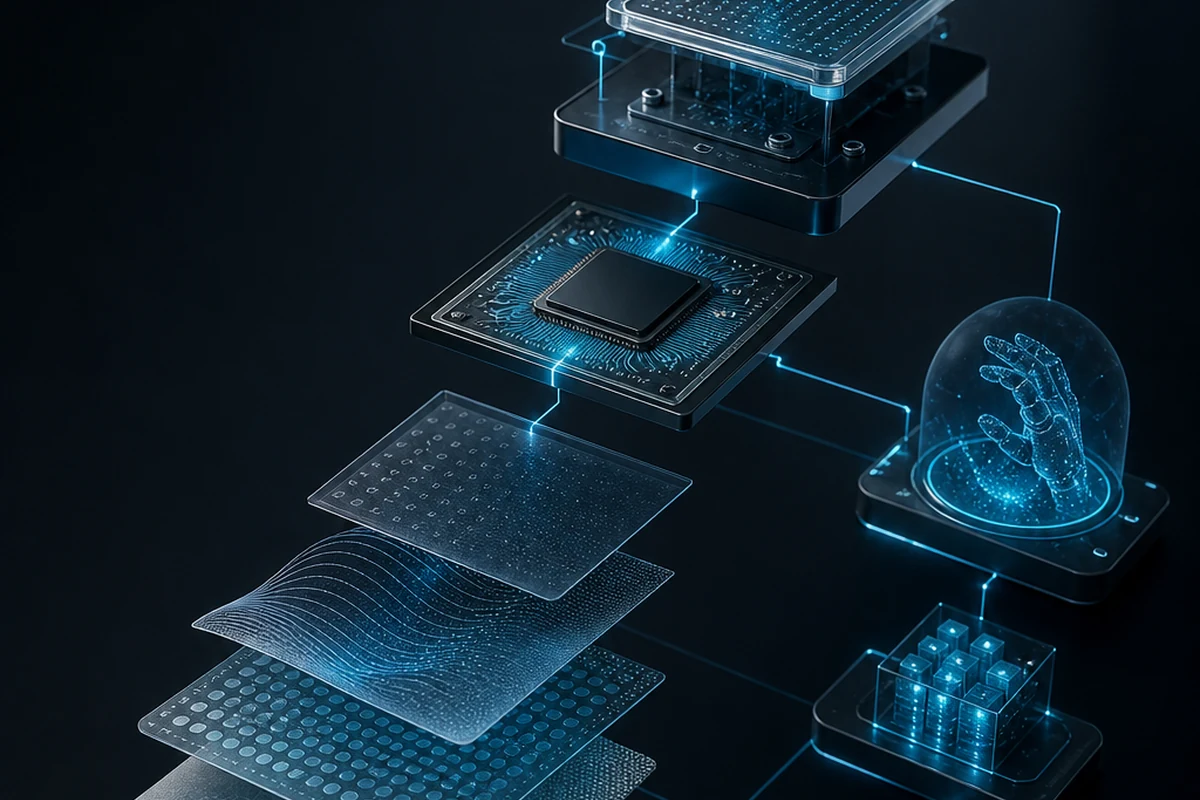
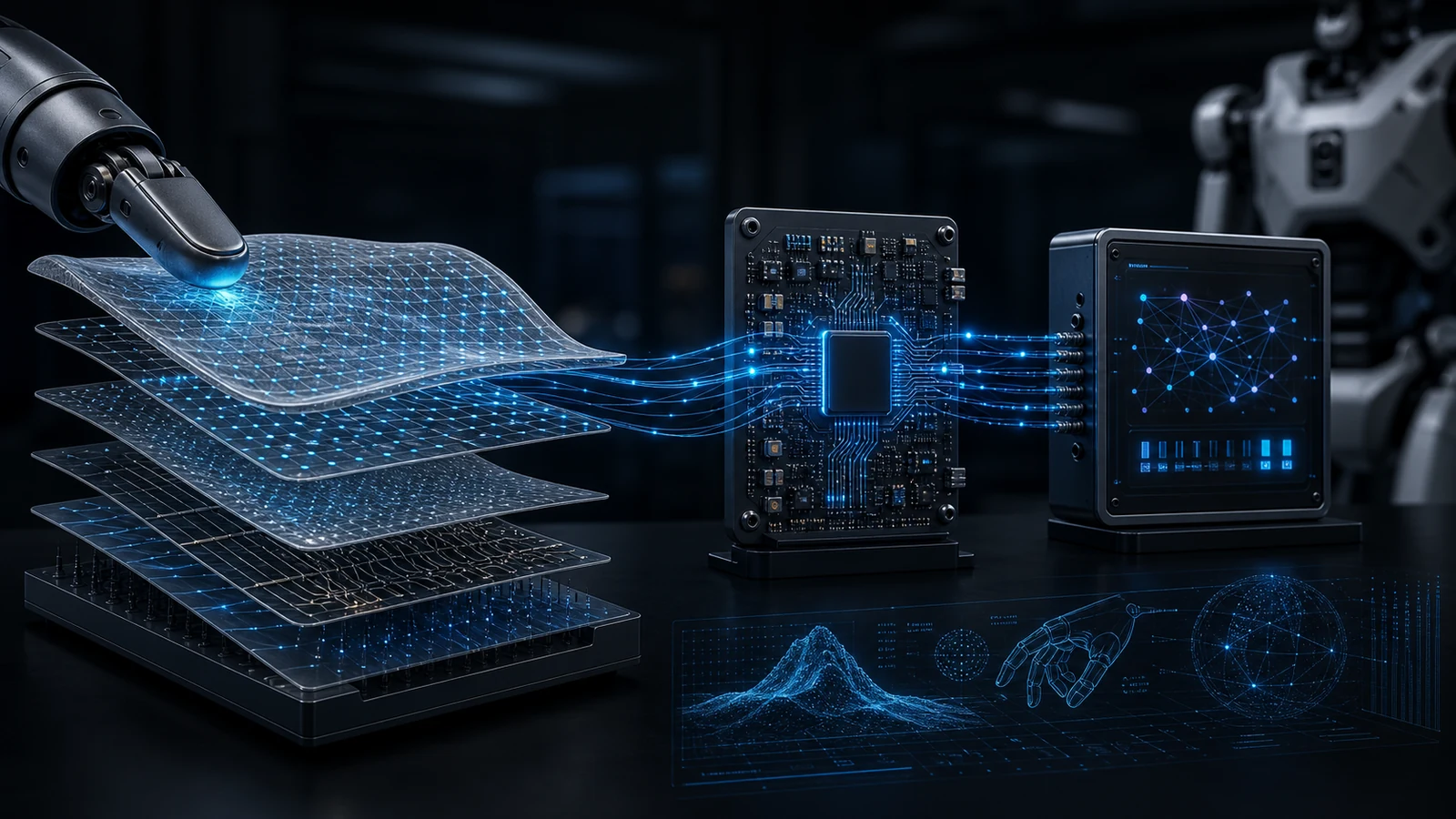
For robot skin, this stack includes the elastomer or sensing surface, sensor placement, calibration, local processing, representation learning, robot middleware, and controller behavior. A site that only repeats "robots need touch" adds little value. A useful article tells readers where the data comes from, what its resolution or modality means, how it affects control, and what remains difficult.
What this means for robot hands
Full-hand tactile sensing matters because dexterous manipulation uses more than fingertip contact. A robot hand may stabilize an object through the palm, side of a finger, thumb opposition, or a contact patch that shifts during motion. High-resolution touch is useful only when that distributed data changes control behavior.
For readers, the next useful route is the robot hand tactile sensor route. That page frames fingertip, palm, full-hand, slip, and grasp-stability sensing as one evaluation problem instead of separate hardware facts.
What this does not prove yet
The F-TAC Hand result does not prove that every robot hand needs the same sensor placement, coverage percentage, or vision-based tactile architecture. It also does not remove integration costs: calibration, wiring, compute load, cleaning, durability, and data handling still decide whether a tactile hand is practical outside a study.
Where this fits next
The next step after full-hand sensing is model and middleware. Dream-Tac tactile world model explains why tactile data should support prediction, while the ROS 2 tactile data pipeline explains why contact data must be replayable and synchronized.
Practical questions
- Why is full-hand tactile sensing different from fingertip sensing? Full-hand sensing can expose palm, side-finger, and shifting contact patches that fingertip-only systems may miss.
- Does high-resolution touch replace vision? No. Vision still gives scene context; tactile sensing adds local contact evidence after the hand touches an object.
- What should readers compare next? Compare this news brief with the Dream-Tac tactile world model and the ROS 2 tactile data pipeline.
What readers should take away
Full-hand tactile sensing matters because dexterous manipulation is distributed. A grasp may start at the fingertips, stabilize through the palm, and fail through slip or collision at an unexpected surface. Robot hands therefore need tactile coverage that matches the task, not merely a decorative sensor label.
The cautious conclusion is that high-resolution touch does not automatically solve manipulation. It adds data, and data must be calibrated, synchronized, interpreted, and acted on. The strongest robot skin systems will be judged by whether tactile feedback changes robot behavior under real execution noise.
Source boundary
This article summarizes public research and Meta FAIR announcements. RoboSkin.ai adds editorial interpretation for robot skin and tactile AI readers; it does not claim affiliation with the cited projects.
Sources
Continue the topic