Energy constrained touch encoding for large-area e-skin
A technical brief on bioinspired spiking architecture, large-area soft e-skin, low-power tactile localization, and neuromorphic touch processing.
Updated technical brief - June 2026
Why this source matters
Large-area robot skin creates a data problem. More surface coverage means more signals, more wiring, more sampling, and more computation. If every contact point needs dense high-rate processing, the tactile system becomes difficult to scale on mobile robots, humanoids, prosthetics, or assistive devices.
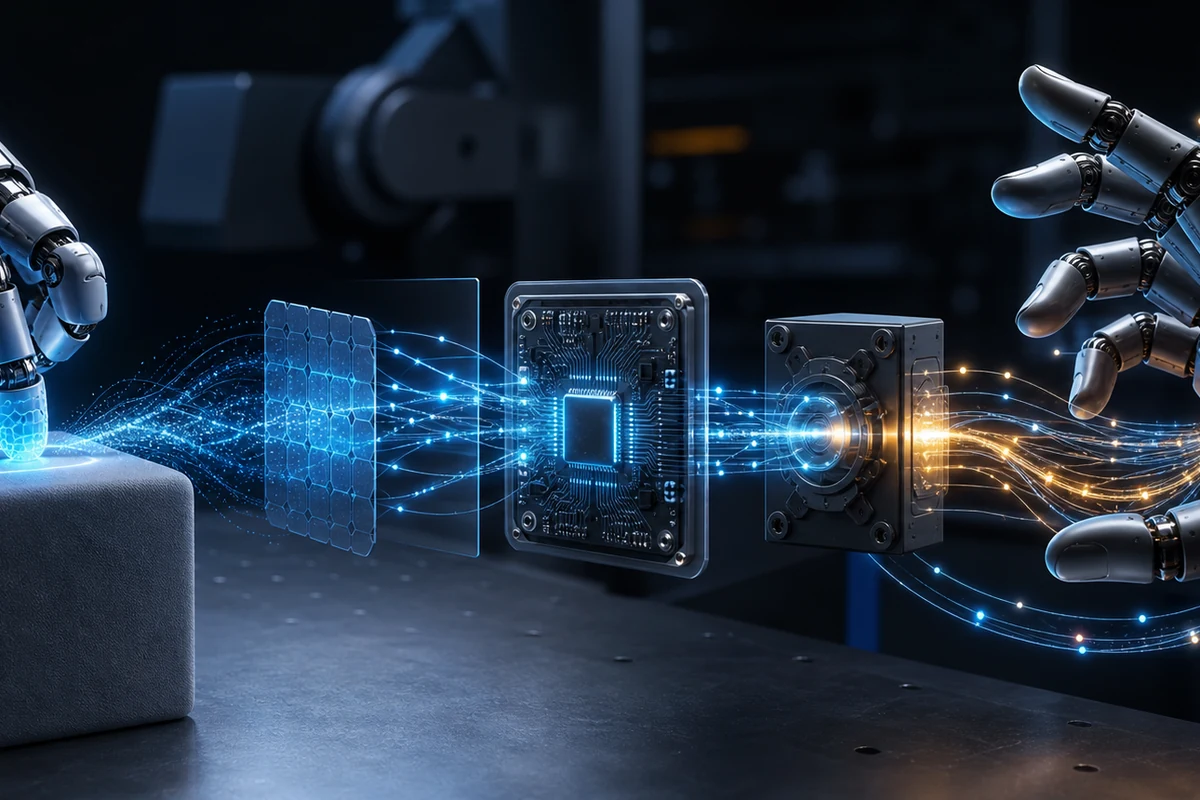
The Nature Communications article on bioinspired spiking architecture is useful because it connects e-skin hardware with energy constrained touch encoding. The source describes a Fiber Bragg Grating-based e-skin combined with a spiking neural network that mimics early somatosensory processing. For RoboSkin.ai, the important idea is not just neuromorphic branding. It is the need to process tactile signals under energy, wiring, and latency constraints.
Core idea
Spiking systems process information through events rather than dense continuous frames. That can be attractive for robot skin because many tactile surfaces are quiet most of the time, then suddenly produce local contact events. Event-like processing may help focus computation where contact changes happen.
| Scaling pressure | Why it appears | What spiking touch processing can test |
|---|---|---|
| Large coverage | More sensing locations | Distributed event encoding |
| Power limits | Mobile robots cannot spend unlimited compute on touch | Low-power processing |
| Latency | Contact response must be fast | Event-driven localization |
| Multitouch | More than one area may be active | Parallel tactile processing |
Engineering implications
The strongest lesson is architectural. Robot skin should not be evaluated only as a sensor material. It also needs a signal-processing plan. A large skin surface that requires heavy centralized processing may work in the lab and fail on a mobile platform. Energy constrained touch encoding asks whether tactile intelligence can move closer to the surface.
This matters for Physical AI because tactile feedback becomes useful only when it can influence action. A delayed contact map is less valuable than a lower-power contact event that arrives quickly enough to change grip, stop motion, or log an interaction.
Evaluation checklist
- Check whether power consumption is measured at the sensor, processor, or whole system level.
- Ask whether the system handles multitouch and dynamic contact, not only a single static touch.
- Review localization accuracy under constrained sensor resolution.
- Compare event-like processing against dense frame processing.
- Ask whether the neuromorphic chip result is a real hardware implementation or only simulation.
- Look for latency and wiring analysis before assuming scalability.
What not to infer
This source does not mean every robot skin should use spiking neural networks. It also does not prove that neuromorphic processing is always better than conventional embedded inference. The right architecture depends on surface area, sensing modality, latency target, available power, and controller requirements.
This note supports a narrower claim: large-area e-skin evaluation must include compute and energy constraints. A tactile sensor is not scalable if the readout and processing architecture cannot scale with it.
Source
Nature Communications: Bioinspired spiking architecture enables energy constrained touch encoding
Continue the topic