Event-based tactile sensing for sparse, low-latency robot touch
A source-backed note on event-based and neuromorphic tactile sensing, sparse contact events, and why low-latency touch matters for robot control.
Updated technical brief - May 2026
Why this source matters
Most tactile systems are described as frames or maps: a sensor array is sampled at a fixed rate, producing a stream of pressure or contact values. That can be useful, but it may waste bandwidth when nothing changes and may introduce latency when fast events matter. The Frontiers article on event-based opto-tactile skin is useful because it applies an event-driven idea to touch: report meaningful changes rather than continuously sending dense frames.
This is similar in spirit to event-based vision. A camera does not always need to send a full image if the important information is motion or change. A tactile system does not always need a full pressure map if the important information is slip onset, vibration, or a sudden contact transition.
Core idea
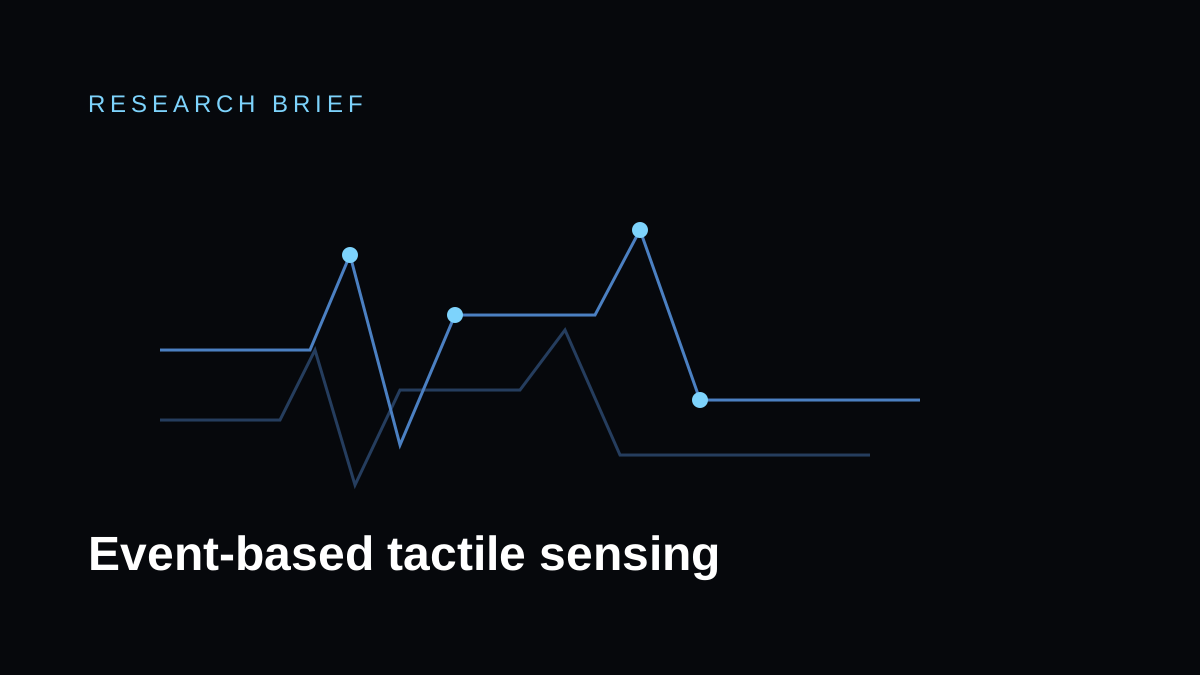
Event-based tactile sensing focuses on changes. Instead of sampling every taxel at the same frequency regardless of activity, the sensor or processing layer emits events when contact conditions change. For robot manipulation, this can be useful because many important tactile moments are short: first contact, micro-slip, release, impact, vibration, and texture transitions.
| Data style | Strength | Weakness |
|---|---|---|
| Dense frame tactile data | Rich spatial map at each time step | Higher bandwidth and processing load |
| Event-based tactile data | Sparse, fast response to changes | Less intuitive for static contact maps |
| Hybrid tactile data | Combines state and change information | More complex software architecture |
Why opto-tactile designs are relevant
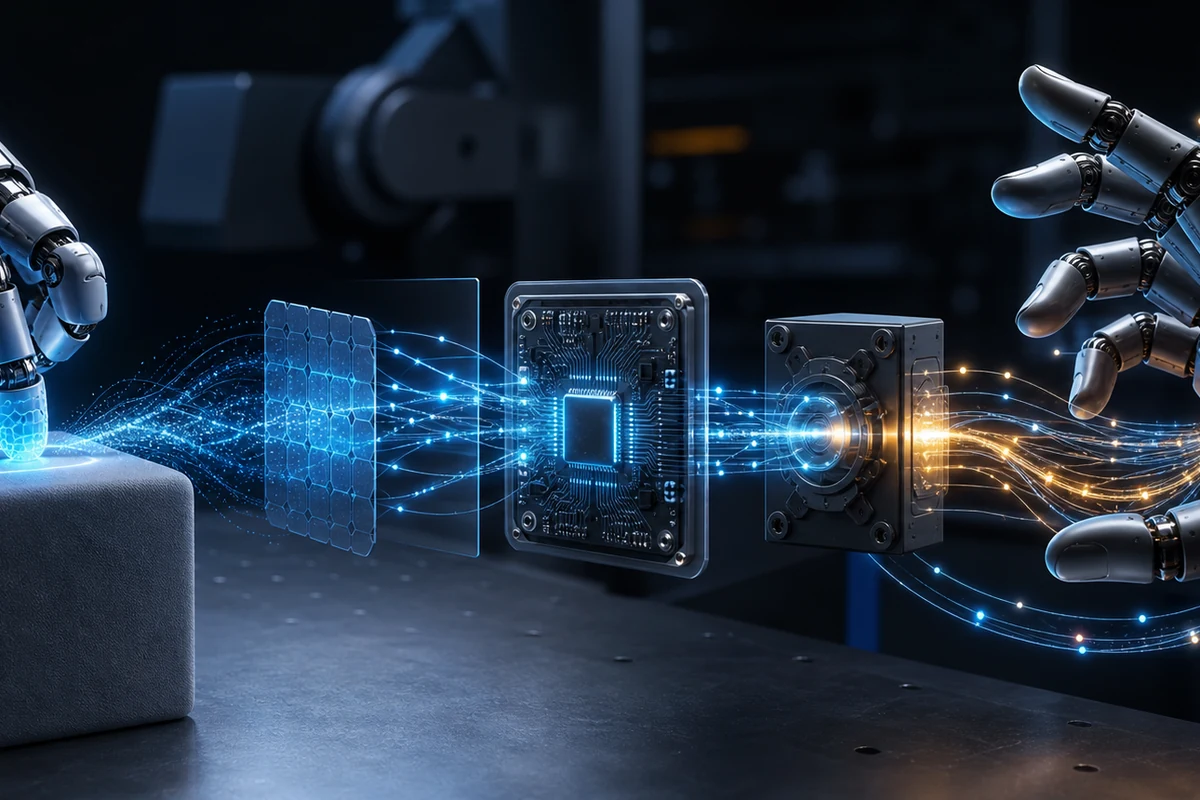
Opto-tactile systems often separate the compliant contact surface from the sensing electronics. A deformable surface changes optical patterns, and the system interprets those changes as tactile information. An event-based opto-tactile design can reduce the amount of data sent downstream by focusing on meaningful contact changes.
This matters for robot skin because large surfaces can generate large data streams. A full hand, arm sleeve, or safety skin may contain many sensing regions. If every region streams dense data continuously, the robot needs more bandwidth, memory, synchronization, and processing. Event-based encoding can make the data stream more task-focused.
Where event-based touch helps
Event-based tactile sensing is strongest when timing matters more than a complete static map. Slip detection is the clearest example. A robot may need to react quickly when an object begins sliding, long before a dense pressure map would be interpreted by a slower control loop. Vibration and texture detection are also event-like because they depend on changes over time.
For static load monitoring, event-based sensing may not be enough by itself. A robot holding a heavy object may still need an estimate of current pressure distribution or grip force. That is why a hybrid design can be attractive: dense or reduced state data for slower decisions, event streams for rapid changes.
Reader value
This source is useful because it gives tactile AI writers a concrete way to discuss latency. Instead of saying a sensor is "fast," the article can ask what data is emitted when a contact changes. A sparse event stream can make early slip and vibration easier to detect, but it also changes the debugging workflow. Engineers must inspect event timing, thresholds, noise filters, and spatial registration.
The distinction matters for real robots. A manipulation policy may need dense state to decide grip posture and event data to react to sudden slip. A safety skin may need persistent contact state and separate impact events. A research article that names these differences is more helpful than a general claim that event-based sensing is efficient.
Evaluation checklist
- What qualifies as an event: threshold crossing, optical change, vibration, slip, or learned feature?
- Are event timestamps precise enough to synchronize with robot control?
- Does the system preserve spatial location of events?
- Can static contact state still be recovered when needed?
- What happens during high-frequency vibration or repeated contact?
- Does event filtering remove noise without suppressing useful early slip signals?
Software implications
Event-based tactile data changes the software pipeline. A frame-based tactile map can be visualized as an image. An event stream is more like a time-stamped log. The robot stack needs message definitions, buffering, replay, synchronization, and algorithms that understand sparse events. Without this software layer, event-based touch remains difficult to use in production robotics.
For ROS 2 or similar middleware, the practical questions are straightforward: what message type carries events, how are timestamps assigned, how are coordinate frames handled, and how can engineers replay a failed grasp? Event-based sensing is valuable only if it can be debugged.
What not to infer
Event-based tactile sensing is not automatically better than dense tactile sensing. It solves a different problem. It can reduce bandwidth and improve responsiveness for changes, but it may be less direct for slow force distribution, static pressure maps, or calibration inspection.
For RoboSkin.ai, the useful editorial point is that tactile AI should include data representation. A robot skin article should not stop at "the sensor detects touch." It should explain whether the output is a frame, a feature, an event, a contact class, or a controller-ready signal.
Source
Continue the topic