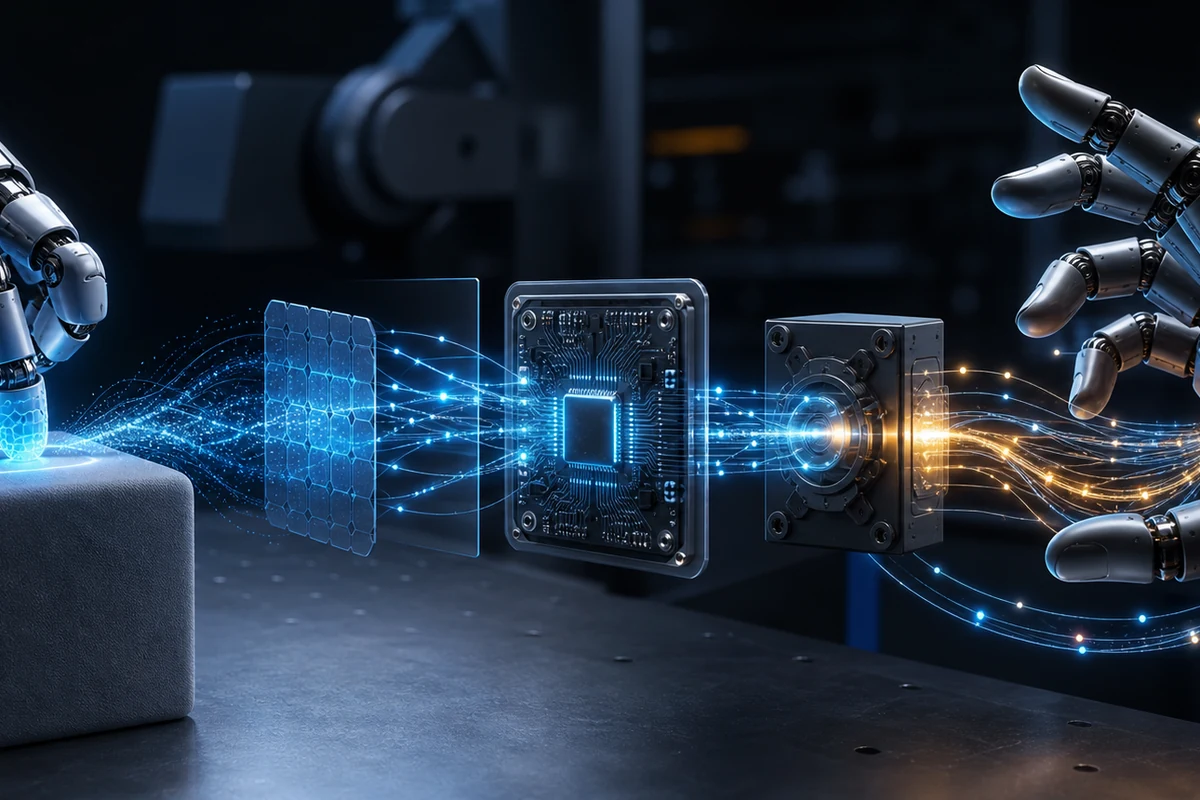
eFlesh and customizable magnetic touch sensing for robot grippers
A source-backed note on eFlesh, cut-cell microstructures, 3D-printable magnetic tactile sensors, low-cost fabrication, and robot gripper deployment tradeoffs.
Updated technical brief - June 2026
Why this source matters
Robot skin adoption is slowed by cost, fabrication difficulty, and poor fit to real gripper geometry. A sensor that is accurate but hard to manufacture or customize may not spread beyond a lab. The eFlesh preprint is useful because it focuses on highly customizable magnetic touch sensing using cut-cell microstructures and accessible fabrication.
The source frames eFlesh as a low-cost tactile sensor that can be fabricated with common 3D printing tools and off-the-shelf magnets. For RoboSkin.ai, the useful point is not that every team should print sensors. The useful point is that fabrication workflow is part of tactile sensor evaluation.
Core idea
eFlesh uses printed microstructures and embedded magnetic elements so that contact deformation can be sensed magnetically. The cut-cell geometry allows customization to different shapes. That matters for grippers because contact surfaces are rarely identical. A sensor pad for a parallel gripper, soft jaw, curved finger, or fingertip needs different geometry.
| Design factor | Why it matters | What to verify |
|---|---|---|
| Custom geometry | Fits different grippers and surfaces | CAD-to-sensor workflow |
| Magnetic sensing | Can estimate deformation and force | Calibration and interference |
| Low-cost materials | Reduces entry barrier | Reproducibility across printers |
| Cut-cell structure | Tunes compliance and response | Durability under repeated grasps |
Engineering implications
Customizable tactile sensing is valuable when a robot team needs a sensor for a specific end effector. Off-the-shelf flat sensors often do not match the robot. A fabrication route that adapts to geometry can reduce integration friction, but it shifts responsibility to calibration, mechanical repeatability, and documentation.
The strongest use of this source is as a manufacturing lens. If a tactile sensor can be printed quickly, the next question is whether two printed sensors behave similarly enough for a policy to transfer. Low cost is useful only if the data remains reliable.
Evaluation checklist
- Check what printer, material, magnets, and magnetometer hardware are required.
- Ask whether the sensor works on the target gripper geometry.
- Review contact localization, force estimation, and slip detection separately.
- Test multiple printed copies to see fabrication variation.
- Look for open-source design files, code, and calibration procedures.
- Evaluate abrasion, compression fatigue, and magnet stability over time.
What not to infer
This source does not mean 3D-printed tactile sensors are ready for every industrial or humanoid hand. Printed materials, magnets, and electronics may change behavior under heat, wear, contamination, and high load.
eFlesh supports a practical engineering rule: evaluate how the sensor is made, replaced, and calibrated, not only how it performs in one demo.
Source
arXiv: eFlesh: Highly customizable Magnetic Touch Sensing using Cut-Cell Microstructures
Continue the topic