<- Back to news

Electronic skin | Updated 2026-06-22

Electronic skin research shows why robot skin is becoming a systems problem

Cambridge, UCL, and graphene-liquid metal research show that robot skin depends on materials, sensing geometry, signal processing, and tactile AI.

electronic skinsingle-material skingraphene liquid metal3D force sensing

News brief - June 2026

Robot skin is often described as a surface, but recent research shows that the real challenge is a complete system: material, sensor geometry, signal interpretation, machine learning, and robot control.

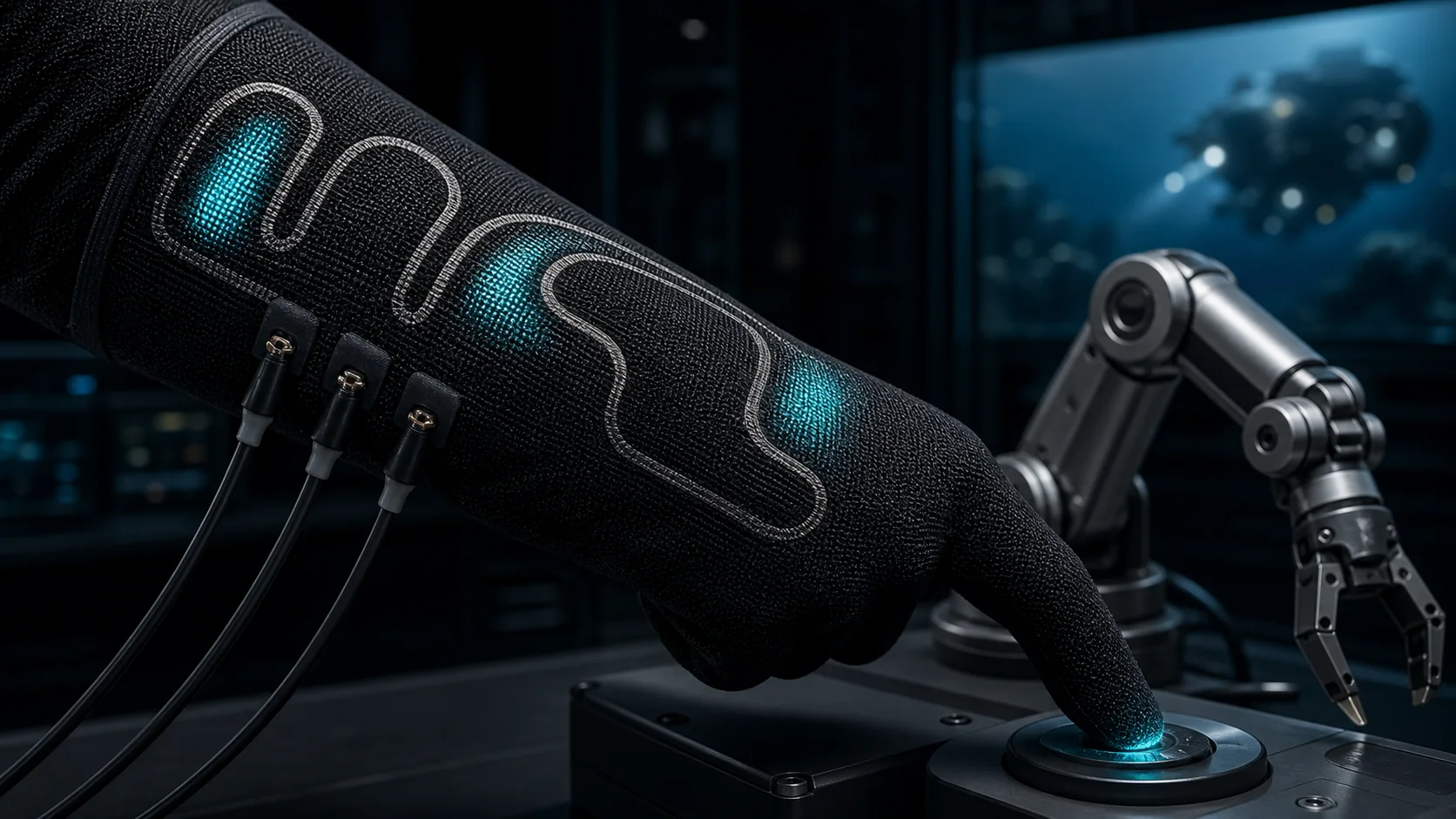
In June 2025, researchers from the University of Cambridge and UCL reported a single-material electronic skin that can be added to robotic hands like a glove. Unlike designs that embed separate sensors in small areas, the whole material acts as a sensor. Cambridge reported that the skin can detect signals from more than 860,000 tiny pathways in the material, helping it recognize touch and pressure events such as finger taps, hot or cold surfaces, sharp-object damage, and multiple contact points.

The researchers used physical testing and machine learning to identify which signal pathways mattered most for different contact types. That is an important shift. The material alone is not enough; the system also needs interpretation.

A separate Cambridge research direction, based on graphene and liquid-metal composites, pushes the point further. Researchers described a miniature tactile sensor capable of reconstructing a full 3D force vector. Reported performance included sensitivity up to 110 kPa^-1, a 500 kPa linear sensing range, force-direction errors below two degrees, and a detection limit below one micronewton. The sensor can distinguish shear forces from normal forces, which is essential for detecting slip.

For robot skin, these results are useful because they separate real technical progress from vague language. A serious robot skin discussion should ask what is measured, where it is measured, how the signal is calibrated, whether normal and tangential forces can be separated, and how the robot uses the resulting data.

Electronic skin is not just a material trend. It is part of the tactile AI stack that connects contact surfaces to usable robot behavior.

Key data points

  • Cambridge and UCL single-material skin detects signals from more than 860,000 pathways.
  • The whole electronic skin acts as a sensor.
  • Graphene-liquid metal sensor reports sensitivity up to 110 kPa^-1.
  • Linear sensing range: 500 kPa.
  • Force-direction error: below 2 degrees.
  • Detection limit: below 1 micronewton.
MetricReported valueWhy it matters for robot skin
Single-material signal pathwaysMore than 860,000 pathwaysWhole-surface sensing can reduce blind spots compared with isolated sensor islands.
Electrode count in Cambridge/UCL skin32 electrodes at the wristA sparse external interface can still observe many internal signal paths.
Graphene-liquid metal sensitivityUp to 110 kPa^-1High sensitivity supports small-force detection if noise and calibration are controlled.
Linear sensing range500 kPaWide range matters when touch varies from gentle contact to firm grasping.
Force-direction errorLess than 2 degreesDirectional accuracy helps separate normal pressing from shear and slip.

RoboSkin analysis

Electronic skin research is sometimes presented as a material race, but the stronger interpretation is systems engineering. The Cambridge and UCL single-material skin is interesting because it simplifies the sensing surface: the entire skin acts as a sensor. That design direction could reduce the complexity of embedding many separate sensor types into a soft cover. It also creates a hard signal-processing problem, because one material has to produce distinguishable signals for several types of contact.

The reported 32-electrode wrist interface is especially useful for readers thinking about robot skin integration. Wiring is one of the most practical barriers in large-area tactile surfaces. A robot hand, arm, or soft surface cannot always carry thousands of individual wires without becoming fragile, bulky, or difficult to repair. A material that exposes rich information through fewer external connections is worth watching, but the value depends on whether machine learning can classify contact reliably outside controlled tests.

The graphene-liquid metal work addresses a different but related issue: force direction. Many touch claims collapse contact into a single pressure value. Real manipulation needs more. Normal force says how hard the robot presses into a surface. Shear force says whether the object is sliding sideways. Directional force information helps the robot distinguish a stable grasp from the beginning of slip.

Together, these sources show why robot skin cannot be evaluated by one metric. Sensitivity, range, spatial coverage, wiring, durability, force direction, calibration, and software interpretation all matter. A material breakthrough is only the first layer of the tactile AI stack.

What readers should take away

Electronic skin is becoming a systems problem because better materials create more demanding data questions. Whole-surface sensing can reduce blind spots, but it must still produce interpretable signals. High-sensitivity 3D force sensing can detect subtle contact, but it must still survive mounting, repeated deformation, and changing surfaces.

For readers comparing e-skin claims, the practical checklist is straightforward: ask what physical input is measured, how many contact types can be separated, how the signal is calibrated, where the electrodes or readout electronics sit, whether shear is distinguished from normal force, and whether the robot can use the output in closed-loop behavior. That is the difference between a promising sensor sample and a usable robot skin system.

Source boundary

This article summarizes public university research. It uses the sources to explain robot skin evaluation questions and does not imply product availability, certification, or measured performance by RoboSkin.ai.

Sources