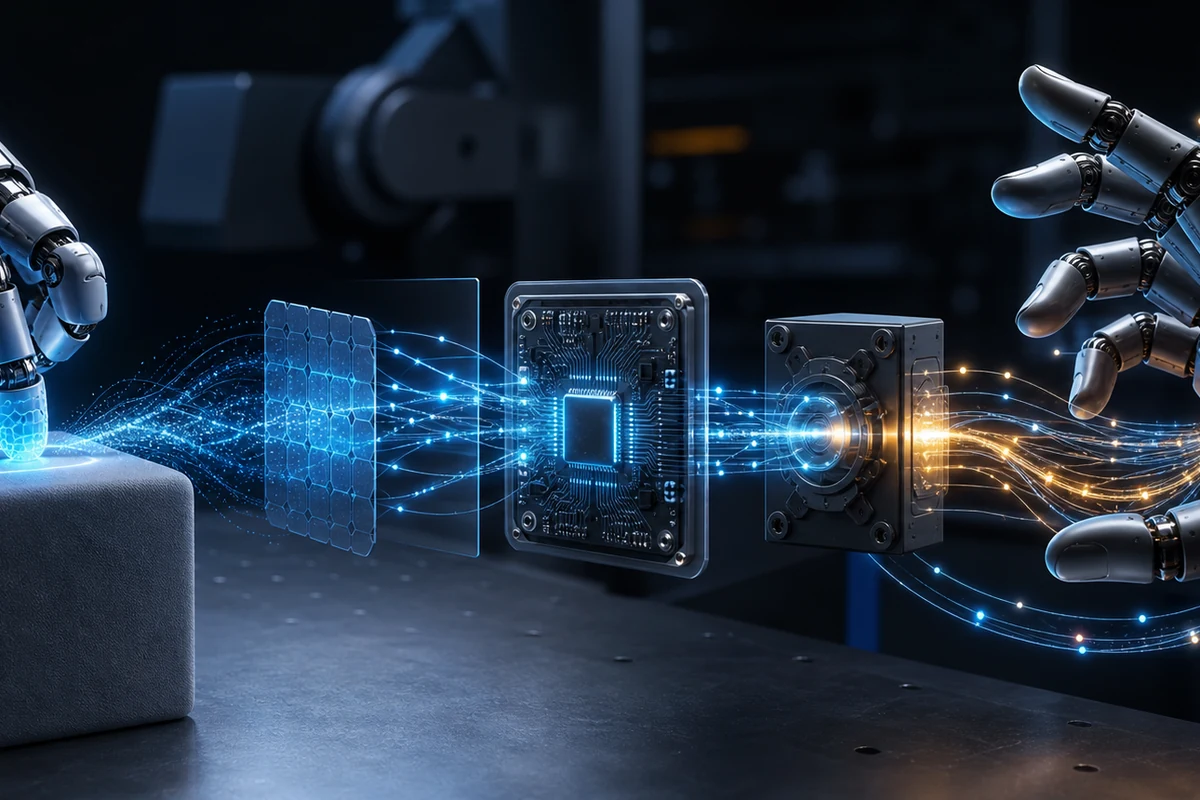
Slip-actuated bionic tactile sensing with E-textile
A source-backed note on slip-actuated bionic tactile sensing, dynamic DC generator E-textile, robotic fingers, and real-time grasp monitoring.

Updated technical brief - June 2026
Why this source matters
Slip detection is central to dexterous manipulation. A robot can touch an object, apply force, and still fail if it cannot detect the moment contact begins to slide. The Nature Communications article on slip-actuated bionic tactile sensing is useful because it treats slip as a distinct dynamic event and pairs it with a normal force sensing route.
The source describes a slip-actuated bionic tactile sensing system using a dynamic direct-current generator integrated into stretchable electronic textile. It is designed to work with robotic fingers and support fast slip and grasp monitoring. For RoboSkin.ai, this source strengthens the distinction between static pressure sensing and dynamic slip-aware touch.
Core idea
Human touch uses different receptor behaviors for slowly changing pressure and fast changing events. A robot skin system can follow a similar principle by separating normal force monitoring from fast slip event detection. That is useful because the controller needs both: how hard the robot is pressing and whether the object is starting to move.
| Signal type | Robot question | Why it matters |
|---|---|---|
| Normal force | How hard is the finger pressing? | Prevents weak grip or crushing |
| Slip event | Is the object starting to slide? | Enables fast corrective grip |
| Multidirectional force | Which way is contact changing? | Helps adjust pose and force |
| Textile integration | Can the sensor conform to a finger? | Supports skin-like placement |
Engineering implications
Dynamic slip sensing is not just another feature label. It changes the controller problem. A robot may not need to wait until a camera sees object motion. It can use tactile signals to increase grip, reposition contact, or pause motion. That is one reason slip detection should have its own content cluster rather than being buried inside general tactile sensing pages.
The E-textile angle also matters because robot skin is a surface. Stretchable textile-like integration may help fit curved fingers or soft gripper forms, but it raises questions about durability, washing, abrasion, electrical stability, and attachment.
Evaluation checklist
- Ask whether slip is detected before visible object displacement.
- Separate normal force measurement from dynamic slip signal generation.
- Check whether tests include different directions, speeds, and surface textures.
- Review whether the sensor is integrated into robotic fingers or only tested on a bench.
- Ask how the controller uses slip events in a feedback loop.
- Look for durability evidence under stretching, repeated contact, and abrasion.
What not to infer
This source does not mean every E-textile tactile sensor is ready for robot hands. It also does not prove all slipping objects can be controlled. Slip behavior depends on surface material, contact geometry, contamination, robot speed, and controller timing.
Slip detection evaluation must explain timing. A useful slip sensor is not only accurate; it must produce a signal early enough for the robot to act.
Source
Continue the topic