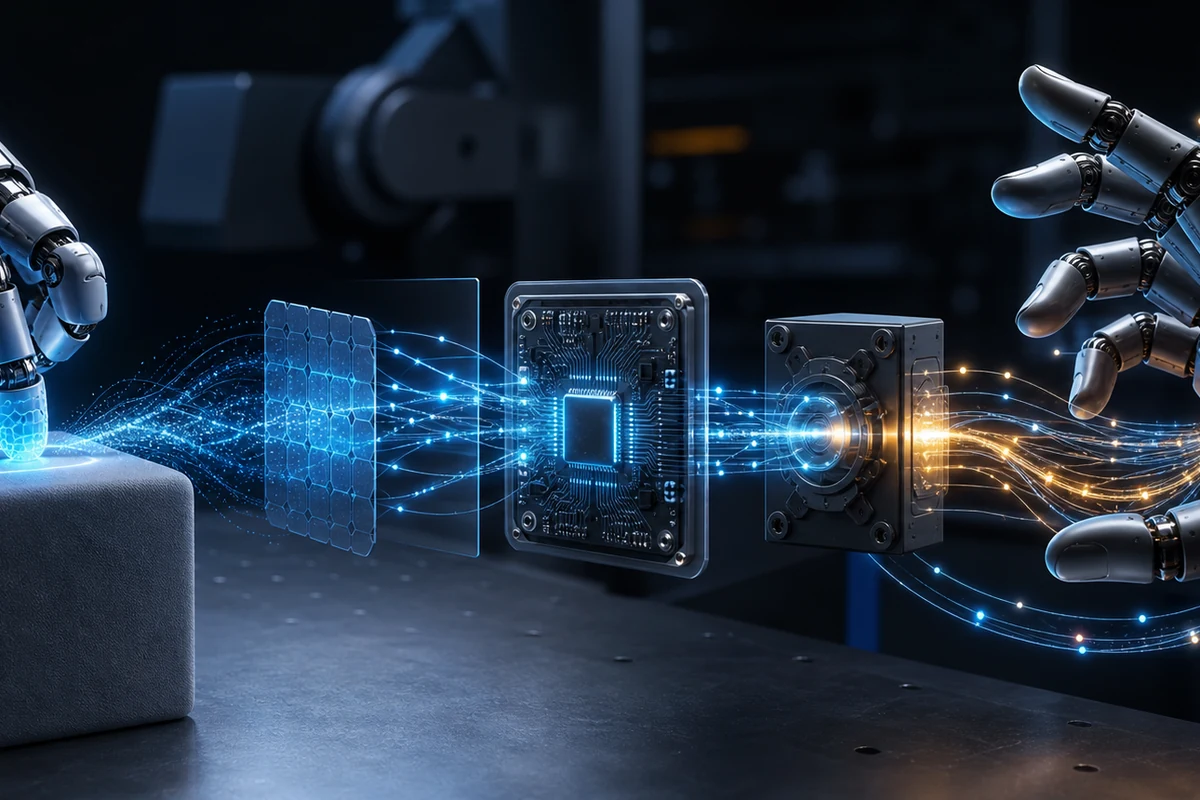
Temperature/pressure bimodal sensing and the crosstalk problem
A practical brief on temperature and pressure bimodal tactile sensing, signal decoupling, and why crosstalk matters for robot skin.
Updated technical brief - May 2026
Why this source matters
Human skin does not sense only pressure. It responds to force, texture, temperature, pain, vibration, and spatial contact patterns. Electronic skin research often tries to reproduce part of that multimodal behavior. The RSC Journal of Materials Chemistry C review on biological skin inspired temperature/pressure bimodal tactile sensing is useful because it focuses on a practical problem: sensing more than one stimulus is valuable only when the signals can be separated reliably.
For robot skin, temperature and pressure are a natural pair. Pressure tells the robot how it is contacting an object. Temperature can indicate environmental conditions, human contact, object state, or safety constraints. But combining both measurements in a soft sensor is not automatically useful. If temperature changes the pressure signal, or pressure changes the temperature signal, the robot may make the wrong inference.
Core idea
Crosstalk is the central issue. Crosstalk happens when one stimulus affects the channel intended for another stimulus. In a bimodal sensor, pressure may change electrical resistance, capacitance, or geometry. Temperature may also change material properties or electrical response. If both effects appear in the same measurement channel, the system has to separate them before the data can be trusted.
| Problem | Example in e-skin | Why it matters |
|---|---|---|
| Pressure-temperature crosstalk | Heat shifts the pressure baseline | Grip force may be misread |
| Mechanical drift | Repeated compression changes material response | Calibration becomes unstable |
| Slow thermal response | Temperature lags behind contact events | Control loops may use stale data |
| Mixed signals | One channel responds to multiple stimuli | Classification becomes unreliable |
What good bimodal sensing should clarify
A useful bimodal tactile sensor should make clear what is measured, how the signals are separated, and what the output means. If the output is two raw channels, downstream software must perform interpretation. If the output is already decoupled into pressure and temperature estimates, the article or datasheet should explain the assumptions behind that decoupling.
This matters because tactile AI models can learn shortcuts. A model trained in one lab setup may associate temperature drift with pressure events if the dataset is not balanced. A sensor that looks accurate in controlled tests may fail when a robot moves from a cool lab bench to a warm factory cell or outdoor environment.
Reader value
The value of this source is the warning it gives to anyone writing or evaluating multimodal sensor claims. More modalities do not automatically mean better robot skin. A pressure-only sensor with stable calibration may be more useful than a pressure-temperature sensor whose channels interfere with each other. The right question is whether the second modality improves the task after decoupling, calibration, and delay are considered.
For a practical robotics team, temperature data should be tied to a decision. If the robot needs to avoid hot objects, detect human contact, handle food, monitor prosthetic comfort, or classify material state, thermal sensing has a clear role. If the task is fast grasp stabilization, thermal data may be slower background context. This distinction keeps the article from overstating the technology while still explaining why the research matters.
| Use case | Pressure value | Temperature value |
|---|---|---|
| Dexterous grasping | Contact force and slip context | Usually secondary or slow context |
| Human contact safety | Contact intensity | Warmth can support contact classification |
| Food or medical handling | Handling force | Temperature may affect safety decisions |
| Material identification | Shape and deformation clues | Thermal transfer may add classification signal |
Evaluation checklist
- Are pressure and temperature measured through separate mechanisms or shared material response?
- Does the source show decoupling across a range of pressures and temperatures?
- Is the response time fast enough for the robot task?
- Does repeated loading change the baseline?
- Are calibration procedures described clearly?
- Does the sensor work on curved or moving surfaces, or only as a flat sample?
Robot skin implications
Temperature/pressure bimodal sensing is most useful when temperature affects the task. A warehouse gripper handling cardboard may not need thermal sensing. A medical assistive device, prosthetic cover, food-handling robot, or human-contact safety surface may benefit from knowing both contact force and thermal condition. The value depends on the task.
For humanoid robots, temperature can also help distinguish object categories or human contact scenarios, but it should not be oversold. Thermal sensing is usually slower than pressure sensing, and soft materials may introduce delay. A robot controller must know whether a thermal reading is immediate enough for control or better suited for monitoring and classification.
What not to infer
The RSC review is a research and survey source, not a universal product recommendation. It should not be used to claim that any particular robot skin can measure temperature and pressure accurately in all environments. The correct conclusion is more disciplined: multimodal sensing is promising, but decoupling, calibration, response time, and drift must be evaluated together.
A multimodal e-skin evaluation should not merely list "pressure and temperature" as features. It must explain crosstalk, decoupling, and validation to show whether the modalities are genuinely useful together.
Source
Continue the topic