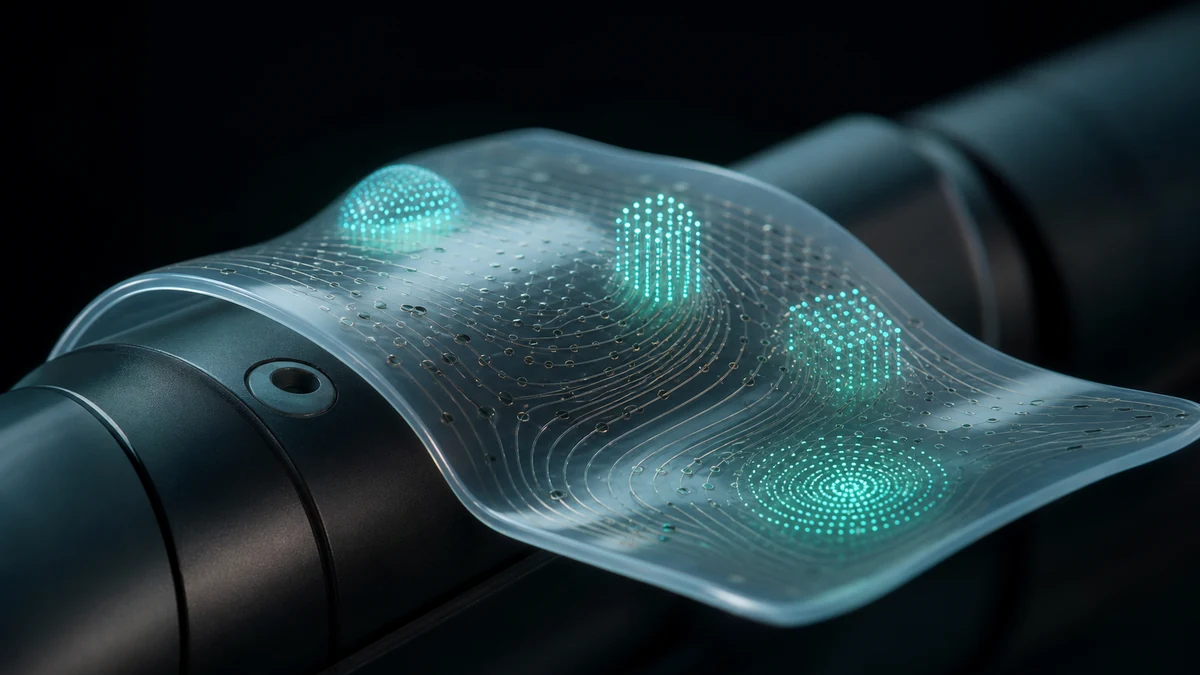
Self-healing multimodal e-skin: useful direction, careful claims
A conservative guide to self-healing e-skin claims, multimodal sensing, damage recovery, and what must be validated before deployment language is credible.
Updated technical brief - May 2026
Why this source matters
Robot skin is exposed. It touches objects, bends around joints, scrapes against surfaces, and may be cut, compressed, contaminated, or replaced. That makes self-healing e-skin an attractive research direction. If a sensor layer can recover mechanical and electrical function after damage, it could reduce maintenance and make soft robotic surfaces more practical.
The cited Chemical Engineering Journal article is useful as a research signal because it connects self-healing material behavior with multimodal sensing. For RoboSkin.ai, the more important point is not that "self-healing skin exists." The important point is that healing claims need careful boundaries.
Core idea
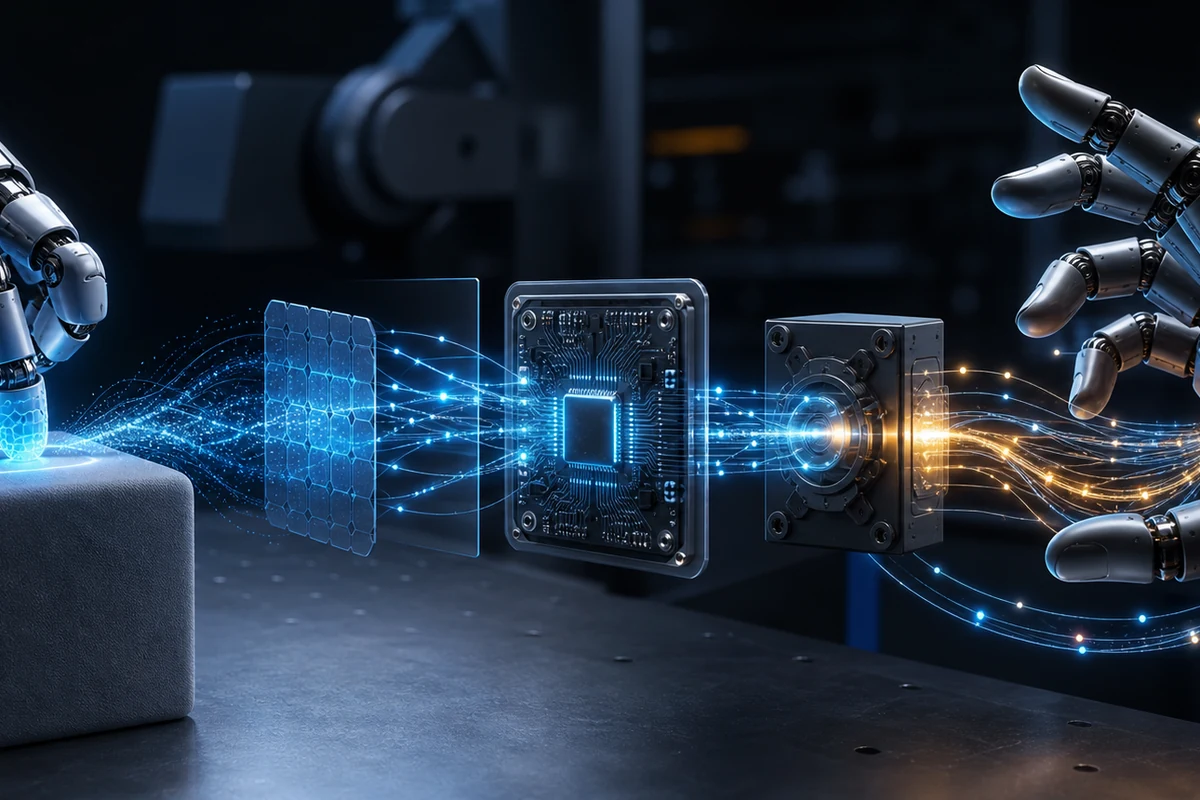
Self-healing e-skin usually involves materials that can restore some structure or electrical pathway after damage. That may involve reversible bonds, polymer networks, liquid metal pathways, conductive fillers, or layered architectures. Multimodal sensing means the same skin may respond to more than one stimulus, such as pressure, strain, temperature, or damage.
Those ideas are valuable, but they also multiply validation questions. A material can look healed visually while its electrical signal remains shifted. A sensor can recover conductivity while calibration is no longer reliable. A sample can heal under warm, clean lab conditions but fail in a dirty, cold, or mechanically loaded robot environment.
| Claim type | What should be checked | Why it matters |
|---|---|---|
| Mechanical healing | Tensile strength, flexibility, surface integrity | The skin must still survive motion |
| Electrical healing | Conductivity and signal continuity | The sensor must still produce data |
| Sensing recovery | Baseline, sensitivity, drift, crosstalk | The data must remain interpretable |
| Operational recovery | Healing time and required conditions | The robot needs a realistic service path |
Why careful claims matter
Self-healing is easy to overstate. A public page might say a skin "repairs itself," but that phrase hides many details. What kind of damage? How deep? How long does recovery take? Does it require heat, pressure, water, light, or rest? How many cycles can it survive? Does the repaired area match the original calibration?
Repairability depends on the damage mode, healing conditions and recovery of the sensing signal. A mechanically closed cut does not establish restored calibration or service life. Self-healing e-skin remains an application-specific research direction.
Reader value
The practical contribution of this source is a vocabulary for separating recovery claims. A material can heal mechanically, electrically, or functionally, and those are not the same thing. Functional recovery is the most important for robot skin because the robot does not care whether the surface looks repaired if the pressure, strain, or temperature signal has shifted beyond calibration.
For a robotics reader, the important comparison is service strategy. A self-healing skin might reduce small-damage downtime, but a modular replaceable skin might be simpler for industrial maintenance. A hybrid approach may also make sense: use materials that recover from minor scratches while designing larger damaged sections to be replaced. That kind of deployment reasoning is more credible than presenting self-healing as a magic property.
| Recovery question | Strong evidence would show | Weak evidence would show |
|---|---|---|
| Mechanical recovery | Strength and flexibility after repeated damage | A visual close-up of a healed cut |
| Electrical recovery | Conductivity and signal continuity after healing | One conductivity reading without cycling |
| Sensing recovery | Baseline and sensitivity after repair | Contact still produces some response |
| Service recovery | Practical healing time and conditions | Healing only under ideal lab conditions |
Evaluation checklist
- What damage was tested: cut, puncture, abrasion, bending fatigue, or compression?
- Was recovery measured mechanically, electrically, or as sensing performance?
- How long did healing take, and under what conditions?
- How many damage-heal cycles were tested?
- Did the source report calibration shift after healing?
- Is the sensing layer still usable on curved, moving, or attached surfaces?
Deployment implications
For a robot hand or gripper, repair is only one part of serviceability. The skin must remain attached, safe, cleanable, and replaceable. If a damaged surface heals but becomes sticky, swollen, electrically noisy, or mechanically weak, the robot may still need service. A useful deployment discussion should include both healing and maintenance.
Multimodal sensing makes the problem harder. A sensor that measures pressure and temperature may heal mechanically but change its temperature response. A damage sensor may detect cuts but interfere with pressure readings. The more signals a skin claims, the more carefully crosstalk and recovery must be documented.
What not to infer
The cited source should not be read as proof that self-healing e-skin is ready for all robot skin applications. It supports a research direction and a vocabulary. It does not remove the need for application-specific testing.
For RoboSkin.ai, this article sets a policy for language: use "self-healing" only with context. Say what heals, what is measured, and what conditions are required. Avoid universal claims about durability, repair, or commercial readiness unless a public source explicitly supports them.
Source
Chemical Engineering Journal: A self-healing e-skin for quadruple-modal sensing
Continue the topic